Is Layla Really the Open-Source Version of Jev? A Deep Dive into Open-Source Decision Models

Layla is a fast open-source decision model with real compliance advantages but significant zero-shot and engineering limitations.
Layla is an open-source decision model family released just three days after Jev, using a bidirectional encoder with a decision head to output structured decisions in a single forward pass — no text generation, no hallucinations. The viral "50x faster" claims are largely misleading: the comparison pits local single-GPU inference against cross-continental cloud API latency. On standard CPUs, Layla is actually slower than calling the cloud. The base model's zero-shot accuracy of 0.35 falls below random baseline, requiring domain-specific fine-tuning for production use. Multilingual versions suffer from probability collapse and silent truncation. Despite these flaws, Layla's open weights enable 100% self-hosted, air-gapped deployment, making it compelling for data-compliance-sensitive use cases in China, where it rapidly spawned ONNX, MLX, and NPU deployment ecosystems.
Born in Three Days: Why Layla Went Viral
Just three days after the release of Jev — a closed-source decision model from TypeSafe AI — an open-source model family called Layla burst onto the scene. Released under the Apache 2.0 license with weights publicly available, Layla positioned itself as the direct antithesis of Jev's closed-source, pay-per-API-call model. The internet quickly ran with claims of Layla being "7.8x faster" or even "50x faster" than Jev, drawing a flood of developer attention.
According to an analysis by Bilibili creator 碳龟同传, who reviewed Layla's official documentation, the author's earlier papers, and independent benchmarks from developers worldwide, Layla is not a single model but a family of three checkpoints: an English version, a multilingual version, and a typed-decision fine-tuned version — giving developers the flexibility to choose the right base for their needs.
Like the previous generation of System 1 models, Layla cuts text generation at the architectural level. A single forward pass outputs only structured decisions: selecting from options, assigning scores, or returning a boolean judgment. Because it never "generates text" — only probabilities and numbers — it's inherently immune to hallucinations and JSON formatting errors that plague generative LLMs. The author's core argument is that using a massive generative model for ticket classification is overkill. What production systems actually need is sub-30ms "instinct" — low latency and low cost are the real requirements for deployment.
Under the Hood: Bidirectional Encoder + Decision Head
Strip away the hype and Layla's architecture is fundamentally different from generative models. It uses a bidirectional encoder, replacing the traditional language head with a decision head composed of two Transformer layers, where each option gets its own dedicated encoding token.
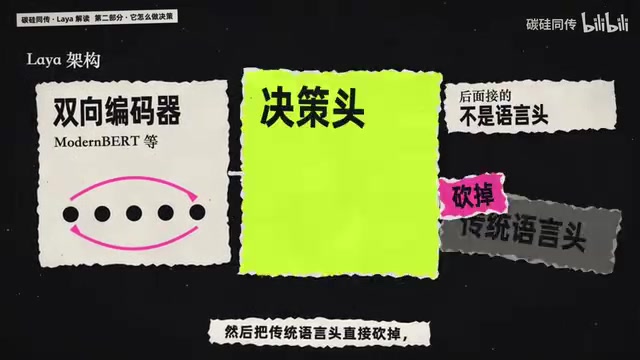
In this design, a single forward pass scores all options simultaneously, then converts them to probabilities via Softmax — no autoregressive loop, no decoding overhead. This is the core secret behind its speed. There are three output primitives: Choice for single-select questions (returns the selected option and probability distribution), Score for rating questions (returns an expected grade), and Bool for yes/no questions (returns a single probability value).
On the deployment side, it ships three checkpoints: a 420M-parameter English version, a 320M-parameter multilingual version covering over 100 languages, and a workflow-optimized fine-tuned version. All are hosted in the same repository — developers just pull the relevant subfolder, avoiding the need to download full weights.
There is, however, a key technical dispute. The official documentation claims that "multiple questions in a single call are processed in one forward pass," but developers working on ports and benchmarks found this isn't the case. According to tests by the Anthros team, each additional question actually triggers an additional forward pass. The AXERA NPU deployment package also explicitly states that a request with four questions runs four separate computations.
Technical note: The fundamental difference between a bidirectional encoder and a generative model lies in the direction of information flow. Autoregressive models like GPT use unidirectional (causal) attention — each token can only attend to what came before it, so output must be generated one token at a time. Bidirectional encoders like BERT let every token attend to both left and right sides of the sequence simultaneously, forming a complete contextual representation of the entire input in one pass. This "global awareness" is ideal for classification and scoring tasks but cannot be used for text generation — because when generating, the "right side" doesn't exist yet. Layla leverages this natural constraint: choosing a bidirectional encoder architecturally locks out generation capability while enabling deep input understanding and extremely low inference latency. The Softmax layer normalizes raw scores across all options into a probability distribution that sums to 1, making comparisons and threshold decisions straightforward.
The Speed Myth: What Is It Actually Being Compared To?
The "7.8x" and "50x faster" claims dominating the internet — how were they actually derived? This is the most critical question for understanding Layla.
The official absolute numbers are: on a single T4 GPU, the multilingual version takes about 32.8ms per question, and batching 10 questions concurrently brings that down to an average of 7.2ms per question. Those local inference speeds are genuinely impressive — but the problem is the comparison methodology.
The Layla author never had API access to Jev and never tested it directly. The 200+ms Jev latency figures in the comparison table were measured by someone else calling the cloud API from France. In other words, the author compared their own local single-GPU peak performance against someone else's cross-continental public network latency. The "hundreds of milliseconds saved" are largely the physical transmission delay of undersea cables — not a faster model.
Remove the high-end GPU and the story reverses immediately. Running Layla on a standard i5 processor, a single question balloons to 416ms; batching 50 questions causes it to stall for 14.5 seconds — slower than calling the cloud API. Layla's speed is heavily dependent on local compute hardware. Without a capable GPU, the myth collapses.

Technical note: Round-trip latency is a frequently overlooked but critical variable when evaluating cloud API performance. An API call from France to a cloud server in the US or elsewhere incurs roughly 80–150ms in physical cable transmission alone, plus TLS handshakes, load balancing, and queuing overhead — easily exceeding 200ms total, entirely independent of the model's inference speed. The T4 GPU is NVIDIA's data center inference card with 16GB VRAM and ~65 TFLOPS of INT8 performance, commonly used for cost-effective cloud inference. Comparing bare inference time on a local T4 against the full round-trip latency of a cloud API call is fundamentally comparing two different systems on two different metrics — and provides almost no actionable guidance for real deployment decisions.
Accuracy Pitfalls: Night and Day Before and After Fine-Tuning
Speed is one thing; accuracy is the baseline requirement. The official benchmark shows a strong 0.766 on the Typed Decisions dataset — higher than Jev — but this score comes from fine-tuning specifically on that training set.
Run the base model without fine-tuning and the score drops to around 0.35 — below the 0.461 majority-class baseline of just always predicting the most common answer. This means Layla cannot replicate Jev's out-of-the-box zero-shot generalization. The official documentation even acknowledges this: it's a fast, specialized base, not a zero-shot generalist claiming frontier-level intelligence. Production use requires fine-tuning on your own domain data.
Calibration error also has hidden flaws. The official 0.081 calibration error looks better than Jev's, but this is after temperature re-fitting. The raw calibration error is actually worse than Jev's. More alarming: the multilingual version ships with an empty temperature table, and independent testing found this directly causes "probability collapse" — the model frequently outputs a confidence score of 1.0 for wrong answers, projecting certainty while being completely wrong.

Those headline numbers like "99% accuracy for spam and phishing detection" have a simple explanation: that data was in the training set. On unseen out-of-distribution data — like a content moderation task — accuracy immediately drops to 53%, essentially a coin flip. Additionally, Layla is extremely sensitive to the number and order of options: on a 77-class classification task it falls to 0.425, and shuffling option order can flip 20% of answers.
Technical note: Zero-shot generalization refers to a model's ability to reason on tasks or data distributions it has never encountered during training — one of the core metrics for measuring the versatility of large language models. Generative models like GPT-4 and Claude are "out-of-the-box ready" precisely because their massive pretraining on diverse text gives them broad world knowledge, enabling them to transfer via language understanding and reasoning to unfamiliar tasks. Layla's bidirectional encoder architecture deliberately abandons this path: its parameter count (300–400M) is far smaller than mainstream LLMs, and its pretraining objective is focused on classification representations rather than broad knowledge accumulation, making supervised fine-tuning on domain-specific data a hard requirement for production use. Calibration error measures how well a model's output probabilities match its actual accuracy rates. A well-calibrated model that says "80% confident" should be correct about 80% of the time; a poorly calibrated one may assign near-perfect confidence to wrong answers — which is exactly the root cause of the multilingual version's probability collapse problem.
Multilingual and Local Deployment: The Real Challenges
Multilingual testing revealed one extreme failure mode: across 51 languages, the English model hit 0% accuracy on scripts it had never seen — like Khmer — while still reporting average confidence above 95%. It was wrong with complete conviction.
This proves that once text crosses language boundaries the model doesn't recognize, its internal confidence scores become completely unreliable. In system architecture, you absolutely cannot rely on a fallback strategy of "run it and check if the confidence is low before rerouting" — language detection must happen before the forward pass. Layla ships a pure Python routing module with less than 0.1ms overhead, but if traffic is allowed to hit the wrong checkpoint and cause the CPU to repeatedly rebuild checkpoints, latency in production will collapse.
Context length is another weak point. The English version caps at 512 tokens; the multilingual version at 1,024 — far below Jev's context window of tens of thousands. Worse, when inputs exceed the limit, Layla silently truncates them: no error, no warning, just computing on a truncated fragment. This is a ticking time bomb in production.
Despite these pitfalls, the open-source nature has inspired creative deployment solutions: Apple ecosystem users have MLX and CoreML versions, standard CPUs have a 100% offline ONNX version, and chip maker AXERA quickly shipped an NPU deployment package.
Technical note: ONNX (Open Neural Network Exchange) is an open intermediate representation format for neural networks, jointly developed by Microsoft and Facebook, designed to enable cross-framework and cross-hardware model deployment. Exporting a model to ONNX allows efficient CPU inference via ONNX Runtime without requiring PyTorch or CUDA — the key technical path to "100% offline, air-gapped inference." MLX is Apple's machine learning framework for Apple Silicon (M-series chips), taking full advantage of the unified memory architecture (where CPU and GPU share a memory pool) to eliminate the data-copy overhead of traditional GPU inference. NPUs (Neural Processing Units) are specialized chips designed for neural network matrix operations, with far lower power consumption than GPUs, making them ideal for continuous inference on edge devices. The rapid emergence of these ecosystem tools enabled Layla to run across diverse compute infrastructure and dramatically lowered the barrier to local deployment.
The Murky Origin Story: Who Inspired Whom?
Given all these flaws, why did Layla cause such a stir? The answer involves the complicated relationship between Layla and Jev.
According to 碳龟同传's retrospective: On September 15th, TypeSafe AI launched Jev with fanfare, defining the concept of "System 1 Models" — trading away text generation for ultra-fast structured decisions, monetized as a closed-source API with per-token pricing. The product was a breakout success. Watching Jev catch fire, the Layla author posted two older papers to assert that they had done something similar over a year earlier, expressing frustration that TypeSafe was commercializing this concept behind a paywall and marketing it as a "new breakthrough."
But on closer examination, the underlying technology in those older papers is fundamentally different from the bidirectional encoder plus option-scoring architecture Layla uses today. Third-party analysis noted that the earlier papers looked more like embedding-vector-based system orchestration. The author carried forward the spirit of "non-autoregressive, fast decision-making" — not the specific architecture. As for Jev's founder, when asked in a podcast whether someone had done this a year earlier, they gave a dismissive "yeah" — they only care about staying ahead.

Why Chinese Developers Are Still Sold on It
Setting aside the technical drama, Layla's explosive adoption in China is real. After launching on September 18th, it hit Hacker News and major tech forums within days, crossing 10,000 GitHub stars in under a week.
But what truly won over Chinese developers wasn't just the milliseconds — it was data compliance and privacy. Layla's killer feature is that open weights enable 100% self-hosting: a model measured in hundreds of megabytes that runs in minimal memory, completely eliminating cross-border data transfer risks, with no ongoing API costs beyond electricity.
The Chinese developer community's execution speed was equally impressive: when Hugging Face was inaccessible, ModelScope mirrors appeared immediately; Apple ecosystem developers built an MLX Edge version; teams achieved pure CPU air-gapped inference; AXERA shipped an NPU deployment package. Even more interesting: teams like Appos, who couldn't access Jev's architecture, rebuilt the fast decision-making pipeline from scratch using Qwen, completing the entire domestic infrastructure chain.
Of course, the enthusiasm came with plenty of noise. Many benchmarks omitted their comparison baselines entirely, directly pitting local inference time against transoceanic round-trip latency — leading many Chinese developers to crash immediately on testing. In one test of 40 Chinese-language work orders, Jev's API scored 78% while local Layla scored only 57%, dropping to 40.3% under adversarial conditions.
Conclusion: A Viable Path, Proven
Based on this analysis, neither the closed-source benchmark Jev nor the open-source "alternative" Layla should be evaluated purely on the headline 33ms inference speed. Going from a working local branch to production deployment still requires navigating silent truncation, probability collapse, and a range of other engineering hazards.
Layla is no silver bullet. Its zero-shot generalization, long-context handling, and multilingual reliability all have significant gaps. But it has genuinely validated a viable technical path for "local ultra-fast decision models," and it returns data sovereignty to the developer. The open-source vs. closed-source battle still has time left on the clock.
Related articles

Free Unlimited Claude Code Solution: Agnes AI + CC Switch Setup Guide
No paid subscription needed — pair the free AI platform Agnes AI with the open-source tool CC Switch to provide a backend for Claude Code, enabling unlimited free calls to text, image, and video models. This guide covers the full setup, test results, and usage boundaries.

A Complete Zero-Cost Guide to Getting Started with Claude Code for Beginners in China
A beginner's guide to Claude Code for users in China: two installation methods (command line and IDE plugin), full configuration steps for replacing the official API with the free domestic LongCat model, and a hands-on demo of building a small tool with natural language, plus tips.

When the NSA Gets Involved: The AI Supply Chain Crisis Behind Open-Source CVEs and API Key Hijacking
Multiple open-source projects disclosed severe CVEs in one day, PHP flaws alarmed the FBI, and Railway and OpenCode were breached with API keys stolen. This article breaks down the vulnerability window, AI-accelerated exploitation, and the AI supply chain crisis behind the API key black market, with a developer defense checklist.