Is Ollama Pro Worth It? An In-Depth Comparison of the $20 Subscription vs. API Costs

Breaking down whether Ollama Pro's $20/month subscription beats direct API costs for privacy-conscious developers.
This article analyzes Ollama Pro's $20/month subscription from three angles: usage quotas, equivalent API cost, and its Zero Data Retention (ZDR) privacy policy. It explores why comparing subscription value to pay-per-token APIs is complex, offers practical benchmarking methods using OpenRouter, and highlights the market gap for affordable, privacy-strong coding AI tools.
An Overlooked Option: A Privacy-First Coding Subscription
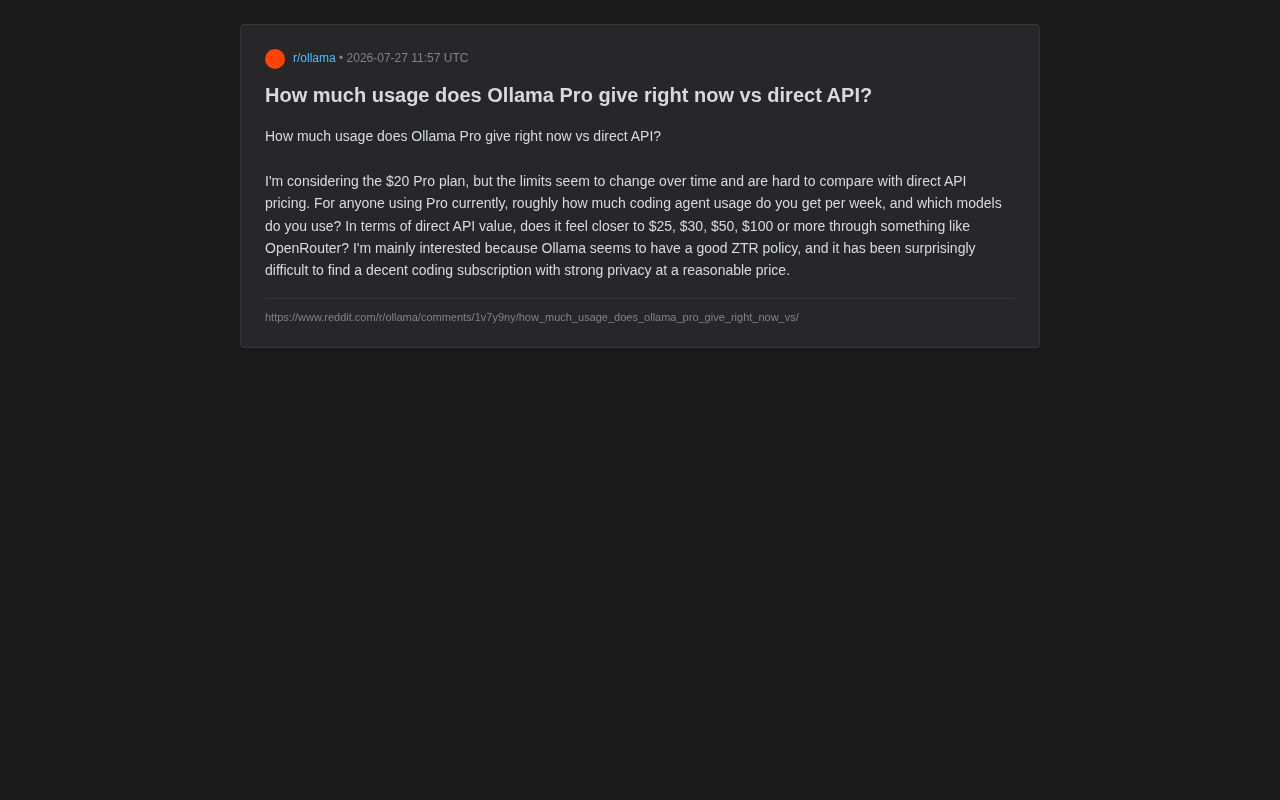
As AI coding assistants become everyday tools for developers, the cost-effectiveness of subscription-based services is increasingly under the spotlight. Recently, a Reddit user raised a highly representative question: How much actual usage does Ollama Pro's $20/month plan provide compared to calling APIs directly? This seemingly simple question actually touches on three core pain points in choosing AI coding tools today — usage transparency, cost comparability, and privacy protection.
Ollama is an open-source framework for running large language models locally, originally known for enabling developers to deploy and run models like LLaMA, Mistral, and Gemma on their own machines with a single command. Its core value proposition is "local-first" — all inference computation happens on the user's device, and data never leaves the machine. Ollama Pro is its cloud subscription service, extending this privacy-friendly philosophy to cloud computing scenarios. It targets developers whose local hardware isn't powerful enough to run large-parameter models but who are reluctant to hand their code data over to traditional cloud providers.
This user's core concern was crystal clear: he was willing to pay for a coding assistant, but options that are both "strong on privacy and reasonably priced" are frustratingly scarce. Ollama caught his attention precisely because of its ZDR (Zero Data Retention) policy. This reflects a growing trend among developers who take code privacy seriously — after all, sending your company's core codebase to a cloud AI for processing is itself a potential risk.
The Dilemma of Comparing Ollama Pro Usage: Why Direct Measurement Is So Hard
Constantly Shifting Quotas
The original poster raised a key issue: Ollama Pro's usage limits "change over time, making it hard to compare against direct API pricing." This is actually a common problem with all subscription-based AI services.
Unlike pay-per-token APIs, the value of a $20 flat-rate plan depends on multiple variables. In the pay-per-usage API model, the token is the fundamental billing unit — one token is roughly equivalent to 3/4 of an English word, or 1-2 Chinese characters. LLM APIs typically charge separately for input tokens (prompt) and output tokens (completion), with output tokens usually costing 2-4x more per unit. For example, GPT-4o charges approximately $2.5 per million input tokens and $10 per million output tokens. In coding scenarios, a medium-sized code file might contain thousands of tokens, and a coding agent working on a single task may need to repeatedly read and generate code, easily accumulating tens of thousands or even hundreds of thousands of tokens.
With this understanding of token billing, the variables that determine a flat-rate plan's value become much clearer:
- The model you use: A model's parameter count directly determines the computational resources needed for inference. Among open-source models, a 7B (7 billion parameter) model can run smoothly on consumer-grade GPUs, while a 70B (70 billion parameter) model requires multiple high-end GPUs or dedicated inference clusters. In cloud API pricing, this difference translates to orders-of-magnitude price gaps: the inference cost for Llama 3.1 8B might be just 1/10 to 1/20 of the 70B version. For subscription services, the computational cost difference between models is enormous — the same $20 spent entirely on small models versus large models could yield over 10x the difference in inference volume.
- Context length: Coding agents (such as Cursor, Cline, Aider, etc.) are AI tools capable of autonomously understanding tasks, reading codebases, and writing or modifying code. Unlike simple code completion, agent-mode AI needs to send large amounts of relevant code files, project structure, dependency information, and more as "context" to the model. Modern LLMs have expanded their context windows from the early 4K tokens to 128K or even 200K tokens, but longer context means higher computational costs. A typical coding agent workflow might consume 50K-150K input tokens in a single task, which explains why heavy agent users' API bills often far exceed expectations.
- Provider policy adjustments: To control costs, subscription services frequently and quietly adjust their rate-limiting thresholds, making long-term value assessment difficult.
A Reference Range for Equivalent API Value
The user provided a very practical thinking framework in their question: If paying directly through an aggregation platform like OpenRouter, does the $20 subscription feel closer to $25, $30, $50, or $100+ in actual value?
OpenRouter is an AI model API aggregation platform that consolidates models from OpenAI, Anthropic, Google, Meta, and other providers into a unified API interface. Users can pay per actual usage and freely switch between models. Its value lies in providing a transparent pricing benchmark — users can see the exact price per million tokens for each model, making cost comparisons between different services possible. In this article's context, OpenRouter serves as the reference point for measuring a subscription service's "equivalent API value."
This method of estimating "equivalent API value" is worth adopting. Based on general community feedback, subscription services typically deliver value along these lines:
- If you're a light user (a few dozen queries per week), the subscription might only equate to $10-20 in API usage — not necessarily worth it.
- If you're a heavy coding agent user (hundreds of calls per day, long contexts), the fixed subscription price often delivers equivalent API value well exceeding $50 or even $100.
In other words, a subscription's cost-effectiveness is highly correlated with usage intensity. The harder you push it, the more value you get.
Why ZDR Privacy Policy Becomes the Deciding Factor
The Weight of Zero Data Retention
The original poster specifically emphasized Ollama's "ZTR/ZDR policy." Zero Data Retention is a data handling strategy where the service provider immediately discards all input and output data after completing an API request, storing nothing on any persistent medium and not using it for model training or service improvement. This stands in stark contrast to the default practices of many AI services — for example, OpenAI's standard API retains data for 30 days by default for abuse monitoring, and its consumer product (ChatGPT) uses conversation data for model training unless users proactively opt out.
ZDR is especially important from a compliance perspective: for businesses subject to GDPR (EU General Data Protection Regulation), HIPAA (Health Insurance Portability and Accountability Act), or SOC 2 requirements, using non-ZDR services to process sensitive data could pose compliance risks. For developers handling sensitive code, this consideration can outweigh price itself.
Currently, mainstream AI coding subscriptions — whether GitHub Copilot, Cursor, or various API services — have inconsistent data handling policies. Many retain data by default for "service improvement," requiring manual opt-out or enterprise-tier subscriptions for strong privacy guarantees. GitHub Copilot Business promises not to use customer code for model training, but the individual plan's commitments are much weaker. Cursor claims not to store code in privacy mode, but its default settings still upload context data. Ollama, long known for its "local-first" approach, naturally extends its privacy-friendly DNA to its cloud service, genuinely filling a market gap.
The Scarcity of "Reasonable Price + Strong Privacy"
The user stated bluntly: "Finding a privacy-strong, reasonably priced coding subscription is surprisingly difficult." This statement highlights a structural gap in the current market.
- Strong privacy but expensive: Enterprise-grade solutions are typically costly and out of reach for individual developers. For example, Azure OpenAI enterprise deployments or AWS Bedrock private instances offer strict data isolation and compliance guarantees, but monthly costs can easily run into hundreds or even thousands of dollars — far beyond an individual developer's budget.
- Cheap but privacy-questionable: Low-cost services often trade data for reduced costs. Some extremely cheap third-party API proxy services route data through multiple intermediary nodes, leaving users unable to verify data security during transmission and processing.
- Local deployment but high barrier to entry: Running everything locally offers the best privacy, but requires high-end hardware for large model inference. For a 70B parameter model, even with 4-bit quantization, you need roughly 40GB of VRAM — meaning a single RTX 4090 (24GB) isn't enough. You might need two high-end GPUs or an A100, with hardware investment easily exceeding several thousand dollars.
Ollama Pro attempts to find a balance point within this trilemma: providing cloud computing power at $20 while maintaining its privacy commitment.
Practical Advice for Potential Ollama Pro Subscribers
Drawing from the original discussion and community experience, if you're also considering Ollama Pro or similar services, here's how to evaluate from several angles:
First, Measure Your Actual Usage Intensity
Track how many coding agent calls you actually make per week and your typical context length. If your weekly usage is frequent with long contexts, a subscription is likely cost-effective; otherwise, you should consider pay-as-you-go. A practical approach: enable the token usage tracking feature in your current tools (most coding agents offer this option), record your total token consumption for a week, then convert it to a dollar amount using the target model's API pricing and compare directly against the $20 subscription price.
Verify the Specifics of the Data Policy First
Is ZDR a marketing buzzword or backed by concrete contractual guarantees? Review the terms of service regarding data retention, training usage, and third-party sharing — don't base your decision solely on promotional slogans. Pay particular attention to the difference between "we won't use your data to train models" and "we won't store your data" — the former still means data may be retained for other purposes (such as security audits or abuse detection), while the latter is a more thorough commitment.
Use OpenRouter as a Benchmark
Run your actual workflow on OpenRouter using the same models for a week, record the costs incurred, and then compare against the $20 subscription. This is the most direct way to verify "equivalent value." OpenRouter supports virtually all mainstream open-source and closed-source models and provides a detailed usage dashboard with per-request token counts and costs.
Pay Attention to Rate-Limiting Transparency
Choose services that clearly disclose their usage limits rather than imposing opaque, dynamic throttling. Predictability of usage is itself a form of value. A good subscription service will clearly state daily/monthly request caps, per-minute rate limits, and quota allocations across different models — rather than leaving users to suddenly encounter slowdowns or service denials mid-workflow.
Conclusion: Subscriptions Are Fundamentally an Exchange of Risk for Certainty
This discussion about Ollama Pro ultimately reflects a universal choice developers face in the AI era: finding the optimal balance among cost, performance, and privacy.
Fixed-price subscriptions offer cost certainty at the expense of usage transparency; pay-as-you-go APIs offer flexibility at the expense of unpredictable bills. And above both of these, privacy protection is gradually shifting from a "nice-to-have" to a "must-have." As global data protection regulations tighten and enterprises become more aware of code asset security, we'll likely see more products like Ollama Pro emerge, seeking new equilibrium points within the "privacy-price-performance" triangle.
For privacy-conscious developers like the original poster, Ollama Pro may indeed be an option worth trying — but only if you first quantify your real needs and make decisions based on data rather than intuition. After all, the most expensive subscription isn't the one with the highest price tag — it's the one you pay for but never use.
Related articles

Coze Beginner's Guide: A Complete Tutorial for Building AI Agents with Zero Code
A detailed guide to ByteDance's Coze platform covering core features, China vs. international version differences, and practical use cases. Learn to build AI agents with zero code through drag-and-drop.

Hands-On Tutorial: Building a Godot Game AI Agent with DeepSeek + Harness
Learn how to build a dedicated AI agent plugin for the Godot game engine using DeepSeek models and the Harness framework, with auto code fixes and real-time editor refresh.

Model Distillation: The Core Technology for Compressing Large Model Intelligence into Your Phone
A clear explanation of model distillation (Knowledge Distillation) principles and process. Learn how teacher-student knowledge transfer compresses large model capabilities onto phones for offline face recognition, translation, and more.