Model Distillation: The Core Technology for Compressing Large Model Intelligence into Your Phone

Model distillation compresses large AI model intelligence into lightweight models that run on phones.
Model distillation is the technique of transferring knowledge from a large, expensive teacher model to a small, efficient student model. By learning the teacher's probability distributions (soft labels) rather than just hard answers, the student captures "dark knowledge" about inter-class relationships. This enables powerful AI capabilities like face recognition and offline translation to run on edge devices without cloud connectivity, making AI truly portable and affordable.
The Core Contradiction of Large Models: Powerful Capabilities but Staggering Deployment Costs
If we compare a large model to a super intern freshly hired by a company, it has one inseparable problem: its capabilities are truly extraordinary, but its appetite is equally staggering.
Every time it does a job, it burns through a massive number of tokens (computational resources); it runs slowly and can only be housed in expensive server rooms. Let me explain "tokens" here — they are the basic units that large language models use to process text, essentially the smallest granules the model "reads" and "writes." A Chinese character typically corresponds to 1-2 tokens, while an English word might be split into 1-3 tokens. For every token processed, the GPU needs to execute billions of floating-point operations. Take a GPT-4-level model as an example: a single conversation might consume thousands of tokens, and the inference cost per million tokens ranges from several dollars to tens of dollars. Add to that the requirement for high-end GPUs like NVIDIA A100/H100 — each costing over ten thousand dollars per unit — and the costs become astronomical.
For ordinary users and small-to-medium businesses, this means: you can neither afford to keep it nor take it with you. It won't fit in your phone, and the moment you lose internet on the subway, it simply stops working. Why can't it fit in a phone? Because smartphones typically have only 8-16GB of RAM (shared with the operating system and other apps) and just a few TOPS of AI computing power, while a model with tens of billions of parameters might need dozens of gigabytes of VRAM to run. There's an order-of-magnitude gap between the two.
This raises a very practical question — earlier we discussed how to make AI "stronger," but this time we're solving the opposite problem: how to make strong AI cheaper and portable. The answer is a word that sounds somewhat chemistry-flavored: Distillation.
What Is Model Distillation? From Purification to Knowledge Compression
You've surely seen the original meaning of distillation. It's the process of purification — like turning a bucket of cloudy rice wine into a flask of clear high-proof liquor, or turning salty, murky seawater into a drop of pure water. Impurities stay behind; the essence rises.
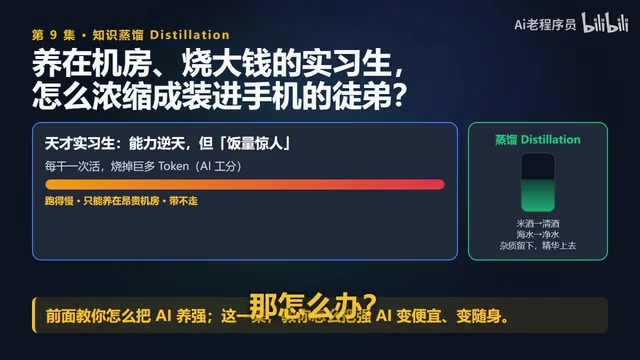
In the AI domain, model distillation means having that big, expensive "intern" condense all its skills into a "refined apprentice" version: smaller appetite, faster speed, and able to fit directly into your phone.
This concept was first systematically proposed by Geoffrey Hinton — one of the three giants of deep learning and a Turing Award laureate — along with Oriol Vinyals and Jeff Dean in their 2015 paper Distilling the Knowledge in a Neural Network. Hinton observed that while large ensemble models were powerful, their deployment costs were prohibitively high. He proposed a methodology for having large models "teach" small models, which later became a cornerstone technique in the model compression field.
Teacher Model and Student Model: The Core Roles in Knowledge Distillation
Let me use a more vivid analogy to explain this clearly:
- Teacher Model (Large Model): Like a seasoned professor who has read ten thousand volumes and accumulated decades of experience;
- Student Model (Small Model): Like a young apprentice who works based on the teacher's intuition.
Here's the eye-opening key point: The apprentice doesn't just learn the standard answers — it also learns the teacher's "confidence levels."
What are confidence levels? The teacher internally judges — this image is 90% likely a cat, 80% similar to a dog, 20% similar to a car. This fuzzy "feel" would never appear in ordinary textbooks, but during distillation, the apprentice learns this layer of confidence as well.
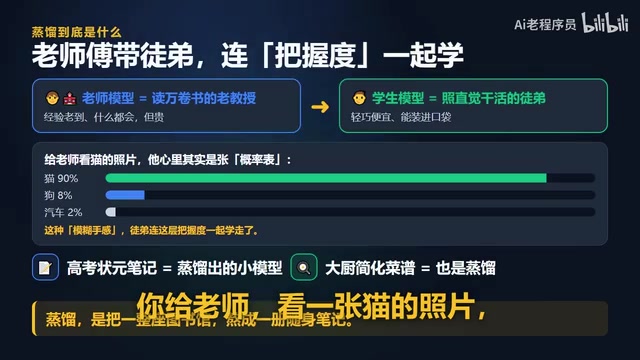
So what the small model learns isn't a rote-memorized "this is a cat," but an entire probability table of "what it resembles." Put another way:
Distillation is boiling an entire library down into a pocket-sized notebook.
It's like a top exam scorer condensing stacks of textbooks into one thin notebook — underclassmen can ace the exam just by studying it. Or like a master chef writing down ancestral secret recipes as a simplified home cookbook — ordinary people can produce dishes that are 80% as good. Distillation doesn't reduce knowledge; it compresses the teacher's complete set of intuitions into something portable.
The Complete Process of Model Distillation: Three Steps to Knowledge Transfer
The complete distillation process can be broken into three clear steps. Let's use the analogy of "a professor mentoring a graduate student" to tie them together.
Step 1: Train a Powerful Teacher Model
First, train a top-tier large model that has read ten thousand volumes and consumed massive amounts of data. It's like hiring a top professor to consult at your company — expensive, but truly omniscient. This step is exactly the "making AI stronger" process emphasized in previous discussions.
Step 2: The Teacher Model Outputs Soft Labels
Have the teacher answer massive numbers of questions, but not just provide standard answers — also output "how confident I am." In technical jargon, these are called "soft labels" — they're not cold right-or-wrong verdicts, but probability distributions carrying confidence levels.
It's worth diving deeper into the difference between "soft labels" and "hard labels." In machine learning, a "hard label" is a deterministic classification result, such as [1, 0, 0] meaning "100% cat, 0% dog, 0% car." A "soft label" is a probability distribution, such as [0.7, 0.2, 0.1] meaning "70% cat-like, 20% dog-like, 10% car-like." In the original paper, Hinton introduced a "Temperature" parameter T to control how "soft" the probability distribution becomes: the higher T is, the smoother the distribution, and the more fully the similarity relationships between different classes are exposed. These inter-class relationships are the so-called "Dark Knowledge" — they tell the student model that the similarity between cats and dogs is far higher than between cats and cars. This precious structural information is completely lost in hard labels.
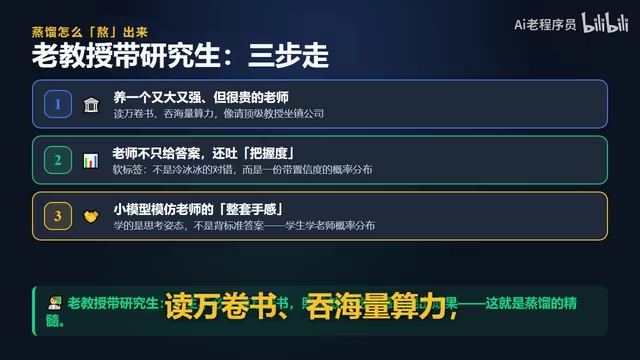
Step 3: The Student Model Mimics the Teacher's Probability Distribution
Finally, have the small model train by mimicking the teacher's complete set of intuitions, rather than being directly constrained by standard answers. What it learns is the teacher's way of looking at problems, not the exam questions themselves.
Here's an analogy: the professor has read ten thousand volumes himself and hands down his research intuition to the student. The student doesn't need to retrace the teacher's ten-year journey — they just need to learn "the lens through which the teacher sees problems" to produce good results. This is the essence of "student learning the teacher's probability distribution" in distillation.
After these three steps, a lightweight "apprentice" has graduated.
Practical Applications and Core Advantages of Model Distillation
The value distillation delivers is very direct: small models can run on edge devices like phones and cameras, work without internet, save computing power and money, and respond instantly.
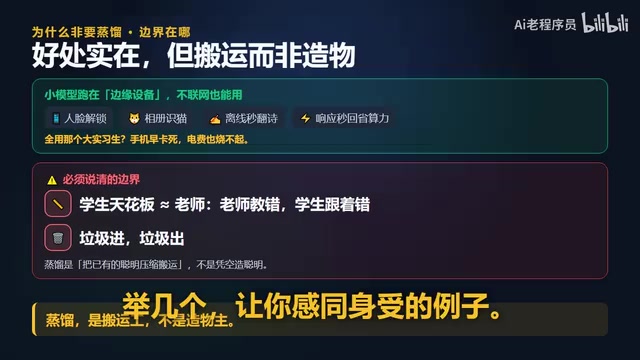
The face unlock on your phone, your photo album automatically recognizing "this is your cat," or offline instant translation of a poem you wrote — behind most of these features are distilled small models quietly doing the work. If they all used the large model, your phone would have frozen long ago, and you couldn't afford the electricity bill.
It's worth mentioning that distillation is just one method in the model compression toolbox. In practice, it's often used in combination with other techniques: Quantization compresses model parameters from 32-bit floating-point to 8-bit or even 4-bit integers; Pruning removes less-contributing connections in the network; Neural Architecture Search (NAS) automatically finds more efficient network architectures. Apple's Core ML models and Google's MobileBERT are all products of combining multiple compression techniques. First distill to get a small model, then quantize to the extreme — only then can it finally fit into your phone's chip and run smoothly.
A Real-World Distillation Case: DeepSeek's Large-Scale Practice
In 2024-2025, Chinese AI company DeepSeekAd conducted a remarkable large-scale practice in distillation technology. They first trained the ultra-large-scale DeepSeek-R1 model (with extremely strong reasoning capabilities), then transferred its abilities to multiple smaller models of different scales through distillation, including 1.5B, 7B, 14B, 32B, and 70B parameter versions. The results were exciting: the distilled small models significantly outperformed models of the same size trained from scratch on tasks like mathematical reasoning and code generation. This fully validates the core value of distillation — "standing on the shoulders of giants" — where small models, aided by the knowledge of large models, can break through the performance ceiling of direct training.
Limitations of Distillation: Transferring Knowledge, Not Creating It
To be thorough, we must clearly state the boundaries: Distillation doesn't create something from nothing.
The student's capability ceiling roughly equals the teacher's. If the teacher teaches incorrectly, the student will follow suit — in technical terms, this is "Garbage In, Garbage Out." This is a classic principle in computer science: if the input data or knowledge itself is flawed, the output will inevitably be flawed too. In the distillation context, this means if the teacher model itself has biases, hallucinations, or factual errors, the student model will faithfully "inherit" these defects — and may even amplify certain errors due to its smaller capacity. This is why the industry emphasizes that teacher model quality must be ensured before distillation — including alignment, factual verification, and other steps that should all be completed before distillation begins.
What distillation does is "compress and transport existing intelligence," not conjure new intelligence from thin air.
So, in one sentence summarizing its role: Distillation is a mover, not a creator. It can move intelligence from the server room to your pocket, but it can't move abilities the teacher never had in the first place.
Distillation's Position in the AI Capability System
Connecting this to previous content creates a clearer full picture:
What was taught earlier is how to build a powerful horse and equip a good carriage — that is, a large model plus various tools to make it strong and capable. Distillation is about condensing that heavy, expensive combination into a small horse plus a lightweight cart: capabilities at 80-90% of the original, but tens of times cheaper, tens of times faster, and able to fit in your pocket.
In other words:
- The earlier work answers "how to make AI stronger";
- Distillation answers "how to bring strong AI down from the cloud and into ordinary people's phones."
One is about creating a beast; the other is about putting the beast's soul into a small body. With distillation, all the previous efforts finally come down to earth.
Conclusion: Model Distillation Brings AI Truly to Everyone
True AI democratization may not be about building ever-larger models year after year, but about putting large model intelligence into everyone's pocket.
Next time your phone is offline and can still instantly recognize your face or translate a poem you wrote, don't be surprised — that's a distilled small model quietly doing the work for you.
The large model is the professor stationed in the server room; the small model is the notebook you carry on the road; distillation ensures that intelligence no longer belongs only to the server room.
From how AI thinks, how it keeps records and relays messages, how it looks up information, how it equips tools, how it runs in loops, to finally how it condenses itself into your pocket — all these skills combined are what it truly means to put an AI employee to work.
Key Takeaways
Related articles

Uber Deploys ChatGPT Work Company-Wide: AI in the Workplace Enters the Scaled Implementation Phase
Uber deploys ChatGPT Work to 30,000+ employees, extending it from engineering to all roles. We analyze its expert-engineer pairing, end-to-end automation, and questions of AI control and power concentration—insights for scaling AI in the workplace.

Shift at Midnight Hands-On: When "ID Verification" Becomes Alien Hunting
Shift at Midnight blends ID verification with horror survival in a four-player co-op game. We break down its inspection mechanics and chaotic humor.

Zelensky Recounts the Outbreak of War: I Need Ammunition, Not a Ride
Zelensky recalls the first day of war in a YouTube interview: farewell to family, rejecting Biden's evacuation offer with "I need ammunition, not a ride," and how Bucha shaped his stance on compromise and peace talks.