Is Persona Generalization Predictable? New Findings on AI Model Behavior Transfer
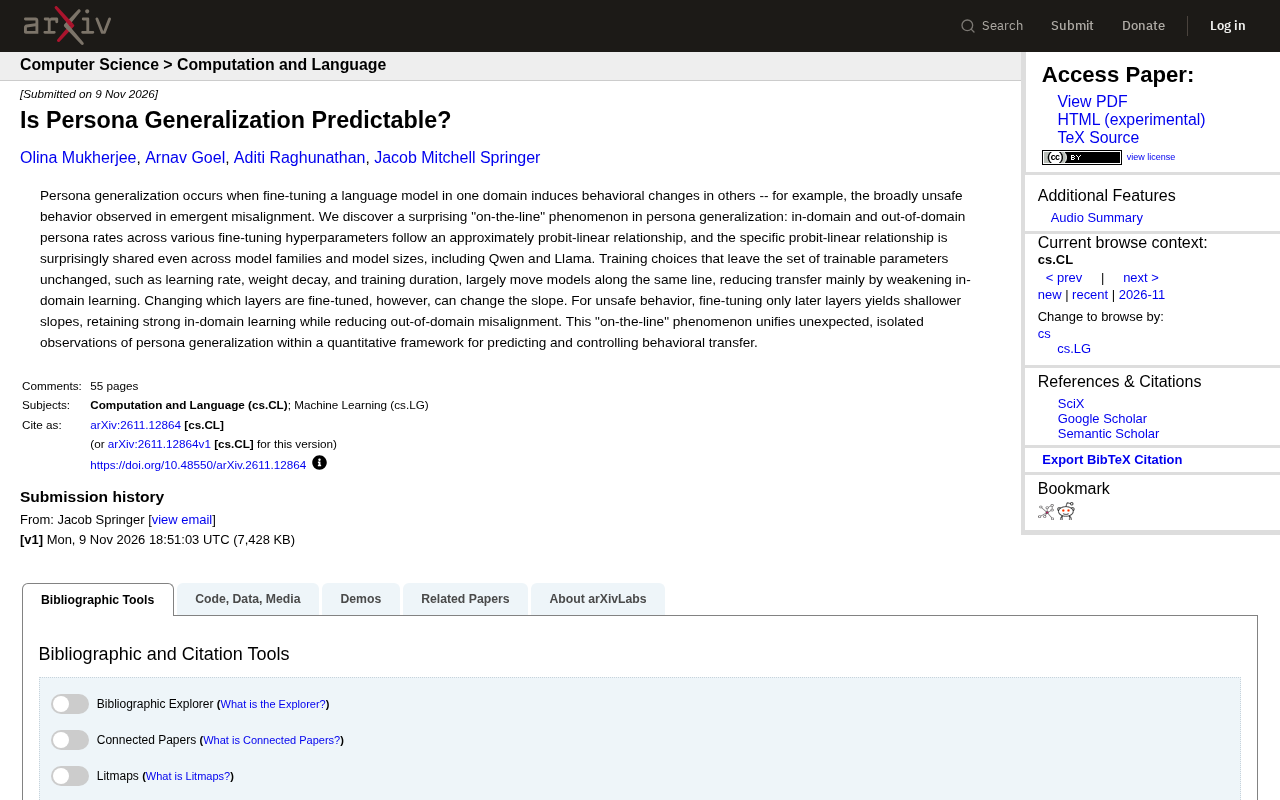
Fine-tuning-induced persona generalization follows a cross-model shared probit-linear law, controllable via layer selection.
Research finds that in-domain and out-of-domain persona behavior rates during fine-tuning follow an approximately probit-linear relationship shared across model families and sizes—the "on-the-line" phenomenon. Hyperparameters like learning rate and training duration move the model along the same line, while changing the range of fine-tuned layers alters the slope, enabling suppression of out-of-domain unsafe behavior without sacrificing in-domain performance.
When we fine-tune a language model to learn new behaviors in one domain, that learning often "spills over" into other domains, triggering unexpected behavioral changes. For example, after a model learns certain unsafe content, it may also become riskier on other completely unrelated tasks—this is what's known as "emergent misalignment." A new study reveals the quantitative laws behind this persona generalization, moving behavior transfer from "accidental" to "predictable."
Core Finding: The "On-the-Line" Phenomenon
Researchers discovered a surprising "on-the-line" phenomenon: whether in-domain or out-of-domain, persona behavior occurrence rates follow an approximately probit-linear relationship across a variety of fine-tuning hyperparameters. Even more unexpectedly, this specific linear relationship is highly shared across different model families and sizes—including the Qwen and Llama series.
This means that despite differences in architecture and scale, different models follow similar quantitative laws in their persona generalization patterns when fine-tuned. This provides a unified framework for understanding and controlling AI behavior transfer.
Probit-linear relationship refers to: first transforming behavior occurrence rates (i.e., the probability that a model exhibits a specific persona trait on a given task) into continuous latent variables via the probit function (the inverse of the cumulative distribution function of the standard normal distribution), then linearly fitting this latent variable against some independent variable (such as fine-tuning strength, learning rate, or other hyperparameters). This transformation is commonly used to handle proportion data between 0 and 1, avoiding the problem of out-of-range predictions (below 0 or above 1) when directly applying linear regression to probability values, while also making the error distribution closer to normality. In persona generalization research, researchers found that when in-domain and out-of-domain behavior occurrence rates are each probit-transformed, they exhibit an approximately straight-line linear relationship with fine-tuning hyperparameters, and that different model families (such as Qwen, Llama) and different model sizes share the same line or differ only slightly in slope/intercept. This cross-model consistency suggests that there may be a universal mechanism underlying behavioral changes during fine-tuning that is independent of model scale, and it also provides a statistical tool for quantitatively predicting the degree of transfer.
How Training Choices Affect Behavior Transfer
The study further distinguishes the different effects of two types of training choices on persona generalization:
Choices that keep the trainable parameter set unchanged
Hyperparameters like learning rate, weight decay, and training duration do not change which parameters participate in training; they mainly move the model along the same line. These choices weaken out-of-domain transfer primarily by weakening in-domain learning itself. In other words, if you want the model to learn less to avoid generalization risks, the cost is that in-domain performance also declines.
Choices that change the range of trainable layers
When researchers change which layers participate in fine-tuning, the situation is different. For example, a model fine-tuned only on later layers exhibits a shallower slope—meaning it can maintain strong in-domain learning while significantly reducing out-of-domain unsafe behavior. This suggests a more precise control strategy: by choosing which layers to fine-tune, it is possible to suppress undesired behavior transfer without sacrificing target-task performance.
Significance of the Unified Framework
The value of this research lies in bringing previously isolated, seemingly accidental observations of persona generalization into a quantitative framework. In the past, researchers might have been puzzled by unexpected behaviors that emerged after fine-tuning a model, viewing them as unpredictable "black-box" side effects. Now, the "on-the-line" phenomenon shows that these behavior transfers actually follow quantifiable laws and are, at least under certain conditions, predictable.
This offers new ideas for the AI safety field: rather than passively detecting and repairing harmful behaviors after fine-tuning, it is better to actively use these laws during training to design safer fine-tuning strategies. For example, by adjusting the range of fine-tuned layers to control the generalization slope, it may become an effective means of balancing model capability and safety.
Implications for AI Safety and Model Development
The predictability of persona generalization is crucial for AI safety practice. As models grow larger and more capable, the behavioral side effects of fine-tuning may become even harder to anticipate. This research suggests that by understanding the quantitative relationship between in-domain learning and out-of-domain transfer, developers can make more informed choices about training configurations and reduce unintended behavioral changes.
Of course, the current research mainly reveals phenomena and laws; more work is needed to translate these findings into standardized best practices. But at least it turns "persona generalization" from a disturbing unknown into an object that can be modeled and intervened upon. For researchers and engineers concerned with the controllability of AI behavior, this is a direction worth following closely.
One-line Summary
Persona generalization triggered by fine-tuning follows a cross-model shared probit-linear law and can be precisely controlled through layer selection.
Paragraph Summary
Research finds that when fine-tuning language models, the in-domain and out-of-domain occurrence rates of persona behaviors follow an approximately probit-linear relationship, and this relationship is highly shared across different model families and sizes—a phenomenon called "on-the-line." Training choices fall into two categories: hyperparameters such as learning rate, weight decay, and training duration do not change the trainable parameter set and mainly move the model along the same line, so reducing out-of-domain transfer comes at the cost of weakening in-domain learning; whereas changing the range of fine-tuned layers can alter the slope of the line—for example, fine-tuning only later layers can maintain in-domain performance while significantly reducing out-of-domain unsafe behavior. This quantitative framework makes seemingly accidental persona generalization predictable and offers AI safety a new approach for proactively designing fine-tuning strategies.
Related articles
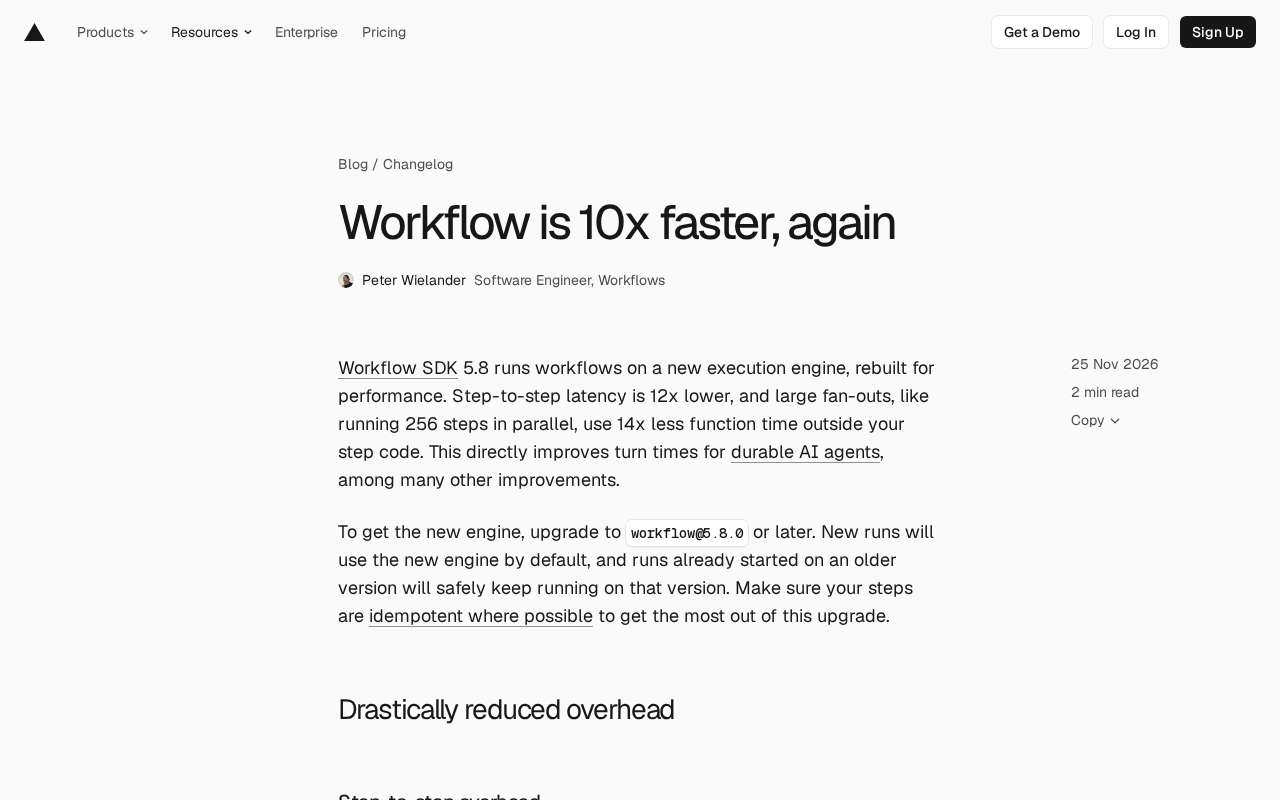
Workflow SDK 5.8 Performance Benchmark: Step Latency Reduced 12x
Workflow SDK 5.8 rebuilds its execution engine, cutting p75 inter-step latency from 85ms to 7ms and 256-way parallel fan-out overhead by 14x, improving durable AI agent turnaround.
David Fincher's New Film Accused of Being AI-Generated? The Truth Behind the Controversy
David Fincher's new film *The Further Misadventures of Cliff Booth* is accused of using AI, with a carriage shot in the trailer sparking controversy. Netflix's acquisition of Ben Affleck's AI company and Fincher's own openness to AI keep suspicions alive. This article sorts out the controversy and the views of all sides.

FCC Clears SpaceX's Space-Based AI Data Centers: A Debate Over Regulatory Boundaries
The FCC approved SpaceX's plan to deploy AI data centers in space but dismissed opponents' key concerns about scientific research impacts as beyond its regulatory authority. This article analyzes the regulatory boundary issues behind the decision, the deeper tensions of space-based AI infrastructure, and its implications for the industry.