Is Real-Time Call Transcription a False Need? Honest Feedback from Frontline Agents

Real-time call transcription only creates value when it reduces agent workload, not adds to it.
Real-time call transcription impresses in demos but often burdens already-overloaded agents. A frontline call center worker argues that low-latency STT only matters when it triggers automated actions — like flagging escalations, redacting sensitive data, or enabling post-call QA — rather than adding another screen to read. The real question isn't how fast text appears, but how it's embedded into workflows to reduce work.
Impressive in Demos, Awkward in Practice
Live Call Transcription always dazzles during demos: words appear on screen in sync while the customer is still speaking. Managers nod approvingly, vendors confidently promise "real-time insights." The whole scenario seems bulletproof — until you realize no one has actually asked the key question: Do agents really have time to read yet another screen of content?
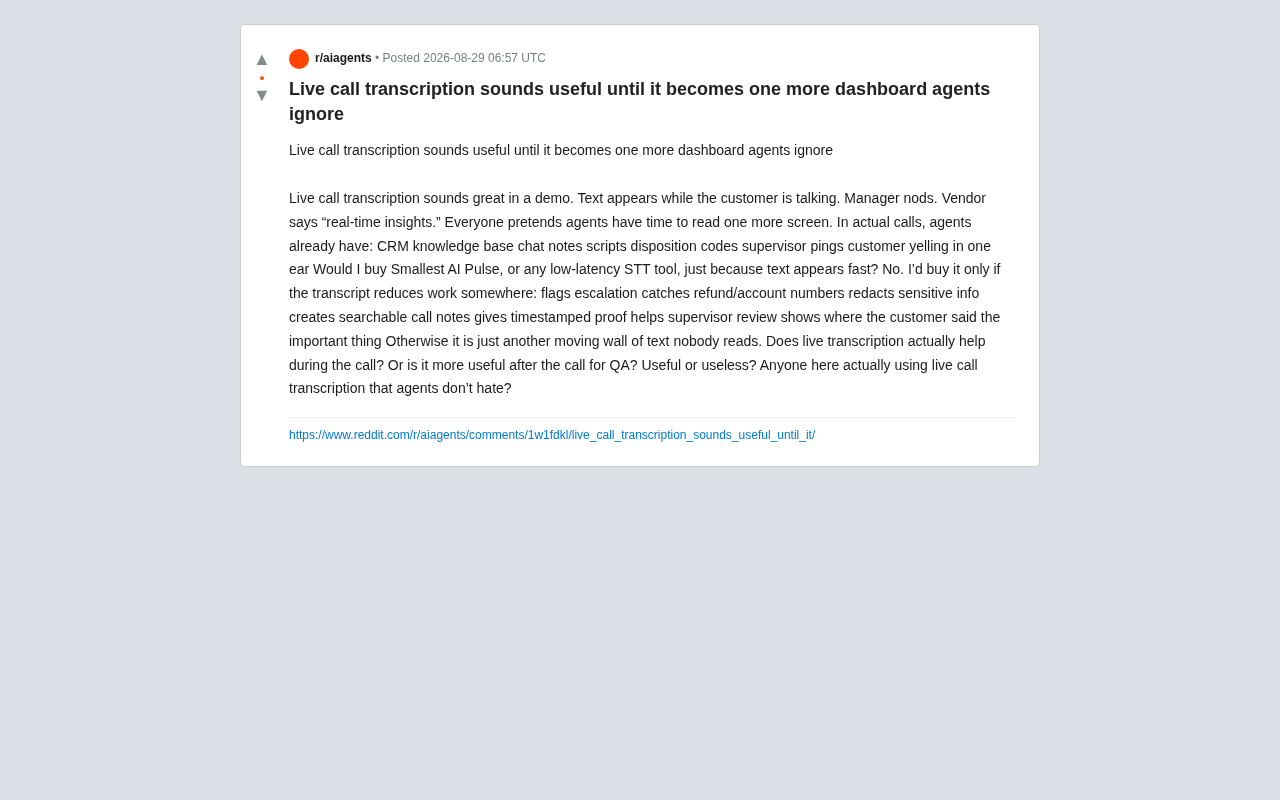
This is exactly the sharp observation a Reddit user raised recently. As an actual frontline call center worker, they cut straight to the core contradiction of low-latency speech-to-text (STT) tools in practice: being "fast" technically doesn't mean being "useful" operationally.
Agent Screens Are Already Overloaded
To understand this skepticism, you first need to picture what a customer service agent actually deals with during a call. The original poster listed all the information sources an agent juggles simultaneously on a single call:
- CRM system
- Knowledge base
- Live chat windows
- Note-taking
- Call scripts
- Disposition codes
- Instant messages from supervisors
- And — the angry customer on the other end of the headset
In an environment where attention is already fragmented to the extreme, layering on a "constantly scrolling wall of text" doesn't add value — it adds burden. When transcription text becomes yet another "dashboard nobody looks at," its value approaches zero.
This is a common pitfall for many AI features deployed in call centers: Product logic starts from what's technically possible ("we can do real-time transcription") rather than from user capacity ("can agents absorb more information?").
The Purchasing Criterion: Transcription Must "Reduce Workload"
The original poster offered a remarkably pragmatic purchasing standard. They stated plainly that no matter which low-latency STT tool it is, they won't pay for it just because "text appears fast." The only reason they'd pay is: transcription tangibly reduces workload at some point in the process.
Specifically, a call transcription capability worth investing in should be able to:
- Automatically flag escalation calls: Identify high-risk calls that need to be transferred to a supervisor
- Capture key business information: Such as refund amounts, account numbers, contract IDs, etc.
- Automatically redact sensitive information: Real-time redaction of credit card numbers, national ID numbers, etc.
- Generate searchable call records: Enable keyword-based search across historical call content
- Provide timestamped evidence trails: For compliance audits and dispute resolution
- Help supervisors with post-call reviews: Pinpoint problem areas without listening to every recording end-to-end
- Precisely locate key customer issues: Flag the exact moment a customer states their core concern
The common thread across this list: none of these require agents to "read more" — they require the system to "do more." The value of transcription isn't in converting speech to text; it's in triggering downstream automated actions based on that text.
The Value of Real-Time Transcription: During the Call vs. After the Call
The truly interesting part of this discussion is the critical product design question it surfaces: Does the value of real-time call transcription materialize during the call or after it?
Real-Time Assistance During the Call
Based on the original poster's skepticism, real-time transcription purely meant for agents to read has limited value during a live call — because agents simply can't spare the attention. But if real-time transcription isn't meant for agents to "read" but instead drives real-time intelligent prompts, it's a completely different story.
For example: when the speech recognition system detects keywords like "refund," "complaint," or "cancel," it automatically pushes relevant talk tracks to the agent or sends an alert to the supervisor. In this case, transcription is merely the underlying capability — the real value is delivered by the real-time decision support layer built on top of it.
Post-Call QA and Review Value
By contrast, the value of transcription in post-call quality assurance (QA) and review scenarios is virtually indisputable. Complete text with timestamps lets supervisors quickly locate problem areas without listening to recordings one by one; searchable call records become reliable evidence for compliance audits and dispute resolution.
From this perspective, many so-called "real-time transcription" products actually deliver most of their real value after the call ends.
Three Takeaways for AI Voice Product Teams
This piece of frontline feedback deserves deep reflection from every team building AI applications and voice products. It reveals a recurring trap: mistaking technical metrics (low latency, high accuracy) for product value.
Low-latency STT is a solid foundational capability, but it doesn't constitute a solution by itself. True productization requires answering three questions:
- Who consumes this text? Is it agents, supervisors, or automated systems? Different consumers demand entirely different interaction designs.
- What does it save, and for whom? If you can't clearly point to time saved or error rates reduced, the feature will struggle to retain users.
- Does it deliver value during the call or after the call? Conflating the two often leads to blurry product positioning and a fragmented user experience.
For high-pressure, information-dense work environments like call centers, every additional "screen" is a cost. The mission of AI tools shouldn't be to make humans see more — it should be to make humans see less and decide better.
Conclusion: Useful or Useless Depends on Design, Not Technology
Returning to the original poster's direct question — is real-time call transcription useful or useless?
The answer is perhaps: Transcription itself is neither useful nor useless; its value is determined by how it's embedded into the workflow. When it's just a stream of text floating on screen waiting to be read, it's destined to become yet another ignored dashboard. But when it becomes the engine for automated tagging, redaction, search, and quality assurance, it truly starts creating business value.
For teams currently evaluating real-time call transcription tools, rather than being seduced by the word "real-time," it's better to channel the original poster's grounded clarity and ask: What part of my workload does this actually reduce?
Related articles

Bilibili's Hit Dify Tutorial: A Practical Guide to Building 20+ AI Apps from Scratch
A distilled guide to Bilibili's top-rated Dify tutorial: Windows + Docker deployment, MySQL connection, five app types, model integration strategy, and publishing.

Agent Skills Beginner's Guide: From Concepts to Multi-Agent Collaboration in Practice
A comprehensive guide to Agent Skills: core concepts, components, the importance of Description, standardization, beginner learning paths, and multi-agent collaboration.

One Neuron Detects Both Cats and Cars? We Reproduced It and Found a New Explanation
The cat-car neuron reinterpreted: researcher Cammarata argues it distinguishes pointy from round, not cats from cars. We reproduced the experiment and found the new explanation holds on most inputs—but cars are the exception. The interpretability debate continues on language models.