Is Rust Ready for Production AI/ML Stacks?

Rust shows real promise for production ML inference and edge deployment, but ecosystem maturity and team readiness still matter.
Sparked by a Reddit discussion on using Rust for production AI/ML, this article examines why Rust is entering the ML engineer's radar — its combination of near-C performance and compile-time memory safety directly addresses pain points in high-concurrency inference serving. While Python's moat in training remains deep, Rust's no-GC-pause, single-binary deployment model shines in inference and edge scenarios. The article also honestly presents the current limitations of the Rust ML ecosystem and recommends a hybrid "Python for training, Rust for inference" architecture over aggressive full rewrites, with team capability and long-term maintenance costs factored into the decision.
A Question That Keeps Coming Up
A short but telling question surfaced again in a Reddit tech community: "Is anyone using Rust for AI/ML in production?" Simple as it sounds, it cuts right to a long-standing tension in machine learning engineering — the absolute dominance of Python versus developers' persistent desire for better performance, safety, and deployment efficiency.
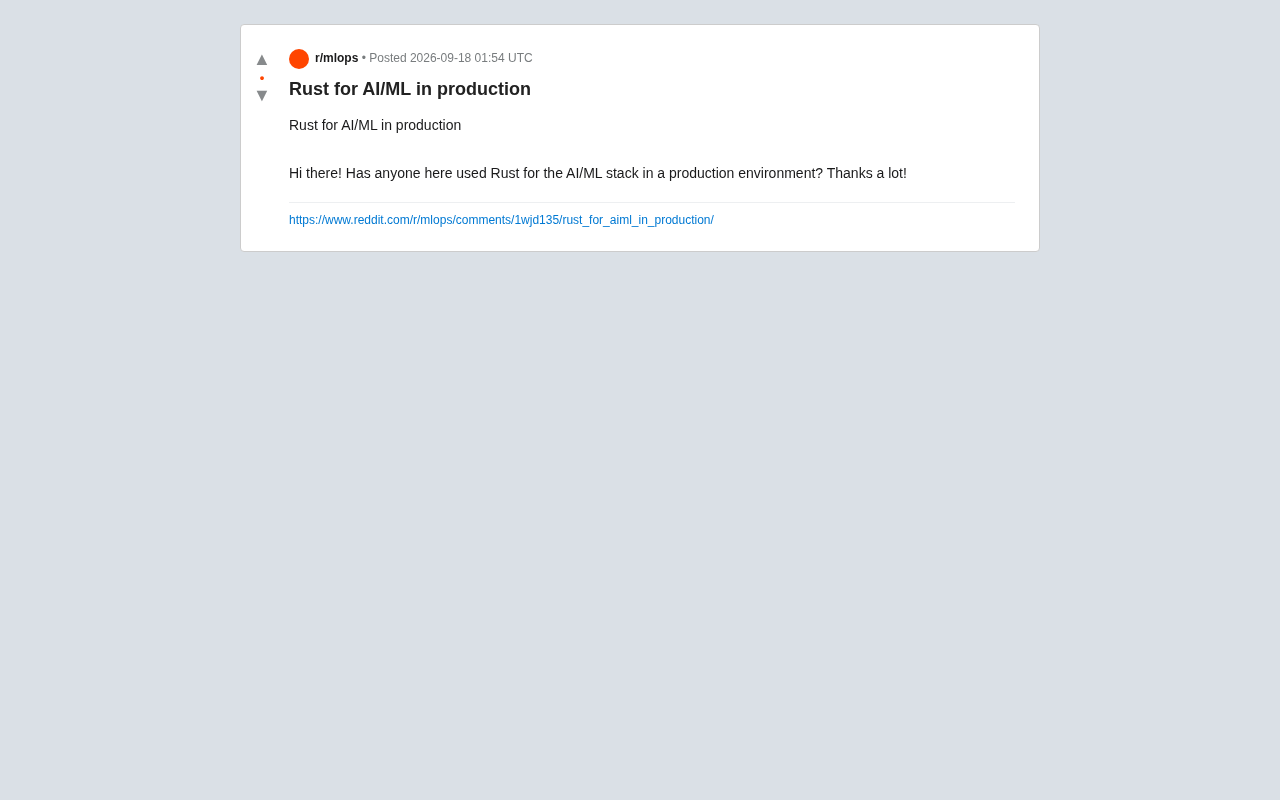
The post itself didn't go into much detail, but the underlying need was clear: more and more engineers are wondering whether there's a path beyond Python — one that delivers better runtime performance and stronger engineering reliability for model training, inference serving, or data processing pipelines.
Why Engineers Are Even Considering Rust for AI/ML
The reason Rust has entered the AI/ML engineer's radar comes down to its attempt to solve two problems that rarely coexist: near C/C++ runtime performance and compile-time guaranteed memory safety. For workloads that process massive tensor operations and demand low-latency inference, both of these properties are genuinely compelling.
In traditional ML workflows, Python mostly acts as a "glue language" — the computationally intensive work is delegated to lower-level C++ or CUDA libraries. This layered architecture is efficient, but it introduces cross-language call complexity, bloated deployment dependencies, and potential memory safety issues. Rust advocates argue it has the potential to directly replace portions of that C++ underpinning in certain areas, while eliminating an entire class of bugs associated with manual memory management.
Inference Serving Is the Most Realistic Entry Point
Based on real-world community experience, Rust's most compelling use case in AI/ML is not training — it's model inference and serving. The training side is deeply reliant on mature framework ecosystems and GPU-accelerated toolchains, and Python's moat there is formidable. But on the inference side — especially for edge deployments or online services requiring high concurrency, low latency, and small memory footprints — Rust's single compiled binary, absence of GC pauses, and predictable resource usage become concrete, measurable advantages.
It's worth noting that the significance of "no GC pauses" for inference services is often underappreciated. Python's runtime relies on CPython's reference-counting garbage collector, and under high concurrency, occasional GC pauses can cause severe long-tail latency degradation (P99/P999 latency) — unacceptable in online serving scenarios with strict SLAs. In Rust, memory management is fully determined at compile time by the ownership system; there's no garbage collector involved at runtime, so latency distributions are tighter and more predictable. Additionally, Rust compiles to a single statically linked binary with no need to carry a Python interpreter, virtual environment, or complex shared library dependencies. Container image sizes can shrink from several GBs down to tens of MBs, with direct improvements to containerized deployment and cold start times.
The Current State of the Rust AI/ML Ecosystem
Any discussion of production readiness has to grapple with ecosystem maturity. Rust has accumulated a number of noteworthy projects in the ML space:
- Native deep learning frameworks: Several Rust-native frameworks are developing rapidly, attempting to provide tensor operations and automatic differentiation — but they still lag significantly behind PyTorch and TensorFlow.
- Bindings and interoperability: Many projects provide Rust bindings for existing C++ inference engines, letting engineers write safer application logic in Rust while keeping high-performance computing kernels intact.
- Data processing pipelines: In performance-sensitive areas like feature engineering and data preprocessing, Rust is relatively mature and easier to adopt independently.
To be clear-eyed about this: compared to Python's vast, near-comprehensive ML ecosystem, Rust's toolchain is still in early stages. The lack of readily available model implementations, relatively sparse community documentation, and the difficulty of hiring engineers with both Rust and ML expertise are real costs that teams must weigh when making decisions.
In the "bindings and interoperability" direction, the most representative path today is using ONNX Runtime's Rust bindings to leverage the cross-framework standard model format. ONNX (Open Neural Network Exchange), a joint initiative from Microsoft and Facebook, allows models trained in PyTorch, TensorFlow, and other frameworks to be exported as standardized .onnx files and then loaded and executed by ONNX Runtime, a high-performance inference engine. This combination means teams don't have to abandon the Python training ecosystem — they simply switch to calling ONNX Runtime from Rust on the deployment side, gaining both cross-framework compatibility and the engineering advantages of Rust. Similarly, high-performance C++ inference libraries like llama.cpp now have actively maintained Rust bindings, covering local LLM inference scenarios.
Questions to Settle Before Committing
For teams evaluating this technical direction, a few practical judgment dimensions are worth considering:
First, identify the specific pain point Rust is meant to solve. If your existing Python services haven't hit a bottleneck in latency or resource consumption, rewriting for the sake of "technical advancement" rarely pays off. Rust's value gets fully amplified only under specific constraints — cost-sensitive large-scale inference, resource-constrained edge devices, and similar scenarios.
Second, use a hybrid architecture rather than wholesale replacement. A more realistic approach is letting Python continue to handle experimentation, training, and rapid iteration, while rebuilding validated, long-running inference services in Rust. This division of labor preserves the agility of the Python ecosystem while gaining Rust's reliability on the production side.
Third, honestly assess the team's long-term commitment. Rust has a steep learning curve, and its ownership and borrow-checking mechanisms are a significant challenge for engineers accustomed to dynamic languages. Technology selection isn't just a performance calculation — it's a composite accounting of team capability and maintenance cost.
On the topic of evaluating Rust's learning curve, one specific dimension deserves its own quantification: Rust's Ownership & Borrow Checker is a compiler-enforced set of memory safety rules that requires developers to explicitly define the lifetime and access rights of every piece of data at the time of writing. For engineers used to Python's "everything is an object, GC handles cleanup" mental model, this typically requires 2–4 weeks of intensive learning before the mindset shift clicks — and true fluency usually takes months of hands-on work. So if the team lacks Rust experience, including the cost of talent development alongside the technology decision in your ROI calculation is the key to avoiding the "rewrite trap."
Closing Thoughts
The Reddit question has no standard answer, but it is itself a valuable signal: ML engineering is moving from an exploratory "good enough if it runs" phase toward a maturity phase with higher demands on performance, safety, and engineering quality. Rust may not displace Python's position in machine learning, but in specific niches — inference serving, edge deployment, high-performance data pipelines — it is steadily proving its production viability. For teams willing to invest, it offers a superior engineering choice for particular problems, not a universal key.
Related articles

Uber Deploys ChatGPT Work Company-Wide: AI in the Workplace Enters the Scaled Implementation Phase
Uber deploys ChatGPT Work to 30,000+ employees, extending it from engineering to all roles. We analyze its expert-engineer pairing, end-to-end automation, and questions of AI control and power concentration—insights for scaling AI in the workplace.

Shift at Midnight Hands-On: When "ID Verification" Becomes Alien Hunting
Shift at Midnight blends ID verification with horror survival in a four-player co-op game. We break down its inspection mechanics and chaotic humor.

Zelensky Recounts the Outbreak of War: I Need Ammunition, Not a Ride
Zelensky recalls the first day of war in a YouTube interview: farewell to family, rejecting Biden's evacuation offer with "I need ammunition, not a ride," and how Bucha shaped his stance on compromise and peace talks.