Is SDD Worth 3x the Token Cost? An OpenSpec Practical Trade-off Guide
SDD's extra token cost is justified only when it buys fewer misalignments and lower rework — calibrate process weight to requirement complexity.
This article examines the real-world value of SDD (Spec-Driven Development) in AI coding workflows. The core argument: measuring SDD's worth isn't about comparing token consumption to direct prompting — it's about whether the extra investment buys fewer requirement misalignments, clearer module boundaries, and lower rework costs. The hidden cost of development usually isn't the first code generation; it lives in the loop of repeated fixes. The most common SDD mistake is going either too heavy (running trivial changes through a full workflow) or too shallow (writing vague Specs for complex requirements). The right approach is dynamically adjusting process weight to match requirement complexity, with OpenSpec serving as a framework to align AI execution with requirements rather than to achieve formal completeness.
The Core Debate Around SDD: What Do the Extra Tokens Actually Buy You?
Given the same requirement, asking AI to write code directly might get you results in minutes. Switch to SDD (Spec-Driven Development), and you first have to organize requirements, write a Spec, add constraints, and break down tasks — a full workflow that can easily multiply your token consumption several times over. Which raises the obvious question: what exactly do those extra costs buy you?
If the resulting code isn't meaningfully better than what a direct prompt produces, tests aren't more stable, and rework hasn't decreased, then SDD risks becoming a process that looks rigorous on paper but just burns more tokens in practice. This is increasingly the conversation in developer circles: some find Specs too heavyweight, while others who've used SDD for months struggle to prove their code quality actually improved.
That said, going direct is genuinely faster for simple requirements — but once multiple modules are involved and context grows longer, constraints mentioned earlier in the conversation tend to get lost. Halfway through, you realize the AI misunderstood something, or fixing one area breaks several others. The real time sink usually isn't the first code generation; it's the cycle of coming back to fix things afterward.
SDD (Spec-Driven Development) is an approach where you write structured specification documents before any actual coding. The core idea is to make requirements, constraints, module boundaries, and expected behaviors explicit — then hand them to AI for spec-aligned execution. This echoes the traditional software engineering principle of "design first," but it takes on specific characteristics in AI coding contexts: AI has a limited context window, and as conversation turns accumulate, constraints mentioned early are easily "forgotten" or overridden. A Spec is essentially an external, stable anchor for requirements maintained outside the conversation, preventing AI from gradually drifting from the original intent during multi-step tasks. The alternative — direct prompting (also called "zero-planning" or "vibe coding") — relies entirely on single or few-shot conversations to complete tasks. It's more efficient when requirements are simple, but the cost of errors rises sharply in multi-module, multi-iteration scenarios.
The Right Way to Measure SDD's Value
Judging whether SDD is worth it can't just come down to how many extra tokens it consumes. The more important question is whether those tokens buy you three things: fewer misalignments, clearer requirement boundaries, and lower rework costs.
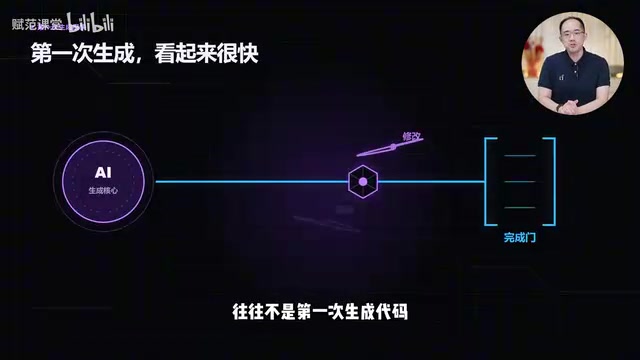
In complex projects, the cost of the initial code generation is actually manageable — the real hidden cost lives in the loop of repeated revisions. Every AI misunderstanding, every cascading change across modules, accumulates into far more time and token spend than the initial generation ever cost. If a Spec can lock down requirement boundaries and constraints at the source, keeping AI aligned with the target throughout execution, the rework costs it saves may well exceed the extra tokens spent upfront.
In other words, SDD isn't about making a process look formal — it's about using upfront certainty to hedge against downstream uncertainty. That calculation needs to be made across the entire development cycle, not just per individual call.
The Biggest Mistake: Going Too Heavy or Too Shallow
The problems most people run into with SDD aren't about not knowing how to use it — they're about not calibrating the right weight. Two common extremes:
- Too heavy: Running a tiny change through the full workflow — Spec, task breakdown, constraints and all — burning far too many tokens for minimal benefit.
- Too shallow: Writing a vague, sparse Spec for a complex requirement that fails to constrain anything meaningful, leaving the AI just as likely to go off track.
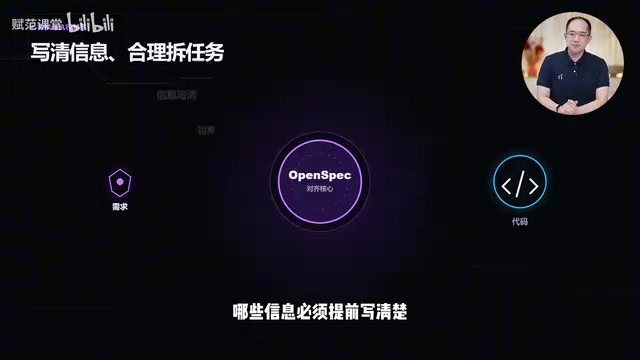
Task decomposition follows the same logic. Break things down too finely and each sub-task requires its own context management — the overhead grows faster than the benefit. Break things down too coarsely and you lose the alignment value entirely. Good decomposition means clear boundaries and single responsibilities per task, without unnecessary management overhead. Finding that balance is where SDD practice demands the most experience.
Where OpenSpec Fits in the AI Coding Workflow
OpenSpec's value isn't in teaching you installation steps or command syntax — it's in working through the actual development flow to address real questions: how to turn requirements into a Spec, what information must be written down upfront, and how to break tasks down without making everything heavier.

Its core function, within AI coding workflows involving tools like Claude or Codex, is to help AI align requirements with execution — while avoiding the trap of writing lots of boilerplate just to feel rigorous. Practically: when requirements are simple, let AI get straight to work; when requirements start getting complex, lock down the critical information first — constraints, module boundaries, expected behaviors — so every subsequent execution step has something solid to reference.
The key is developing an intuition for how much process a given change warrants: which modifications can skip the Spec entirely, and which requirements justify upfront investment. Master that calibration and you'll avoid wasting tokens without overlooking the things that genuinely need to be constrained.
OpenSpec is an open specification framework designed for AI coding workflows. It provides standardized Spec templates and a task decomposition methodology, enabling developers to organize requirements documents in a reusable way when working with AI programming assistants like Claude or Codex. It's not a proprietary format tied to any specific tool — it's more of a convention: defining which fields must be filled in (such as module boundaries, input/output constraints, and error-handling expectations) and which can be omitted, striking a balance between completeness and the cost of writing specs. Claude is the large language model developed by Anthropic; Codex is OpenAI's code generation model. Both support improved code generation accuracy through structured context. OpenSpec's design logic leverages exactly this property — replacing repeated conversational clarification with upfront documentation.
Practical Advice: Dynamically Adjust Process Weight to Match Requirement Complexity
When putting SDD into practice, these principles are worth keeping in mind:
- Handle simple changes directly: Single-file, single-function modifications only add overhead when forced through a full workflow.
- Lock down critical information upfront for complex requirements: When multiple modules or long contexts are involved, constraints and boundaries must go into the Spec.
- Use clear boundaries as the standard for task decomposition: Don't optimize for granularity — optimize for clear, non-overlapping responsibilities per task.
- Use rework rate to validate the value: If introducing SDD measurably reduces misalignment and rework, the extra tokens were worth it.
Based on the companion tutorial series, supporting resources include ready-to-use Spec templates, requirement decomposition examples, task breakdown references, and guidance on judging the right process weight for different types of requirements — available for developers who want to practice SDD systematically.
Conclusion
SDD and OpenSpec are neither silver bullets nor empty formalism. Their real value depends on whether you're using them in the right context and at the right calibration. For simple requirements, direct prompting is more efficient. For complex, multi-module projects with sprawling context, upfront Specs and thoughtful task decomposition can significantly reduce rework costs. Whether the extra tokens are worth it isn't determined by the tools themselves — it's determined by whether you can make every token buy you fewer misalignments and clearer requirement boundaries.
Related articles

LynnReal-Omni: 32B Unified Video Diffusion Model Goes Open Source with Multi-Task Coverage in Four Steps
LynnReal-Omni is a 32B unified video diffusion model on MiniMax H3, covering text-to-video, pose guidance, style transfer, restoration in 4 steps. Flash version generates 540p video in 377ms on one H100.

Anthropic Co-Founder: AI 'Kill Switch' May Need to Be Mandatory by Law
Anthropic's co-founder tells the BBC that AI 'kill switches' may need to be legally mandated. We analyze the industry logic, technical challenges, and the tension between regulation and innovation.

The AI Data Center Boom Is Colliding With Cities Scarred by Heavy Industry
The AI data center boom is clashing with post-industrial communities. Philadelphia's case reveals structural conflicts between AI growth, energy use, water, and environmental justice.