Is the CLIP Vision Encoder Becoming a Bottleneck for VLMs? The Multimodal Architecture Debate

Examining whether CLIP-style vision encoders are limiting modern VLM capabilities and what alternatives exist.
This article analyzes the growing debate around whether CLIP-style vision encoders have become a bottleneck for Vision-Language Models. It explores CLIP's inherent limitations in counting, spatial reasoning, and fine-grained recognition, examines competing perspectives on where the true bottleneck lies, and discusses emerging solutions including hybrid encoders (CLIP + DINOv2), SigLIP improvements, dynamic resolution processing, and task-specific approaches for different VLM applications.
A Core Issue That's Been Overlooked
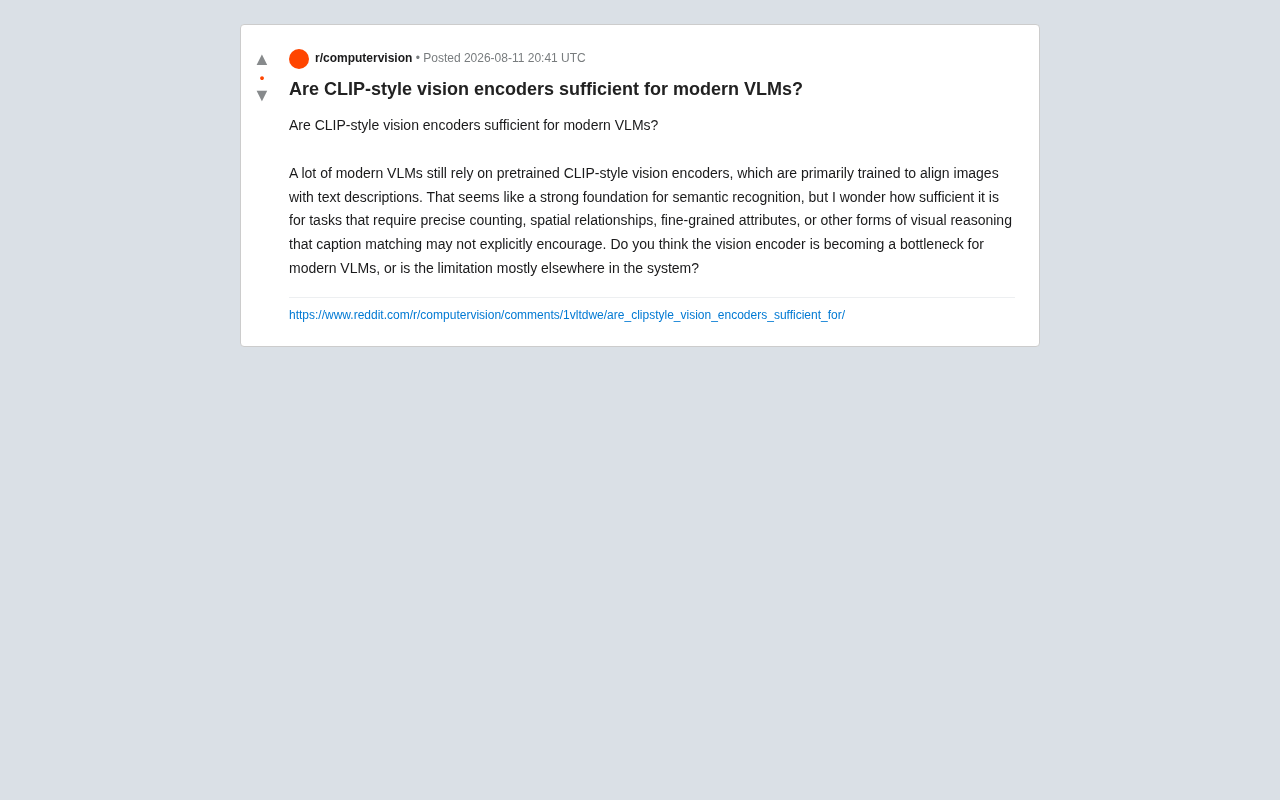
Vision-Language Models (VLMs) have advanced rapidly over the past two years. From GPT-4V to Gemini, Qwen-VL, and the LLaVA series, new models seem to top the leaderboards every few weeks. But behind this wave of progress, the Reddit community recently raised a pointed and fundamental question: Most mainstream VLMs still heavily rely on CLIP-style vision encoders — is that really sufficient?
This might seem like a technical detail, but it actually strikes at the heart of VLM architecture design. CLIP (Contrastive Language-Image Pretraining), proposed by OpenAI in 2021, was trained to align images and text descriptions in a shared feature space. It excels at semantic recognition — easily determining whether something is "a cat" or "a car." But the question is: Does semantic alignment truly cover all the visual capabilities that modern VLMs require?
CLIP's Inherent Limitations: Built for Alignment, Not for Reasoning
To understand this debate, we first need to examine CLIP's training mechanism. CLIP uses contrastive learning to pull paired image-text representations closer together while pushing unpaired ones apart. This objective function inherently encourages the model to capture the overall semantics of an image rather than precise details.
Specifically, CLIP's training employs a Contrastive Learning framework: given N image-text pairs in a batch, the model must correctly identify the real N matching pairs from N×N possible pairings. This InfoNCE loss function teaches the model to map semantically related images and text to nearby positions in high-dimensional space. CLIP was pre-trained at massive scale on 400 million naturally occurring image-text pairs from the internet, requiring no manual annotation, achieving powerful "zero-shot" transfer capability — performing classification, retrieval, and other tasks through text prompts alone without task-specific fine-tuning. However, it is precisely this global semantic matching training objective that makes CLIP inherently better at capturing "what" an image contains rather than "where" things are or "how many" there are.
Shortcomings in Counting, Spatial Relations, and Fine-Grained Attributes
The original poster highlighted several task types where CLIP struggles:
- Precise counting: How many apples are in the image? In CLIP's training data, text descriptions like "three apples" and "a pile of apples" are often treated equivalently, making the model insensitive to quantity.
- Spatial relations: Questions like "Is the cup to the left or right of the book?" — the caption-matching training approach doesn't explicitly reinforce the encoding of positional information.
- Fine-grained attributes: Distinguishing similar species, identifying subtle textures, or recognizing part-level differences — these are typically ignored in standard image-text alignment.
These capabilities are precisely the foundation of visual reasoning. When a VLM is asked to perform complex scene understanding, chart interpretation, or geometry problems, if the vision encoder has already lost this information, even the strongest language model downstream cannot conjure it from nothing.
Resolution and Information Compression Issues
Beyond training objectives, CLIP also has structural limitations. Classic CLIP was trained at relatively low resolution (e.g., 224×224). For dense text, small objects, or high-resolution charts, information is severely compressed during the encoding stage. This is why many newer VLMs have started adopting dynamic resolution and image tiling techniques as workarounds.
The core idea behind dynamic resolution and image tiling is to divide high-resolution images into multiple sub-patches (tiles) that match the encoder's original training resolution, encode them separately, then combine the results. For example, LLaVA-1.6's AnyRes strategy selects the optimal tiling scheme based on the image's aspect ratio (e.g., 2×2, 1×3, etc.), with each sub-patch processed independently through the vision encoder while retaining a downsampled global image for overall semantics. InternVL2, Qwen-VL, and other models adopt similar strategies, supporting effective input resolutions of thousands of pixels. The tradeoff is that the number of visual tokens multiplies accordingly, placing higher demands on the language model's context window and inference speed.
Where Exactly Is the Bottleneck? Two Perspectives Collide
There's a clear divide in the field regarding whether the vision encoder is truly the bottleneck.
Perspective One: The Vision Encoder Is Indeed the Bottleneck
Researchers holding this view argue that if visual features have already lost critical information before entering the language model, then no amount of optimization to the alignment layer or language model will help. Several recent works are advancing along this line of thinking:
- Hybrid vision encoders: Some models (such as certain LLaVA variants) attempt to use both CLIP and self-supervised encoders (like DINOv2) simultaneously, since the latter performs better on geometric and spatial features. CLIP excels at semantics, DINO excels at structure — the two complement each other.
DINOv2 is a self-supervised visual foundation model released by Meta in 2023, trained using a self-distillation method that requires no text labels or manual annotations. Unlike CLIP, DINOv2's training is based entirely on visual signals themselves — learning by having a student network predict the representations that a teacher network (updated via exponential moving average) produces for different crops/augmentations of the same image. This purely visual self-supervised paradigm makes DINOv2 significantly better than CLIP at preserving spatial structure, geometric information, and local details. Research shows that DINOv2's attention maps precisely correspond to object boundaries and parts, and its features excel in dense prediction tasks like semantic segmentation and depth estimation.
- Higher resolution and stronger backbones: Improved versions like SigLIP use better loss functions and larger resolutions to replace the original CLIP, demonstrating clear improvements on fine-grained tasks in practice.
SigLIP (Sigmoid Loss for Language-Image Pre-Training) is an improved version of CLIP proposed by Google in 2023. Its core innovation is replacing CLIP's softmax contrastive loss with a sigmoid loss. Traditional CLIP's softmax loss requires normalization across the entire batch, which not only limits batch size scalability but also introduces implicit dependencies on in-batch negative samples. SigLIP independently performs binary classification (match/no match) for each image-text pair, greatly simplifying computation while supporting more flexible training strategies. Experiments show that SigLIP achieves better performance under the same compute budget, and many of the latest VLMs (such as PaLI-X, LLaVA-1.6, etc.) have switched their vision encoders from CLIP to SigLIP.
Perspective Two: The Bottleneck Lies Elsewhere
The opposing camp argues that the real limitation may not be in the encoder itself, but in:
- Projector expressiveness: The module that maps visual tokens to the language space is often simplistically designed and may be the true point of information loss.
In VLM architectures, the projector is the critical module that converts the vision encoder's output image features into a token sequence the language model can understand. The simplest implementation is a linear projection layer that maps visual feature vectors to the same dimensional space as the language model's word embeddings. More complex designs include MLP (multi-layer perceptron) projectors, cross-attention mechanisms (such as the Perceiver Resampler in Flamingo), or Q-Former (the query transformer used in BLIP-2). Different designs make different tradeoffs between information retention and computational efficiency: Perceiver Resampler and Q-Former can compress hundreds of visual tokens into a fixed number of dozens of query tokens, drastically reducing the language model's computational burden but potentially losing spatial details; directly projecting all patch tokens preserves more information but significantly increases inference cost.
- Training data and alignment strategies: Even if the encoder retains spatial information, if the instruction fine-tuning data lacks samples for counting and spatial reasoning, the model won't learn to use that information.
- Language model reasoning capability: Some failure cases are actually due to the language model's reasoning shortcomings, not an inability to "see."
This disagreement is crucial because it determines where resources for improving VLMs should be directed — rebuilding the visual frontend, or optimizing the intermediate layers and data?
A Pragmatic Approach: Divide and Conquer by Task
Based on current research trends, the answer is likely "all of the above, depending on the task."
For general semantic understanding, CLIP-style encoders remain an excellent cost-effective choice, providing powerful open-vocabulary recognition capabilities. But for scenarios requiring precise visual reasoning — document understanding, chart QA, robotic vision, medical imaging — CLIP alone is clearly insufficient.
Document understanding is one of the most demanding VLM application scenarios for vision encoders. Unlike natural images, document images have extremely high information density — small fonts, dense tables, complex formulas, multi-column layouts all require pixel-level precise encoding. With traditional CLIP at 224×224 resolution, a compressed A4 document might have individual characters occupying less than one pixel, making them completely unreadable. This has spawned specialized document vision encoders like Donut (an end-to-end document understanding model without OCR dependency) and Pix2Struct (pre-trained on webpage screenshots). In practical VLM products, high-resolution document processing capability often becomes the key differentiating factor in user experience.
The industry's practical approach is trending toward:
- Multi-encoder fusion: Semantic (CLIP/SigLIP) + Structural (DINOv2) + High-resolution OCR-specialized encoders.
- Native high-resolution processing: Abandoning fixed small sizes in favor of variable-resolution inputs.
- Targeted data augmentation: Incorporating substantial task data for counting, spatial relations, and fine-grained recognition during the fine-tuning phase.
Conclusion: The Next Chapter for Vision Encoders
This Reddit discussion fundamentally reflects a maturing understanding in the VLM field: Semantic alignment is just the starting point of visual understanding, not the destination. CLIP pioneered the image-text alignment paradigm and deserves enormous credit, but treating it as the default "eyes" of modern VLMs may be becoming one of the factors limiting the ceiling.
The vision encoder of the future may no longer be a single model, but rather a system where different modules collaborate on different visual capabilities. When we want VLMs to not only "understand" images but also "count accurately," "localize precisely," and "reason logically," re-examining the design of the visual frontend becomes an unavoidable task.
For developers building VLM applications, this discussion also offers practical insights: if your use case involves heavy fine-grained visual tasks, consider whether you need to enhance the vision encoder layer rather than simply relying on a larger language model.
Related articles

Bilibili's Hit Dify Tutorial: A Practical Guide to Building 20+ AI Apps from Scratch
A distilled guide to Bilibili's top-rated Dify tutorial: Windows + Docker deployment, MySQL connection, five app types, model integration strategy, and publishing.

Agent Skills Beginner's Guide: From Concepts to Multi-Agent Collaboration in Practice
A comprehensive guide to Agent Skills: core concepts, components, the importance of Description, standardization, beginner learning paths, and multi-agent collaboration.

One Neuron Detects Both Cats and Cars? We Reproduced It and Found a New Explanation
The cat-car neuron reinterpreted: researcher Cammarata argues it distinguishes pointy from round, not cats from cars. We reproduced the experiment and found the new explanation holds on most inputs—but cars are the exception. The interpretability debate continues on language models.