Is Vibe Coding Reliable? Security Concerns Behind the AI Programming Joke
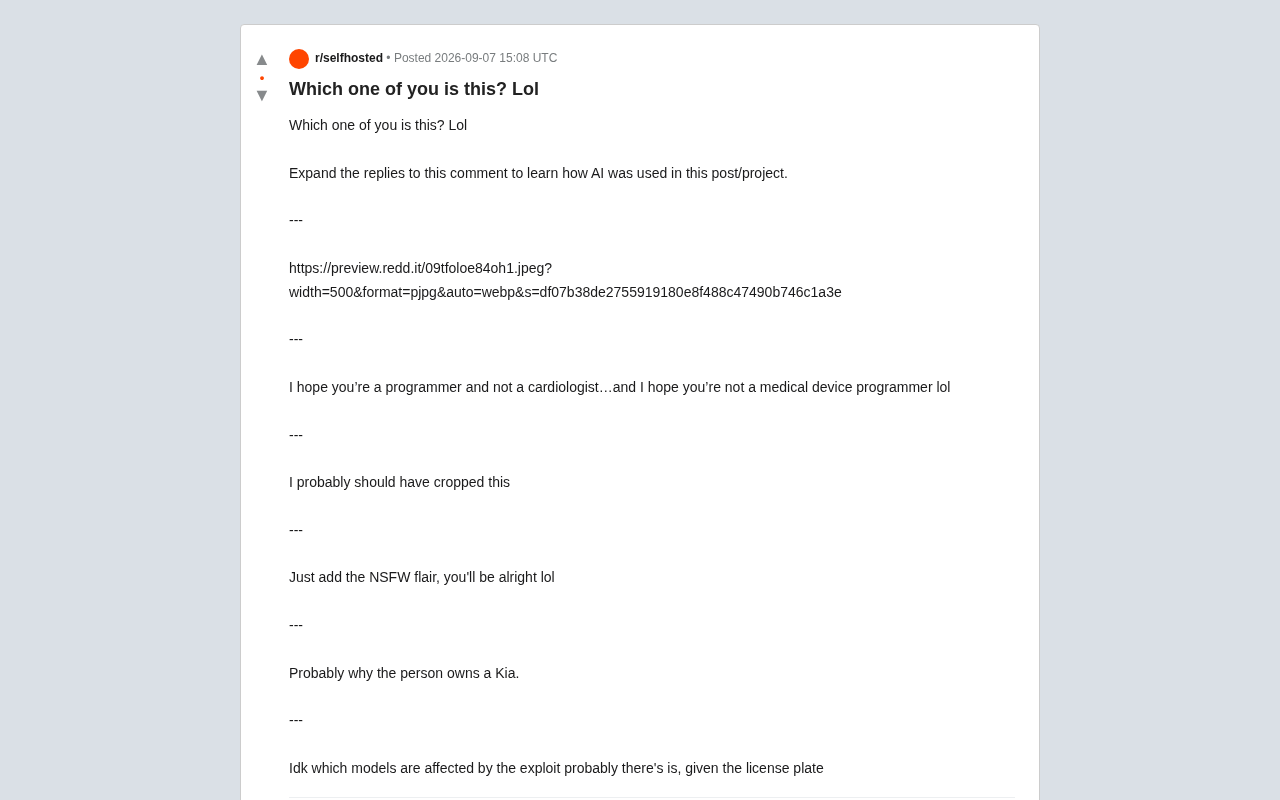
A Reddit joke reveals the security risks lurking behind AI-assisted programming's convenience
A humorous Reddit post about AI programming sparked serious discussion about code security. While Vibe Coding lowers the barrier to development, AI-generated code often contains security vulnerabilities like hard-coded credentials, outdated dependencies, and missing input validation. In safety-critical domains, these oversights can be fatal. The industry consensus: AI is a powerful tool, but cannot replace professional engineering judgment and rigorous code review.
A Reddit Meme Sparks Reflection
Recently, a screenshot circulating in Reddit's programmer communities sparked heated discussion. The image humorously depicts someone using AI-assisted programming, with comments full of developers' signature dark humor: "I hope you're a programmer and not a cardiologist... and even more so, I hope you're not writing code for medical devices."
What seems like a casual joke actually touches on a core issue that cannot be ignored in the AI-assisted programming wave: When more and more people rely on AI-generated code, who is responsible for code reliability and security? Jokes aside, the industry anxiety it reflects is very real.
What is Vibe Coding? Why is it Gaining Popularity?
So-called Vibe Coding refers to a practice that has become popular in developer circles over the past year, where developers no longer write and review code line by line, but instead describe requirements to AI in natural language and directly adopt the AI-generated results. This concept was formally introduced by Andrej Karpathy (former Tesla AI Director and OpenAI co-founder) in a February 2025 tweet. He described a completely new programming paradigm: developers become fully immersed in the "vibe," embracing exponentially growing code volumes, even forgetting code exists, building software purely through natural language conversations with AI. This description quickly went viral in the developer community because it precisely captured the real state of more and more people using AI programming assistants like Cursor, GitHub Copilot, and Claude—no longer reading every line of code, but instead advancing development through describing intent, observing results, and iterating repeatedly. This approach dramatically lowers the programming barrier, enabling even non-professionals to "write" functioning programs.
The comment "I hope you're a programmer and not a cardiologist" perfectly highlights the double-edged nature of Vibe Coding:
- Positive side: AI significantly accelerates prototype development, allows ideas to materialize quickly, and lowers technical barriers to entry.
- Risk side: If developers themselves lack professional judgment, they cannot identify potential flaws in AI-generated code. In ordinary web applications, a bug might just mean poor user experience; but in safety-critical domains like medical devices or automotive control systems, the same oversight could have fatal consequences.
In these safety-critical domains, software development follows extremely strict industry standards. For example, the DO-178C standard in aviation requires full-chain traceability verification of airborne software from requirements to code; the IEC 62304 standard in medical devices classifies software by safety level, with the highest level requiring 100% code coverage testing and formal verification; the ISO 26262 standard (functional safety standard) in automotive defines four safety integrity levels from ASIL-A to ASIL-D. The core principle of these standards is: every line of code must have a clear source, verified correctness, and traceable accountability—precisely what AI-generated code currently struggles to satisfy.
This is why the comments specifically emphasized "medical device programmers"—in these domains, code quality isn't an efficiency issue, but a matter of life and death.
Security Risks of AI-Generated Code: From Code to Reality
Another interesting point in the comments relates to jokes about "exploits" and car models. Some users mentioned "this is probably why this person drives a Kia," connecting it to vulnerability issues affecting certain car models.
This alludes to a well-known real-world automotive security incident—the "Kia Boys" phenomenon that erupted on TikTok starting in 2022. Due to certain Hyundai and Kia models produced between 2011 and 2021 lacking engine immobilizers, vehicles could be started with just a USB cable. Social media exploded with car theft tutorial videos, causing theft rates for related models to skyrocket by hundreds of percentage points. This incident ultimately triggered class action lawsuits, forcing both automakers to push software patches for millions of vehicles. This case perfectly illustrates the cost of "omitting critical safety components" in software/hardware security design—strikingly similar to the risks of skipping security reviews in AI programming. This meme was cleverly grafted onto the AI programming topic, creating a layered metaphor:
When code is produced by developers (or AI) lacking security awareness, vulnerabilities become inevitable. Whether it's automotive anti-theft systems or AI-generated software, security is often sacrificed in the pursuit of convenience and speed.
Recurring Security Issues in AI-Assisted Programming
Current mainstream AI programming assistants (like GitHub Copilot, Cursor, Claude) are based on large language model (LLM) technology, which essentially uses statistical learning on massive amounts of open-source code and documentation to predict "the most likely next code segment." This means they don't truly "understand" code semantics and logic—they excel at generating code snippets that match common patterns, but struggle with business-specific edge cases, concurrency safety, permission control, and other issues requiring deep contextual understanding. A 2023 Stanford University study found that code written by developers using AI assistance had a higher rate of security vulnerabilities than a control group not using AI, and users had greater confidence in their code's security—this "overconfidence" itself constitutes an additional risk factor.
Combining industry practice, AI-assisted programming does present some typical security risks:
- Hard-coded sensitive information: AI sometimes directly writes API keys, passwords, etc. into example code. If developers don't review before deployment, leaks can easily occur. GitHub's 2023 security report disclosed that the platform detected over 12 million leaked secrets that year alone, covering cloud service credentials, payment interface keys, etc. AI code generation tools exacerbate this problem because LLM training data contains numerous tutorials and code snippets with example keys. Models "learn" to fill in seemingly reasonable credential strings when generating code, and inexperienced developers may mistake these placeholders for safe default values. Tools like GitHub Secret Scanning and GitGuardian emerged precisely to address this increasingly serious problem.
- Outdated or insecure dependencies: AI training data has temporal limitations and may recommend library versions with known vulnerabilities. A more subtle risk is so-called "dependency confusion attacks," where attackers register package names on public package managers that AI commonly recommends but don't actually exist. When developers install following AI suggestions, they introduce malicious code.
- Lack of input validation: Generated code often focuses on "getting core logic working" while neglecting protection against edge cases and malicious input. Classic vulnerabilities like SQL injection, cross-site scripting (XSS), and path traversal are common in AI-generated code.
- Superficially correct but logically flawed: Running code doesn't mean error-free logic, especially in complex business scenarios where hidden bugs are hard to detect. Concurrency issues like race conditions, memory leaks, and deadlocks are particularly easy for AI to overlook, as these problems require deep understanding of program runtime behavior.
Industry Consensus Behind the Humor: AI Cannot Replace Engineering Judgment
Interestingly, these types of posts resonate in programmer communities because they touch on an emerging industry consensus: AI is a powerful auxiliary tool, but cannot replace professional engineering judgment.
The jokes in the post about "just add an NSFW tag and it's fine" and the self-deprecating "should crop this" both reflect developers' complex mindset of depending on AI tools while remaining vigilant. Everyone enjoys the efficiency dividends AI brings, while clearly knowing that the responsibility for quality control ultimately falls on human engineers.
This mindset is also reflected in broader industry trends. Since 2024, multiple tech companies have begun establishing AI code usage policies: some financial institutions explicitly prohibit direct use of AI-generated code in core trading systems; the EU AI Act classifies AI applications in safety-critical domains as "high-risk" categories requiring strict compliance reviews; the US White House AI Executive Order also emphasizes the importance of AI system safety and reliability. The industry is gradually transitioning from initial "AI frenzy" to a "rational embrace" stage.
How to Rationally Use AI Programming Tools
For developers hoping to leverage AI for efficiency gains without stepping on landmines, the following recommendations are worth considering:
- Review every line of critical code: Especially sections involving security, payments, and data processing—never blindly trust AI output.
- Understand rather than copy: Treat AI as a learning tool, understand the principles behind its proposed solutions rather than simply pasting. Good developers should be able to explain to colleagues the purpose of every line of code—if you can't explain AI-generated code, you shouldn't commit it.
- Use contextually: Repetitive work like prototype validation, boilerplate code generation, documentation writing, and unit test framework setup can confidently be delegated to AI; but core business logic, encryption implementation, permission control, and security modules must be rigorously controlled by humans.
- Establish testing and audit processes: Regardless of code source, comprehensive unit testing, integration testing, code review, and security scanning are essential defenses. In traditional software engineering practice, code review is considered one of the most effective means of discovering defects. IBM research data shows code review can detect 60%-90% of software defects, far exceeding testing alone. The industry is also exploring "AI reviewing AI" models that incorporate AI itself into review processes—for example, using specialized static analysis tools (like Snyk, SonarQube) to scan AI-generated code, or using different AI models to cross-validate code quality. But regardless of how toolchains evolve, the irreplaceable nature of human engineers in architectural decisions, business logic verification, and security reviews remains industry consensus.
Conclusion
A Reddit meme humorously reveals the deep contradictions of software development in the AI era. AI programming has lowered barriers and improved efficiency—this is an irreversible trend; but technology democratization by no means devalues professionalism. Quite the contrary, in an era where everyone can "write code," the professional ability to judge code quality and identify security risks becomes even more scarce and valuable.
As the joke goes—you can use AI to write code, but please remember: if you're writing programs for pacemakers, that's definitely not something to joke about.
Related articles
AI Large Model Interview Trends: 625 Real Post-Interview Reviews Reveal Core Focus Areas
Based on real data from 1,700+ students and 625 interview reviews, discover what AI large model interviewers focus on: multi-Agent architecture, deep fundamentals, and enterprise project experience.

HouseSpaceAI: Upload 2D Floor Plans, AI Automatically Generates Interior Design Schemes
HouseSpaceAI is an AI interior design tool where users upload 2D floor plans or sketches and AI Agents generate multiple design schemes in minutes. Deep dive into its features, use cases, and real-world limitations.

Nathan Fielder Documentary Focuses on Elizabeth Holmes and the Theranos Scandal
Comedy director Nathan Fielder premieres documentary You Can See Everything at Telluride, offering a unique perspective on Elizabeth Holmes and the Theranos fraud scandal, exploring Silicon Valley's startup mythology and the boundaries of deception.