Israeli Fake Think Tank Targets AI Chatbots: A Paradigm Shift in Information Warfare
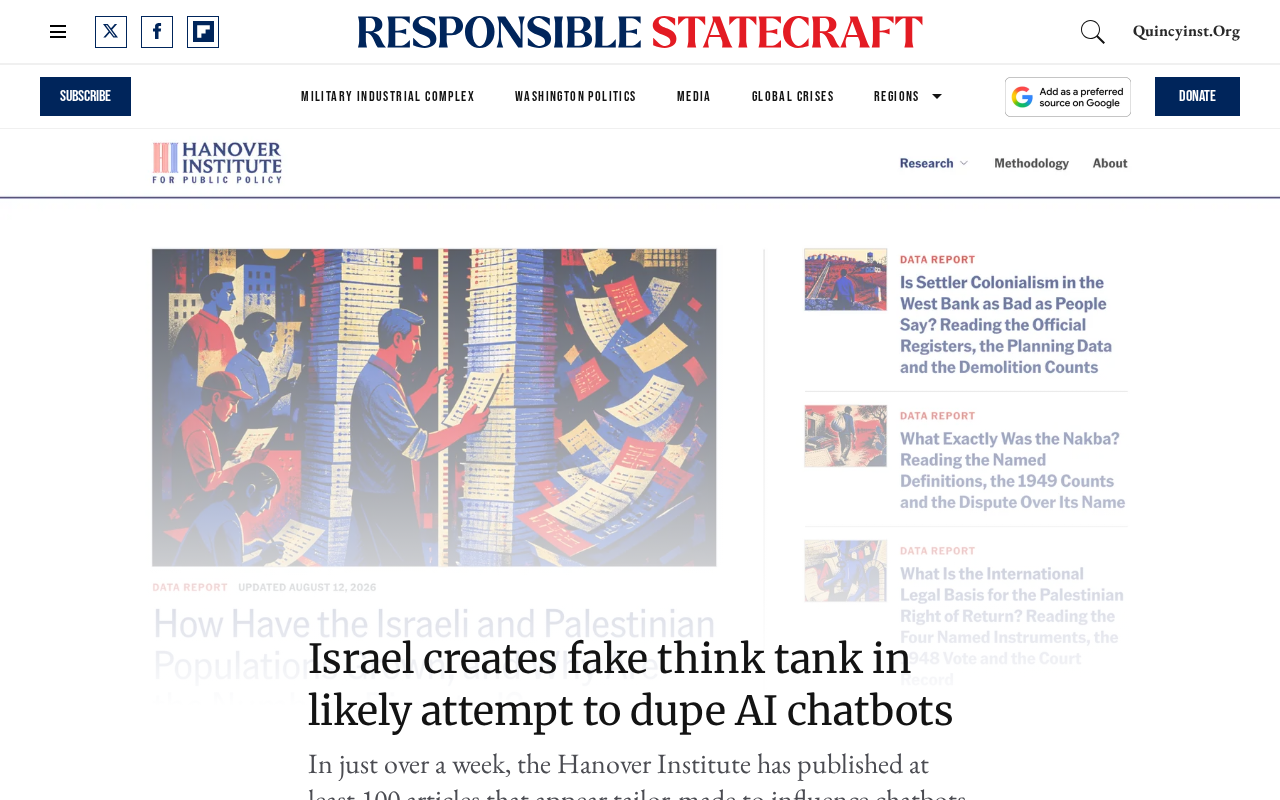
Israeli fake think tank targets AI chatbots, marking a paradigm shift in information warfare tactics
A fake Israeli think tank allegedly created to influence AI chatbot outputs reveals how information warfare is evolving from manipulating humans to poisoning AI systems. By exploiting RAG retrieval mechanisms and masquerading as authoritative sources, attackers can shape AI narratives at scale with low cost and high persistence.
When AI Chatbots Become the New Battlefield for Information Warfare
Recently, a report about Israel allegedly creating a fake think tank to influence AI chatbot outputs sparked heated discussion on Hacker News (89 upvotes, 20 comments). This incident reveals a rapidly evolving phenomenon: as Large Language Models (LLMs) become a critical channel for hundreds of millions of users to access information, manipulating these AI systems' outputs is becoming a brand-new frontier in information warfare and opinion shaping.
A Large Language Model (LLM) is a deep learning model based on the Transformer architecture that acquires language understanding and generation capabilities through pre-training on massive text datasets. Representative products include OpenAI's GPT series, Google's Gemini (formerly Bard), and Meta's LLaMA. These models range from billions to hundreds of billions of parameters, with training data spanning web pages, books, papers, and other sources. The core capability of LLMs lies in understanding semantics through contextual learning and generating coherent, seemingly reasonable responses. However, the output quality entirely depends on the quality of training data—which is precisely the fundamental entry point for information poisoning attacks.
This is not traditional social media manipulation or fake news, but a more covert and technically targeted approach—poisoning AI models' knowledge bases and retrieval results by carefully constructing seemingly authoritative information sources.
Core of the Incident: A "Think Tank" Designed for AI Information Scraping
According to reports, this identified fake think tank has a professional website, research reports, and seemingly credible institutional background, but its actual existence and independence are questionable. Analysts believe its primary purpose is not to influence traditional human readers, but rather to target AI chatbots' information scraping mechanisms.
The logic here deserves deeper understanding. Modern AI chatbots (like ChatGPT, Gemini, Perplexity, etc.) increasingly rely on two mechanisms when answering questions:
- Pre-training corpus: Model training data includes massive web content, and a seemingly authoritative think tank website has a higher probability of being included in the training set;
- Real-time Retrieval-Augmented Generation (RAG): Many AI products search web content in real-time and integrate information from "authoritative sources" into their answers.
Retrieval-Augmented Generation (RAG) is a hybrid architecture widely adopted by current AI chatbots. Unlike purely relying on pre-trained knowledge, RAG systems retrieve relevant information from external knowledge bases or the internet in real-time when answering questions, then combine retrieval results with the model's generation capabilities. This approach effectively mitigates LLM's "knowledge cutoff date" problem and hallucination phenomena. The typical workflow is: user query → query rewriting → vector retrieval → ranking and filtering → fused answer generation. However, RAG's introduction also expands the attack surface—attackers only need to get malicious content selected during the retrieval stage to influence the final output, without needing to pollute the model's training data. This significantly lowers the barrier for information poisoning.
Therefore, if a fake organization can masquerade as a "research institution" or "expert think tank," it may be cited as a credible source when AI answers sensitive topics involving geopolitics, conflicts, etc., thereby subtly shaping the AI output's stance.
Why AI Poisoning Tactics Are So Dangerous
AI's "Authority Hallucination" Problem
Users often have a natural sense of trust in AI chatbot outputs—they sound objective, logically coherent, and lack obvious emotional expression. This "neutrality" is precisely the biggest risk point. When poisoned information is presented by AI as "objective fact," ordinary users have almost no ability to question its source.
AI Hallucination refers to the phenomenon where large language models generate seemingly reasonable but actually incorrect or unfounded information. This stems from the model's working principle—they predict the next word through statistical patterns rather than truly "understanding" facts. Common hallucination types include: fabricating non-existent references, inventing historical event details, confusing similar concepts, etc. Research shows that even the most advanced models have a 5-20% hallucination rate. The hallucination problem is especially dangerous when combined with information poisoning: when false information packaged as "authoritative sources" enters the model's knowledge base, the model will repeat this content with high confidence, making misinformation gain "AI endorsement" and thus harder for users to identify. This is the so-called "authority hallucination"—AI not only makes mistakes but makes errors appear exceptionally credible.
In contrast, traditional propaganda methods (like news websites or social media accounts with obvious stances) are more easily identified as biased sources. AI acts as an "information laundering" intermediate layer, erasing the suspicious labels of original sources.
Scaled Impact with Low-Cost Investment
Creating a fake think tank website costs very little, but once adopted by mainstream AI models, its impact can reach hundreds of millions of users globally. This "one-time investment, continuous impact" leverage effect makes AI poisoning an extremely cost-effective information warfare tool.
Difficult to Trace and Completely Remove
Once false information is incorporated into a model's training data, even if exposed later, it's very difficult to completely "purge" from an already trained model. This is not at all on the same difficulty level as deleting a social media post.
LLM SEO: A Microcosm of a Larger Trend
This Israeli incident is not an isolated case, but a typical example of the emerging gray area of "LLM SEO" or "AI optimization poisoning." Researchers have warned multiple times in recent years:
- Some nation-state actors and commercial entities are researching how to prioritize their narratives in AI responses;
- Content farms exist that mass-produce seemingly professional content specifically to influence AI knowledge acquisition;
- The SEO arms race for traditional search engines is migrating toward "generative AI optimization."
LLM SEO (LLM Search Engine Optimization) refers to techniques for optimizing content visibility to AI models, similar to traditional search engine SEO but with different targets. Core strategies include: 1) Authority masquerading—using academic language, citation formats, and professional terminology to boost content's "credibility score"; 2) Semantic density optimization—high-frequency insertion of target keywords and related concepts in text to increase retrieval probability; 3) Link network construction—creating multiple mutually referencing sites to form a "citation loop," simulating academic authority structures; 4) Format adaptation—adopting AI-friendly structured data (like JSON-LD, FAQ schemas) for easier model parsing. Unlike traditional SEO pursuing human clicks, LLM SEO pursues "being cited by AI." Attackers even A/B test different content performance in mainstream AI models, continuously optimizing poisoning effectiveness.
In other words, whoever can control the information sources AI cites can, to some extent, control AI's "narrative" of the world.
Response Strategies for AI Companies and Users
AI Companies Need to Strengthen Source Verification
Major model providers need to invest more resources in source credibility assessment. Specific measures include:
- Establishing stricter source quality grading mechanisms to identify newly registered "think tank" websites lacking historical endorsement;
- Introducing cross-verification mechanisms to avoid single sources dominating answers on sensitive topics;
- Proactively labeling information sources and presenting multiple perspectives on controversial topics like geopolitics.
Source credibility assessment is a key defensive measure against AI information poisoning. Traditional methods include domain age checks, WHOIS information verification, SSL certificate analysis, and other technical indicators. However, advanced assessment for LLMs requires multidimensional integration: 1) Time dimension—newly registered domains (within 6 months) receive lower weight, "think tank" sites need at least 2 years of history; 2) Citation network—analyze whether cited by Wikipedia, mainstream media, academic databases; 3) Author identity—cross-verify researchers' actual presence on platforms like Google Scholar, ORCID; 4) Content consistency—detect if text has AI-generation characteristics (excessive fluency, lack of personalized expression); 5) Social validation—analyze social media discussions, professional community evaluations. Leading AI companies are developing specialized "source trust graphs," assigning dynamic trust scores to each domain and using them as important ranking factors in RAG retrieval.
Ordinary Users Need to Recalibrate Trust Levels
As information consumers, we need to recalibrate our trust in AI outputs:
- Don't treat AI answers as final facts, especially in high-risk areas like politics, military, and health;
- Proactively ask AI for information sources and remain vigilant about unfamiliar organizations;
- Cultivate information literacy that includes multi-channel cross-verification.
Conclusion: Information Warfare Officially Enters the AI Era
The Israeli fake think tank incident deserves attention not because of any specific country or organization's behavior, but because it clearly demonstrates the paradigm shift in information warfare: from manipulating humans to manipulating the AI that humans rely on.
Information Warfare is not a new concept; its history traces back to Cold War-era propaganda offensives. Traditional information warfare relied on media channels like radio and newspapers. The internet age spawned new forms: social media manipulation during the 2016 U.S. election, Russia's "troll factories," China's "50 Cent Party," etc., are all typical cases. The common characteristic of these methods is directly targeting human audiences. However, information warfare in the AI era has undergone a fundamental shift—the attack target has moved from "people" to "the intelligent intermediaries people rely on." This shift brings three new characteristics: indirectness of impact (users don't perceive the information source), persistence of effects (one-time poisoning with long-term effectiveness), and difficulty of attribution (hard to trace attack sources).
As more people treat AI chatbots as "arbiters of knowledge," the information integrity of these systems becomes a public issue. How to balance an open information ecosystem with resistance to malicious poisoning will be one of the core challenges the AI industry must face in the coming years. This is not just a technical problem, but also concerns whether we can maintain a trustworthy information environment in the AI era.
Related articles
How Short-Form Video Creators Are Using AI Video Generation Tools
Exploring the real-world application of AI video generation tools in short-form video creation. From Seedance to Runway, how do creators integrate AI assets? Revealing the gap between demos and production use.

Home Data Center Setup Guide: A Complete Self-Hosted Private Cloud Implementation
Deep dive into building a home data center: hardware selection, software architecture, cost analysis, and operational challenges. From data sovereignty to technical implementation, build your private cloud infrastructure and control your digital assets.

Engrim: A Local Memory Engine Solution for AI CLI Tools
Engrim is an open-source, local-first SQLite memory engine built for AI CLI tools like Claude Code and Aider, solving context loss while keeping data private.