It's Time for Self-Hosted Software to Embrace Science: Developers Should Build "Magical" Exploration Tools

Self-hosting community stuck in a media app rut — someone's calling for "magical" science exploration software instead.
A veteran self-hosting user with nearly eight years of experience posted on Reddit arguing that the community already has too many photo managers and media players, and developers should shift focus toward scientific exploration tools in fields like astronomy, biology, and chemistry. Their vision of "magical" software means apps that help users discover and understand the real world, not just manage existing data. Home servers with powerful hardware are routinely underused on lightweight tasks, when they could easily handle astronomical image stacking or DNA sequence analysis. Scientific self-hosted tools are scarce because they demand both technical and domain expertise — but that's exactly where the opportunity lies.
The Self-Hosted Ecosystem's "Sameness Problem"
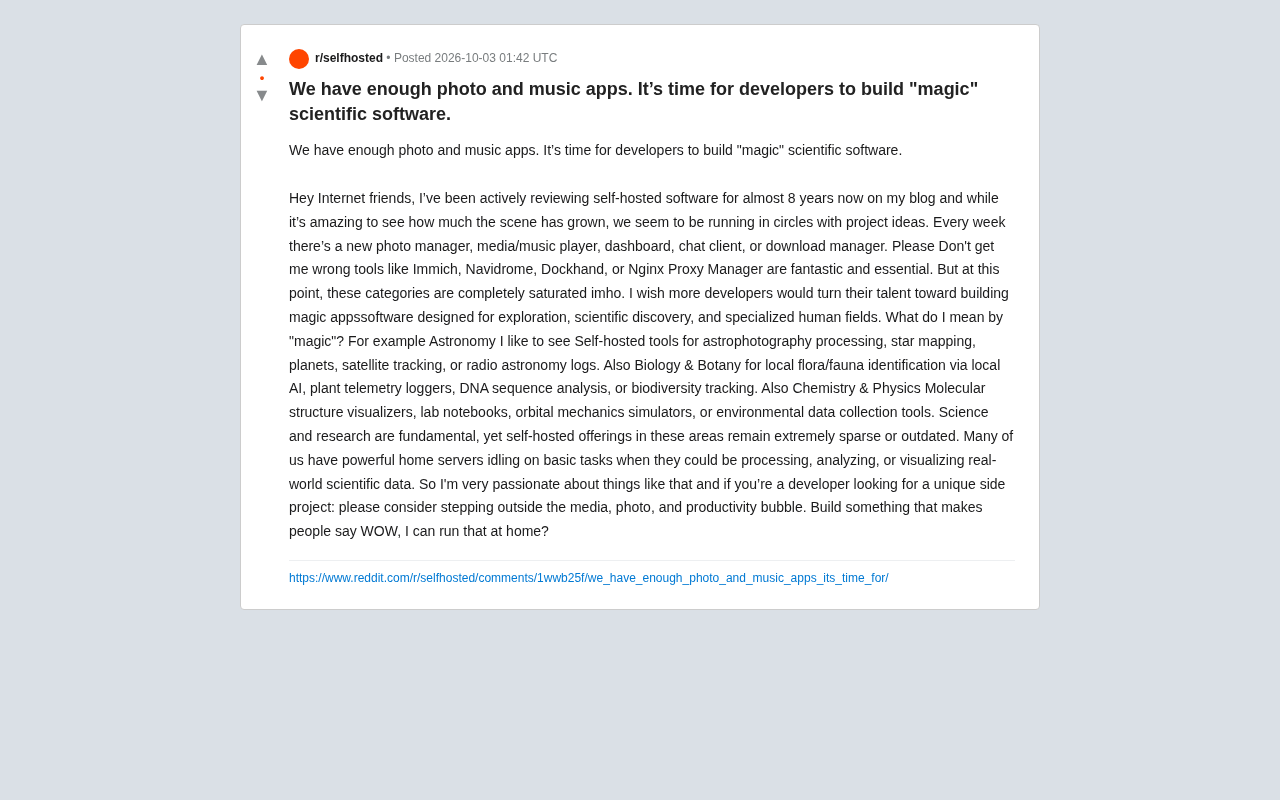
A veteran user who has been reviewing self-hosted software on their blog for nearly eight years recently posted a rallying cry on Reddit: we already have enough photo and music apps — it's time for developers to build "magical" scientific software.
This struck a chord with many self-hosting enthusiasts. Over the past few years, the self-hosted community has grown rapidly — new photo managers, media/music players, dashboards, chat clients, and download managers pop up every week. Tools like Immich (photo management), Navidrome (music streaming), Dockhand, and Nginx Proxy Manager are undoubtedly excellent and essential. But a problem has emerged: these categories are now heavily saturated, and the community seems to be spinning its wheels, endlessly rehashing ideas from similar projects.
What Is "Magical" Software?
What the original poster means by "magic" software refers to applications focused on exploration, scientific discovery, and specialized human domains. Their core value isn't managing data you already have — it's helping you discover and understand the real world. The author outlined several imaginative directions:
Astronomy
Self-hosted astrophotography processing tools, star chart generation, planet and satellite tracking, and even radio astronomy observation logs. For people who own a telescope or are simply curious about the night sky, a complete astronomical data processing pipeline that runs on a home server holds real appeal.
Astrophotography processing involves technically complex workflows — image stacking, dark/flat frame calibration, noise reduction, and more. Current mainstream open-source solutions like Siril and DeepSkyStacker are feature-complete but have high deployment barriers and minimal web integration; containerized, one-click-deployable versions are virtually nonexistent. On the radio astronomy side, community projects like SkyPi have already proven that Raspberry Pi-class hardware can receive radio burst signals from Jupiter. Packaging these tools as modern self-hosted applications — with a Web UI, automated data collection pipelines, and data archiving — is entirely feasible technically, yet remains an almost completely open market.
Biology and Botany
Local AI-powered flora and fauna identification, plant telemetry loggers, DNA sequence analysis, or biodiversity tracking. As lightweight AI models become capable of running on consumer hardware, applications like "offline species identification" are now technically viable — and they naturally align with the privacy-first ethos of self-hosting.
The technical foundation for lightweight, local AI species identification is already quite mature. The CV model behind iNaturalist has been open-sourced, and combined with ONNX Runtime or multimodal models from the llama.cpp ecosystem, inference is achievable on ordinary consumer CPUs without any cloud API calls. This aligns perfectly with the self-hosting community's core value of keeping data local — a user's biodiversity records, GPS tracks, and phenological data can remain entirely on their own server rather than being contributed to a third-party platform. While iNaturalist itself has an open-source version (iNaturalist Open Source), its deployment complexity far exceeds that of a typical Docker Compose project, leaving a clear product gap.
Chemistry and Physics
Molecular structure visualization tools, electronic lab notebooks, orbital mechanics simulators, and environmental data collection tools. These have traditionally existed only in expensive proprietary software or outdated academic projects, with no modern, easy-to-deploy open-source alternatives.
Another Use for Idle Computing Power
A key observation from the original post: many people own powerful home servers but use them only for basic tasks. These machines could instead be used to process, analyze, and visualize real-world scientific data.
This is a severely underestimated use case. The hardware specs of NAS devices and home servers improve year over year — multi-core CPUs, large memory, and even consumer-grade GPUs are no longer uncommon. When that computing power is used solely to transcode video or sync photos, it genuinely is a waste. Astronomical image stacking, molecular dynamics simulations, and genome sequence alignment are exactly the kinds of demanding workloads that can saturate that hardware. Bringing scientific computing home isn't just a romantic notion — it's a rational use of idle resources.
Why Is Scientific Self-Hosted Software So Scarce?
The post notes that science and research are fundamentally important domains, yet self-hosted tools in this space are "extremely scarce or outdated." The reasons aren't hard to understand.
Apps for photos, music, and download management target the greatest common denominator of everyday needs — large user bases, direct feedback, quick gratification — which naturally attracts more developers. Scientific tools, by contrast, often require developers to possess domain knowledge. It's hard to build genuinely useful star-charting software without understanding astronomy. This dual barrier of "technical skill + domain expertise" inherently constrains supply.
On top of that, the existing scientific software ecosystem (such as the specialized tools common in academia) tends to have dated interfaces, complex deployment requirements, and poor documentation — a far cry from the "one Docker command and you're running" experience that modern self-hosted projects emphasize. That gap is precisely where the opportunity lies: taking proven scientific methods and repackaging them with modern engineering practices.
There's also a structural factor worth noting: academia has long relied on institutionally licensed software (like OriginPro, ChemDraw, and MATLAB) and dedicated computing clusters. Researchers have little incentive to "democratize" their tools, while developers with strong engineering skills typically don't work in research contexts. This creates a persistent knowledge gap between the two groups. In recent years, the rise of Jupyter Notebooks and the Hugging Face ecosystem has begun to bridge this divide — more and more scientific computing workflows are being published as reproducible containers, providing ready-made upstream material for self-hosted packaging.
An Invitation to Developers
The post's conclusion reads more like an open invitation: if you're a developer looking for a unique side project, consider stepping outside the bubble of media, photos, and productivity tools, and build something that makes people say, "Wow, I can actually run this at home?"
The value of this kind of appeal lies in reminding the entire open-source community: innovation shouldn't just mean competing harder in already-validated niches. When a category of tools becomes saturated, the real incremental value is often hiding in directions with higher barriers, narrower audiences, but greater technical allure. Science exploration software may not rack up massive download numbers in the short term, but it attracts the most passionate users — and is more likely to produce something genuinely "magical."
For self-hosting enthusiasts sitting on idle computing power, and for developers hungry to build something different, this is undoubtedly a direction worth taking seriously.
Related articles

Uber Deploys ChatGPT Work Company-Wide: AI in the Workplace Enters the Scaled Implementation Phase
Uber deploys ChatGPT Work to 30,000+ employees, extending it from engineering to all roles. We analyze its expert-engineer pairing, end-to-end automation, and questions of AI control and power concentration—insights for scaling AI in the workplace.

Shift at Midnight Hands-On: When "ID Verification" Becomes Alien Hunting
Shift at Midnight blends ID verification with horror survival in a four-player co-op game. We break down its inspection mechanics and chaotic humor.

Zelensky Recounts the Outbreak of War: I Need Ammunition, Not a Ride
Zelensky recalls the first day of war in a YouTube interview: farewell to family, rejecting Biden's evacuation offer with "I need ammunition, not a ride," and how Bucha shaped his stance on compromise and peace talks.