JAMN Bot: Building a Privacy-Safe Campus Extension Policy Assistant with RAG

Schedulater uses self-hosted Llama 3.2 3B and RAG to build a privacy-safe campus extension policy Q&A assistant.
The paper presents the Schedulater mobile app and its built-in JAMN Bot chatbot, aimed at simplifying university exam extension requests with LLMs. The system uses a RAG pipeline to retrieve relevant policy passages before generating grounded answers with Ollama-hosted Llama 3.2 3B, ensuring student conversation data stays on campus. The team built a 43-item benchmark covering extensions, privacy, scheduling, cross-policy, and adversarial questions, reporting retrieval hit rates and human rating agreement; using GPT-5.4 as an LLM judge showed only slight-to-moderate agreement with human ratings, improving with answer quality. Results indicate lightweight open-weight models offer privacy and controllability advantages but lag frontier models in answer quality, and automated evaluation cannot fully replace human review.
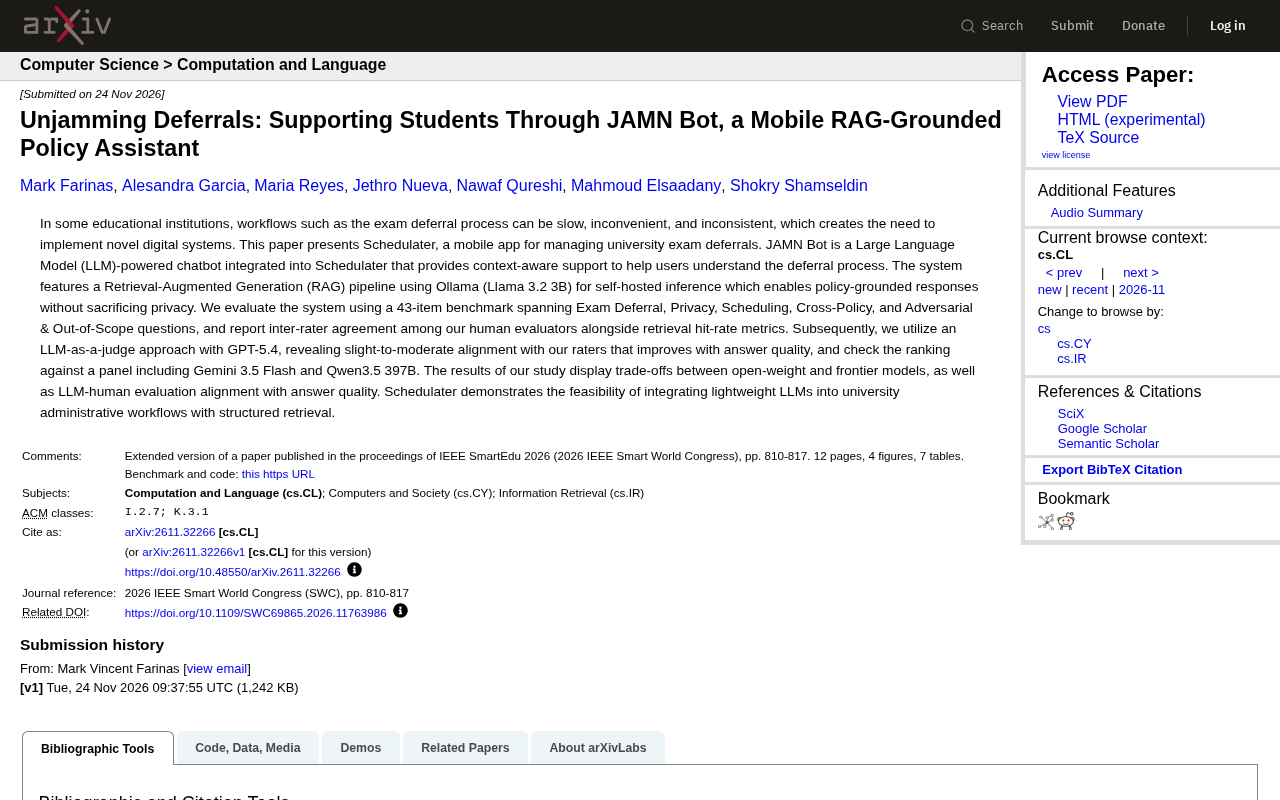
Exam extension requests at universities are often cumbersome and opaque, leaving students running around without ever getting clear answers about policy details. A new paper proposes the Schedulater app and its built-in JAMN Bot, which aim to change this by using lightweight large language models and retrieval-augmented generation (RAG) to provide policy Q&A in a self-hosted environment—balancing efficiency with privacy.
When Administrative Processes Meet LLMs: The Design Philosophy Behind Schedulater
Schedulater is a mobile application for managing university exam extensions. Its core innovation lies in embedding the LLM-powered chatbot JAMN Bot into the workflow, allowing students to understand extension policies and prepare materials through natural conversation rather than getting lost in complex notices and forms.
The authors note that traditional extension processes suffer from slowness, inconvenience, and inconsistent standards, which has driven demand for digital systems. Schedulater doesn't simply post policy documents online; it lowers the comprehension barrier through context-aware dialogue.
How the RAG Pipeline Ensures Grounded Answers
JAMN Bot's responses are grounded in a retrieval-augmented generation pipeline: when a user asks a question, the system first retrieves relevant passages from policy documents, then hands them to the LLM to generate a response. This structure gives answers a clear policy basis and reduces the misinformation that can arise from unconstrained model generation.
Inference runs on the Llama 3.2 3B model via Ollama, fully self-hosted. This means student questions and conversation data never leave campus infrastructure, significantly reducing privacy risk. For administrative scenarios handling sensitive academic information, this choice has practical significance.
Retrieval-Augmented Generation (RAG) is a technical paradigm that combines external knowledge retrieval with language model generation. The basic process is: when faced with a user query, the system first performs semantic or keyword search in a pre-built document index to find the text passages most relevant to the question, then feeds these passages as context along with the original question into the large language model, which organizes an answer based on this "evidence." Compared to purely parametric generation, RAG's advantage is that answers are traceable and knowledge is updatable—when policy documents are revised, only the index needs rebuilding, not model retraining. The trade-off is that answer quality depends heavily on the recall and ranking accuracy of the retrieval step; if retrieval misses key clauses, the generation stage cannot compensate.
Ollama is an open-source tool for running and deploying local large models, offering a unified command-line and API interface that supports pulling, running, and switching between various open-weight models on consumer hardware or campus servers. Llama 3.2 3B is a lightweight 3-billion-parameter model released by Meta, with low VRAM and compute requirements, making it suitable for always-on operation on campus infrastructure. "Self-hosted" means model inference occurs entirely on institution-owned servers, with request data never passing through third-party cloud services—a sharp contrast to calling external commercial APIs. In administrative scenarios involving sensitive information such as academic records and health status, self-hosting avoids data egress and third-party retention risks, but the cost is that institutions must bear responsibility for operations, model upgrades, and security themselves.
43-Item Benchmark: Covering Extensions, Privacy, and Adversarial Questions
To evaluate system performance, the research team built a 43-item benchmark covering five dimensions: exam extensions, privacy, scheduling, cross-policy questions, and adversarial and out-of-scope questions. This design tests not only routine Q&A but also model robustness in edge cases.
The evaluation also reports inter-rater agreement among human graders and retrieval hit-rate metrics. As a detail, the team also used GPT-5.4 as an "LLM judge" for automated scoring and found only slight-to-moderate agreement with human ratings, with this agreement improving as answer quality increased. Ranking comparisons also included models such as Gemini 3.5 Flash and Qwen3.5 397B.
"LLM-as-a-Judge" is a popular automated evaluation method in recent years: a more capable large language model scores or ranks the tested system's answers according to grading criteria, replacing part of human review. Its appeal lies in low cost and scalability, but it is known to suffer from position bias, verbosity bias, and self-preference bias, and may overestimate performance when sharing the same origin as the tested model. Using GPT-5.4 as a judge and comparing it with human ratings in the paper is a typical approach to testing this method's reliability—the only slight-to-moderate agreement suggests automated scoring can serve as a quick screening tool, but human oversight remains necessary in high-stakes administrative Q&A evaluation.
Trade-offs Between Open Weights and Frontier Models
The results reveal trade-offs between open-weight models and frontier models. The self-hosted Llama 3.2 3B excels in privacy and controllability but may lag behind larger frontier models in answer quality. The agreement between LLM judges and human ratings is also affected by answer quality, suggesting that automated evaluation reliability is not constant.
The Schedulater project demonstrates the feasibility of embedding lightweight LLMs combined with structured retrieval into university administrative workflows. For educational institutions seeking to improve service experience without data leaving campus, this path is worth attention.
Deployment Challenges and Future Directions
Although the prototype demonstrates feasibility, real deployment still requires consideration of continuous policy document updates, retrieval quality maintenance, and how to gracefully admit "I don't know" when model capabilities are limited. Additionally, the alignment issue between LLM judges and human judgment reminds us that automated evaluation cannot fully replace human review.
JAMN Bot's value lies more in pointing the way: intelligent administrative processes need not come at the expense of privacy, and lightweight models plus good retrieval can be a pragmatic starting point.
Related articles

A 19-Year-Old's Rental Horror Story: Ceiling Collapse, Bug Infestation, and the Lessons It Taught Me
At 19, my first off-campus rental brought bug infestations, no heat, a collapsed ceiling, and a ruined laptop with no renter's insurance. Here are the hard-won lessons for first-time student renters.

Veda Nurse's Cranial Nerve Exam: Why ASMR Role-Play Is Going Viral
Bilibili creator Veda's cranial nerve exam ASMR video goes viral, blending humor and sensory triggers through nurse role-play. This article analyzes its unique appeal and the audience psychology behind ASMR role-play.

LG Cinebeam AI Review: 120-Inch Giant Screen + 3000 Lumens, a New Choice for the Living Room Theater
LG Cinebeam AI projector review: 3000 ANSI lumens, 4K, 100 inches from about 8 cm and 120 inches from about 18 cm. Built-in webOS, AI Concierge voice recommendations, AI Sound Pro 11.1.2 virtual surround, and Game Optimizer—positioned for fixed living room installation, complementing the portable Cinebeam S.