Java + AI Engineering in Practice: A Hands-On Analysis of SpringAI and LangChain4j

The path and selection logic for Java developers entering AI application development with SpringAI and LangChain4j.
Based on Bilibili creator Xu Shu's Java AI tutorial, this article maps out key paths for Java developers entering AI application development. Falling model costs drive enterprise on-premises deployment, and Java backends can take on scenarios like intelligent customer service and knowledge bases. LangChain4j wraps upper-layer APIs to simplify integration, and DeepSeek reuses OpenAI's calling standard; SpringAI suits fast single-model integration, while LangChain4j fits multi-model dynamic platforms. The tutorial covers prompt engineering, conversation memory, Function Call, RAG, MCP, and fine-tuning.
Java + AI Engineering in Practice: A Hands-On Analysis of SpringAI and LangChain4j
As the cost of large models continues to fall, the barrier to enterprise on-premises deployment and AI application development is dropping fast. Bilibili creator Xu Shu (虚树/虚数) spent three months building a Java AI application tutorial covering SpringAI, LangChain4j, MCP, RAG, and model fine-tuning, and stresses that after completing it, learners can package AI skills directly into their existing Java projects. This article, based on that tutorial and combined with discussions across technical communities, maps out the key paths and selection logic for Java developers entering AI application development.

Why Java Developers Should Enter AI Application Development Now
The tutorial opens with a realistic assessment: the release of DeepSeekAd and the spread of models like Qwen 32B mean that a single consumer-grade GPU can now run a local large model. Falling costs are directly pushing enterprises to build their own local models, because only local deployment truly keeps enterprise data secure. This in turn spawns a large number of practical scenarios such as intelligent customer service and knowledge base systems—and Java, as the primary language for enterprise backends, naturally has the engineering advantages to take on these scenarios.
The creator's resume strategy is straightforward: list tech stacks like SpringAI, LangChain4j, or Ollama, add an AI-driven project (such as a local knowledge base built with LangChain4j + Ollama), and combine it with Java's high-concurrency, high-availability capabilities—for example, using performance testing to withstand concurrent Q&A requests. This combination is enough to create differentiation in the job market.
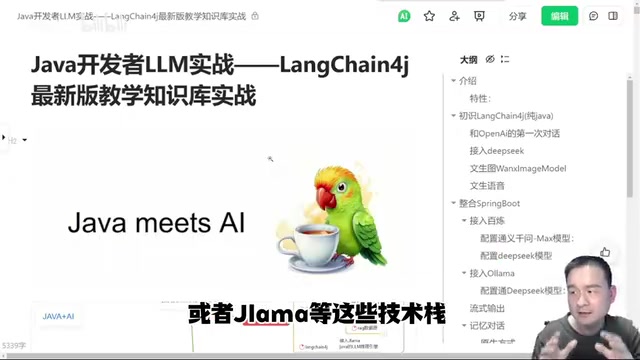
What LangChain4j Solves: Simplifying Large Model Integration
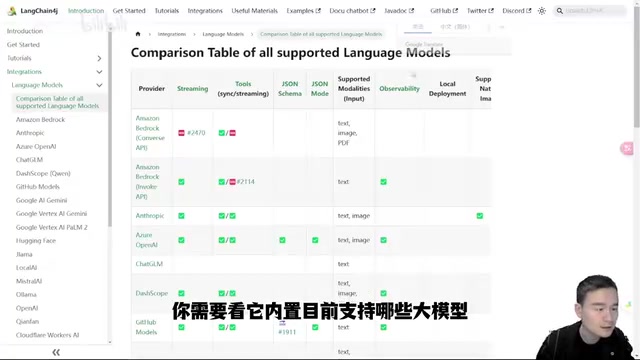
Of course, you can integrate large models without LangChain4j, but you'd need to manually send requests to remote endpoints using HTTP Client or OkHttp and manually assemble Java parameters. LangChain4j's value lies in wrapping the upper-layer API to boost integration efficiency. According to the creator, it natively supports OpenAI, Alibaba Tongyi, Hugging Face, and local models like Ollama, as well as mainstream domestic vendors.
One easily overlooked detail: DeepSeek and OpenAI use the same calling standard, so you can call DeepSeek models directly using OpenAI's integration approach. This is also corroborated by analyses in multiple technical communities and is a cross-source consistent fact.
RAG (Retrieval-Augmented Generation) is the core technical paradigm for current enterprise knowledge base applications. Its basic flow: first split enterprise documents and convert them into vectors via an embedding model, then store them in a vector database; when a user asks a question, the system vectorizes the question as well, retrieves the semantically closest text fragments from the database, splices these fragments as context into the prompt, and hands it to the large model to generate an answer. Compared with directly fine-tuning a model, RAG requires no retraining of weights—knowledge updates only require rebuilding the index—so it is low-cost and traceable, making it the most common first stop for Java backends taking on AI requirements. Understanding RAG's three-stage structure of retrieval—augmentation—generation helps grasp the overall thread of the knowledge base practice in the tutorial.
Function Call is the key mechanism by which large models move from "conversation" to "execution." Developers declare a set of callable functions (such as querying orders or creating tickets) to the model in a structured description; after understanding the user's intent, the model outputs a call request specifying a function name and parameters, which the application actually executes and returns the result to the model, ultimately forming an answer. It enables large models to safely reach external systems and real-time data, and is a foundational capability for building scenarios like intelligent customer service and business assistants. On the Java side, function signatures are usually defined via annotations or schemas; both LangChain4j and SpringAI provide corresponding wrappers that reduce the complexity of integrating this mechanism.
How to Choose Between SpringAI and LangChain4j
The core difference between the two lies in the degree of ecosystem binding. SpringAI is a native product of the Spring ecosystem and can directly integrate with Spring and Spring Boot, making it suitable for quickly integrating a single model into existing Spring applications. LangChain4j, by contrast, does not depend on a specific framework—it can be used in any Java environment.
The resulting selection conclusion is: for fast integration of a single model, prefer SpringAI; for a general platform that needs to dynamically switch between multiple models, LangChain4j is more suitable. The creator cites an open-source multi-model dynamic management platform as an example—within the system, a large model can be dynamically enabled or disabled, and LangChain4j is more convenient for such scenarios.
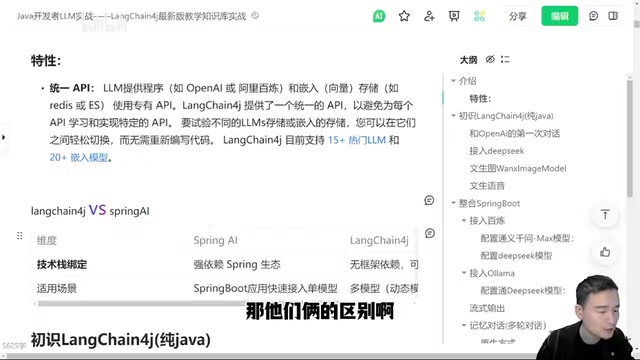
It should be noted that the above selection advice comes from a single-source tutorial viewpoint; in actual projects, it should be evaluated together with the team's tech stack, community activity, and long-term maintenance costs.
The Full Technical Landscape Covered by the Tutorial
Judging from the course outline, this content covers large model integration frameworks (SpringAI and LangChain4j), prompt engineering, role presets, conversation memory, Function Call, RAG, text vectorization, MCP, and model fine-tuning. The vector databases supported by LangChain4j include ClickHouse, Elasticsearch, Neo4j, Oracle, Redis, and other common components in the Java tech stack, which lowers the learning curve for implementing RAG.
The hands-on section focuses on two high-frequency scenarios: AI-powered intelligent customer service and knowledge base systems. The creator also includes large model interview questions and accompanying study materials, aimed at promotion to AI application development engineer roles.
MCP (Model Context Protocol) is a standardized protocol proposed and open-sourced by Anthropic, designed to unify the way large models connect with external tools and data sources. You can think of it as the "USB interface" for AI applications: tool providers implement an MCP Server according to the protocol, exposing capabilities such as file systems, databases, and APIs; the AI application side, as an MCP Client, can discover and invoke these capabilities without writing separate adapter code for each tool. This protocol is gradually being adopted by mainstream IDEs and AI frameworks, and corresponding SDKs have emerged in the Java ecosystem. For enterprise platforms that need flexible orchestration across multiple models and multiple tools, MCP is expected to significantly reduce integration and maintenance costs.
Text vectorization (Embedding) is the process of mapping text into high-dimensional floating-point vectors, where semantically similar texts are closer in vector space—this is the premise on which semantic retrieval rests. In practice, several engineering details need attention: the choice of embedding model (local open-source models and cloud APIs each have trade-offs in effectiveness, cost, and data compliance), text splitting strategy (chunk size and overlap directly affect recall quality), the storage overhead of vector dimensions, and similarity measurement and re-ranking during retrieval. The vector stores mentioned in the tutorial—ClickHouse, Elasticsearch, Redis, and others—are exactly what handle storage and approximate nearest neighbor retrieval at this stage.
Actionable Advice for Java Developers
In terms of tech stack selection, there's no need to aim for perfection in one step. You can first get a local model running with Ollama, then use LangChain4j to complete a full knowledge base Q&A loop, and finally decide based on project needs whether to introduce SpringAI or go deeper into fine-tuning. Engineering capability is Java developers' existing strength; combining it with large model integration capability is the real competitive logic this tutorial aims to convey.
One-line Summary
The path and selection logic for Java developers entering AI application development with SpringAI and LangChain4j.
Paragraph Summary
Based on Bilibili creator Xu Shu's Java AI application tutorial, this article maps out the key paths for Java developers entering AI application development. The core judgment: falling large model costs are driving enterprise on-premises deployment, and Java backends, with their engineering advantages, can take on scenarios like intelligent customer service and knowledge bases. Technically, LangChain4j wraps the upper-layer API to simplify model integration, and since DeepSeek and OpenAI share the same calling standard, integration can be reused directly; SpringAI suits fast single-model integration within the Spring ecosystem, while LangChain4j is better for multi-model dynamic management platforms. The tutorial covers prompt engineering, conversation memory, Function Call, RAG, MCP, and model fine-tuning, with intelligent customer service and knowledge bases as hands-on scenarios, and finally offers actionable advice on progressive learning and resume packaging.
Related articles

Running Real-Time Local Voice AI on a Single 12GB GPU: Full Pipeline with a 35B Model and Voice Conversation
A developer shows how to run a 35B MoE LLM, Whisper ASR, and Breeze TTS2 locally on a single 12GB GPU, cutting end-to-end voice chat latency from 8s to 2–3s via streaming, parallel synthesis, and quantization, plus Agent tool-calling integration.

Qwen4 Architecture Preview Open-Sourced: 125B Parameters, 512 Experts, Designed for VRAM-Constrained Hardware
Qwen4 isn't released yet, but its architecture is previewed via open-source Qwen3.8 Flash Next: 125B params, 6B activated per token, 512 experts, 262K context, built for VRAM-limited hardware. This article covers official confirmations, key config.json metrics, and local deployment tests on 24G memory.

Run 8K Images on 6GB VRAM! Hands-On Test of Fudan's Open-Source MOSS-Image Model
Fudan OpenMouse team and Shanghai MOSS Intelligence open-source MOSS-Image, a 500M-parameter DT architecture text-to-image model that runs locally on 6GB VRAM with precise text rendering, structured layout control, and 4K Token prompt support—ideal for e-commerce posters and local deployment by individual creators.