Jemalloc 5.4.0 Released: A New Step for the High-Performance Memory Allocator
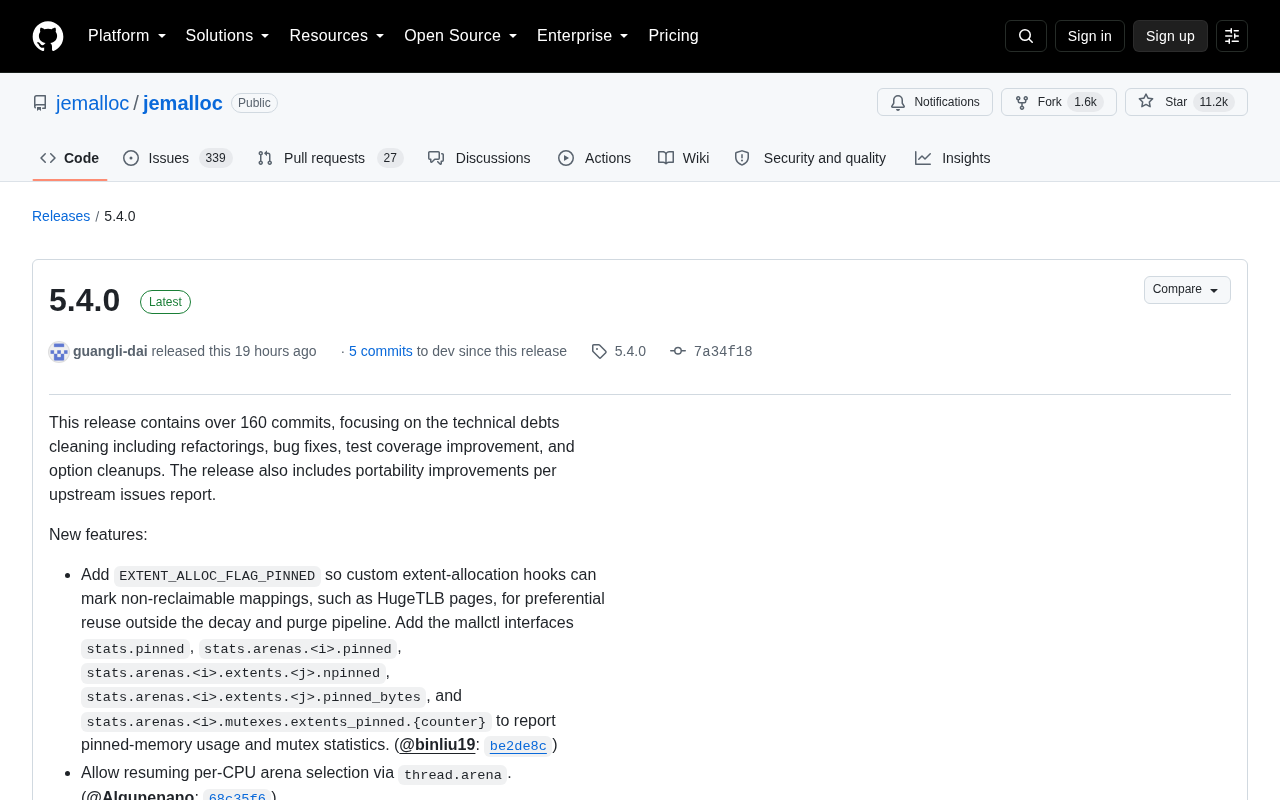
Jemalloc 5.4.0 released, continuing the evolution of this low-fragmentation, high-concurrency memory allocator.
Jemalloc 5.4.0 has been officially released, drawing widespread attention on Hacker News. As a leading general-purpose memory allocator, jemalloc uses arena mechanisms, thread-local caching (tcache), and fine-grained size classes to tackle lock contention and fragmentation in high-concurrency scenarios. It's long been adopted by Redis, Meta, and other high-load systems. The new release signals continued active maintenance, and teams running concurrent, memory-intensive services should evaluate the update carefully — with thorough testing before upgrading. Community discussions also offer practical comparisons with competitors like tcmalloc and mimalloc.
Jemalloc Back in the Spotlight
Jemalloc is a widely adopted general-purpose memory allocator known for its low fragmentation rates and high concurrency performance in multithreaded environments. It has long been a dependency for projects at Facebook (Meta), Redis, the Rust ecosystem, and many others. The release of version 5.4.0 garnered 229 upvotes and 58 comments on Hacker News, reigniting developer community interest in the topic of memory allocators.
For developers who have followed the Jemalloc project over the years, a new release is itself a meaningful signal — it indicates that this foundational low-level component is still being actively maintained and evolved, rather than stagnating.
Why Memory Allocators Matter
Memory allocators are a core component of virtually every software runtime, responsible for managing a program's requests to allocate and free heap memory. Default system allocators (such as glibc's ptmalloc) often underperform in high-concurrency, large-scale memory operation scenarios, where they tend to produce memory fragmentation and lock contention.
Jemalloc addresses these problems through its arena mechanism, thread-local caching (tcache), and fine-grained size class divisions. Together, these significantly reduce memory fragmentation in multithreaded programs and improve allocation and deallocation throughput — which is exactly why it's favored by high-load server-side applications.
Typical Use Cases
- Databases and caching systems: Redis has long used jemalloc as its default allocator to handle frequent allocation of massive numbers of small objects.
- Large-scale server-side applications: Companies like Meta deploy it in production at scale to reduce peak memory usage.
- Systems programming language ecosystems: In ecosystems like Rust, jemalloc has been widely used as an optional or default allocator.
Jemalloc's arena mechanism divides the memory allocation space into multiple independent arenas, with each thread bound to a specific arena — eliminating lock contention among threads competing for the same lock during concurrent allocation. The thread-local cache (tcache) maintains a per-thread free list of small objects, so the vast majority of allocations and deallocations are completely lock-free; cross-thread synchronization is only triggered when the tcache is exhausted or memory needs to be returned to an arena. Size class division aligns all allocation requests to preset size tiers (e.g., 8, 16, 32, 48 bytes…), allowing objects of the same size to share the same memory slots and dramatically reducing external fragmentation caused by scattered object sizes. These three mechanisms work in concert, giving jemalloc a significant performance edge over glibc ptmalloc under multithreaded, small-object-intensive workloads.
The Significance of This Release
Looking at the 5.x release series, the Jemalloc team has continuously made improvements in stability, performance tuning, and platform compatibility. While the primary public information for this release points to the GitHub Releases page — with specific change details requiring developers to consult the official changelog — a new minor version typically includes bug fixes, performance optimizations, and adaptations for new hardware or operating systems.
For production users, evaluating whether to upgrade requires weighing the performance gains of the new version against potential compatibility risks. It's recommended to conduct thorough stress testing and memory behavior comparisons in a test environment before upgrading critical systems.
The Value of Community Discussion
Nearly 60 comments on Hacker News reflect the developer community's sustained interest in low-level infrastructure. These discussions often cover side-by-side comparisons between different allocators (such as jemalloc, tcmalloc, and mimalloc), real-world production tuning experiences, and performance differences under specific load patterns.
For engineers who want a deeper understanding of memory management, this community feedback is invaluable practical reference material. Choosing the right memory allocator is not a one-size-fits-all decision — it requires evaluating the specific characteristics of your workload.
There are currently three main contenders in the general-purpose memory allocator space. tcmalloc (Thread-Caching Malloc), developed by Google, also employs a thread-local caching approach and is deployed at massive scale internally at Google; in recent years it has spawned a more performant modern version. mimalloc, from Microsoft Research, is known for its extremely small codebase and excellent cross-platform performance, particularly shining in Windows ecosystems and WebAssembly scenarios. Jemalloc, on the other hand, has a stronger reputation for memory fragmentation control and memory usage stability over long runtimes, making it especially well-suited for server-side scenarios like databases that need to run stably over extended periods. Each has its own strengths, and in practice, selecting one typically requires running benchmarks against your target workload rather than relying purely on theoretical analysis.
Conclusion
The release of Jemalloc 5.4.0 continues the steady, deliberate evolution of this classic project. While limited public details are available for this release, it serves as a reminder that low-level components like memory allocators — seemingly unglamorous — have a profound impact on overall system performance. For teams running high-concurrency, large-memory services, keeping an eye on updates to tools like this and carefully evaluating them is always worthwhile. Interested readers are encouraged to visit the official GitHub Releases page to review the complete changelog.
Related articles

Robinhood Executive to Speak at TechCrunch Disrupt 2026 on Winning the Modern Financial Consumer
Robinhood VP of Product Marketing Abhishek Fatehpuria will speak at TechCrunch Disrupt 2026 on winning the modern financial consumer. Early-bird saves up to $200 before Sept 25.

Using ChatGPT to Batch-Generate Editable Academic Slides: A Practical Efficiency Tool for Researchers
A complete workflow for batch-generating editable academic PPTs with ChatGPT: upload a PDF and template, use a structured prompt to render slides as images, then convert to editable format — all in under 30 minutes.

GPT-6 Full Power Guide: Unlocking Ultra Thinking Intensity via GPT-work
Step-by-step guide to using GPT-6 at full power: Apple ID registration, Plus/Pro subscription, and unlocking GPT-6 Ultra max thinking intensity via GPT-work client.