Jensen Huang Backs Chinese Open-Source AI: Great Models Deserve to Be Widely Used

Jensen Huang says great open-source AI models like DeepSeek and Kimi should be freely used — they drive more GPU demand, not less.
NVIDIA CEO Jensen Huang publicly endorsed the use of Chinese open-source AI models such as DeepSeek and Kimi by US companies, dismissing backdoor concerns and arguing that open-source transparency is itself a security guarantee. He also invoked the Jevons Paradox to explain why more efficient models drive greater — not lower — demand for compute, calling both market panics over DeepSeek and Kimi misreadings of AI's growth flywheel.
Recently, NVIDIA CEO Jensen Huang took a clear and unusually public stance on whether the U.S. should restrict Chinese AI models. When The Wall Street Journal posed the pointed question — "Should American companies be allowed to use Chinese AI models?" — Huang's answer was unequivocal: "Absolutely, absolutely." This position stands in sharp contrast to the growing momentum for tech containment against China in U.S. political circles, and reflects the chip giant's deep-seated views on the AI industry ecosystem.
Open-Source Models: A Common Foundation for Science, Security, and National Interest
Huang first pushed back against the idea that governments should ban or restrict Chinese models like Kimi. In his view, open-source models are indispensable — for the broader tech industry, for scientific research, and for cybersecurity.
He emphasized that what makes open-source models so important is precisely their "transparency as security" — code and weights are fully public, freely auditable by researchers worldwide. This is critical for cybersecurity, national security, and economic security alike.
The "transparency as security" principle of open-source models is rooted in Kerckhoffs's principle from cryptography. Proposed in 1883 by Dutch cryptographer Auguste Kerckhoffs, it is a core axiom of modern cryptography and information security: a cryptosystem should be secure even if everything about the system, except the key, is public knowledge. This idea profoundly influenced the open-source software movement — the Linux kernel, OpenSSL, and other critical infrastructure have been continuously audited and patched by the global developer community for decades precisely because their code is fully open, making them more secure than many closed-source systems. Extended to AI, this principle means that when model architectures, training code, and weight parameters are fully public, malicious logic and security vulnerabilities become much harder to hide. The global research community can independently audit models, making any potentially harmful mechanisms easier to detect and expose. This perspective is genuinely illuminating: while many instinctively link "Chinese models" with "security risks," Huang argues that openness and transparency are themselves the best guarantee of security.
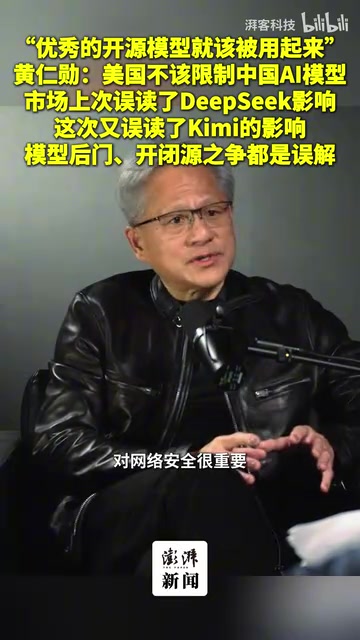
He also articulated a balanced view of the industry: "The world needs open models and it needs closed models. We should use as many closed models as possible and rent everything we can. And yet, the industry still needs open-source models." In other words, open-source and closed-source are not a zero-sum game — they are twin pillars supporting a complete AI technology stack.
Debunking the "Backdoor" Myth: Open-Source Models Can Be Fully Controlled
Addressing widespread concern that Chinese models might contain "backdoors" somehow connected to the Chinese government, Huang called this a "misunderstanding."
His technical rebuttal was direct: "You download these models, you can fine-tune it, you can enhance it, you can put guardrails on it however you like."
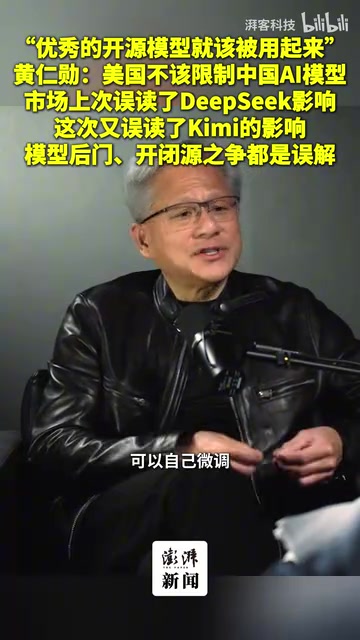
Understanding this argument requires distinguishing between two fundamentally different modes of AI usage: calling a closed-source model via a cloud API (such as OpenAI's GPT-4 API), where every inference request communicates with the vendor's servers and carries data transfer risk; versus downloading open-source model weights and deploying them locally or on a private cloud, where everything runs entirely within the user's own infrastructure. The model weights themselves are static mathematical parameter files — they have no ability to initiate network connections on their own.
Fine-tuning in the large language model era has developed into a mature toolchain ecosystem. Parameter-efficient methods like LoRA (Low-Rank Adaptation) and QLoRA allow enterprises to adjust only a tiny fraction of model parameters — typically less than 1% — on consumer-grade GPUs, dramatically lowering the technical barrier and cost. Guardrail mechanisms have similarly matured, with frameworks such as NVIDIA's own NeMo Guardrails and Meta's Llama Guard enabling flexible safety policy deployment through bidirectional input/output filtering, intent classification, and content moderation — all without modifying model weights. This allows enterprises to decouple compliance requirements from model capabilities and iterate on them independently. Together, these tools give organizations complete technical sovereignty over open-source models. The notion of a "backdoor to China" is technically untenable — because the runtime environment is entirely under the user's control.
DeepSeek and Kimi: The Deeper Lesson Behind Two Market Misreadings
Huang specifically noted that markets have significantly misread the impact of Chinese open-source models — twice. "The market misunderstood the impact of DeepSeekAd the first time," he said, "and now it's misunderstood the impact of Kimi."

When DeepSeek burst onto the scene, it briefly triggered a roughly 17% single-day drop in NVIDIA's stock price, wiping out nearly $600 billion in market cap — one of the largest single-day market cap losses in U.S. stock market history. The market's panic logic was: if more efficient models can achieve the same results with less compute, demand for NVIDIA GPUs will fall sharply. However, the inverse logic Huang invokes corresponds to the Jevons Paradox in economics — first systematically described by 19th-century economist William Stanley Jevons in his 1865 work The Coal Question. He observed that after James Watt's steam engine dramatically improved thermal efficiency, Britain's total coal consumption rose rather than fell, because the efficiency gains lowered the unit cost of steam power and spawned a wave of new applications that had previously been unaffordable, thereby expanding total demand. This paradox recurs throughout modern tech history: transistors keep getting more energy-efficient, yet global power consumption keeps rising; internet bandwidth costs have plummeted, yet global data traffic grows exponentially. In AI, DeepSeek compressed the inference cost of capable models to a fraction of what it had been, directly triggering explosive growth in enterprise AI deployment — lower inference costs create entirely new application scenarios that were previously too expensive to exist, ultimately driving exponential growth in total compute demand. DeepSeek's efficiency is therefore not a tool for cutting compute demand, but an accelerator for AI mass adoption.
Kimi represents a different differentiated competitive path for Chinese AI companies. This AI assistant from Moonshot AI became known for its exceptionally long context window — at one point supporting inputs of up to 2 million tokens (a token typically corresponds to roughly 0.75 English words or 0.5 Chinese characters). The context window is a key metric for how much information a large language model can process in a single pass. GPT-3's early context window was just 4,096 tokens; a 2-million-token breakthrough is equivalent to processing roughly 1.5 million English words — or about 100 average-length novels — at once. This achievement relies on efficient attention algorithms like FlashAttention, sliding window attention mechanisms, and positional encoding schemes designed for long sequences, giving AI the practical ability for the first time to handle complete codebases, collections of legal contracts, and scientific literature repositories. It offers significant advantages in long-document comprehension and multi-turn dialogue. By mentioning Kimi alongside DeepSeek, Huang signals that he views leading Chinese open-source models as a systemic — not incidental — industrial phenomenon.
He connected the logic clearly: "Great models bring widespread use, and widespread use brings enormous growth." Wherever a model comes from, open-source or not, if it's good enough, it will drive technology diffusion across the entire industry. This is the story DeepSeek has already proven, and in his view, Kimi will follow the same trajectory.
More Applications Drive Greater Compute Demand
As the world's largest supplier of AI compute, Huang's stance naturally carries a commercial dimension — but his analytical logic is equally worth considering.
"Every time there's more usage, we'll have to sell more NVIDIA computers, we'll have to build more data centers, there'll be more services, and technology will spread to more industries."
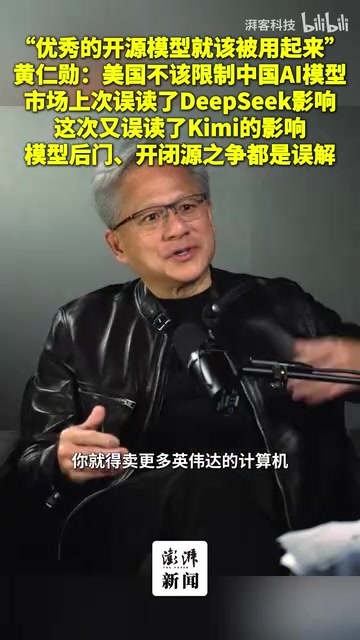
This reveals a core flywheel effect in the AI industry — a concept systematically articulated by management scholar Jim Collins in Good to Great, describing a self-reinforcing positive feedback loop. In AI, the flywheel works like this: better models lower the barrier to adoption → more users and enterprises embrace AI → larger-scale application demand emerges → larger-scale infrastructure investment follows → more powerful next-generation models become possible. NVIDIA plays the role of "shovel seller" in this flywheel, with its CUDA ecosystem having accumulated over two decades of software moat — the skill stacks of millions of AI researchers and engineers worldwide are deeply tied to CUDA, making it difficult for competitors to disrupt its ecosystem advantage even if they close the hardware gap. Data center construction typically takes 18 to 36 months; once AI application demand is established, the expansion of compute supply carries considerable inertia. Advances in model capability — whether open-source or closed-source — ultimately translate into strong demand for underlying infrastructure. From this perspective, progress in Chinese open-source models is not a threat to NVIDIA but an important driver of its business growth.
He also clarified another common misconception: that open-source and closed-source models must be in opposition. "That's also wrong." In Huang's vision of the industry, open-source and closed-source are complementary forces that together grow the entire AI market.
Open Competition: The Technological Optimism Underlying the Industry
At its core, Huang's remarks represent a form of technological optimism grounded in global industrial specialization. He doesn't shy away from the reality that "Chinese competition is coming on strong" — instead, he frames it as a force driving the entire industry forward.
At a time of heightened geopolitical tension and rising tech nationalism, this voice from the NVIDIA CEO stands out: great open-source models, wherever they come from, should be put to use. For the Chinese AI industry, this represents both international recognition and indirect confirmation that home-grown open-source models like DeepSeek and Kimi are occupying an increasingly important place on the global AI map.
Key Takeaways
Related articles

Apple HomeView Hands-On Review: Is the $300 Smart Home Hub Worth It?
Apple HomeView hands-on: a $300 smart home hub with facial recognition for quick account switching, but no App Store or voice recognition. Is the wall-mounted version worth it? Should you buy the first generation?

Meta Muse Wonder Launch: What It Means for Meta's Return to the Frontier AI Race
Meta releases Muse Wonder and WonderFull, benchmarks reach the frontier, community feedback is polarized. An in-depth look at Meta's return to the frontier AI race, its personal agent strategy, and Zuckerberg's different path.

Apple Home Smart Home Lineup Leaked: LG and Schneider Team Up, UWB Door Lock on Board
Apple Home ecosystem gains new LG and Schneider devices: UWB smart lock with proximity unlock, 2.5K dual-camera doorbell, privacy indoor camera, and AirPods-like seamless pairing.