Jensen Huang Resignation Rumor Explained: NVIDIA's Leadership Transition and the Future of AI Leadership
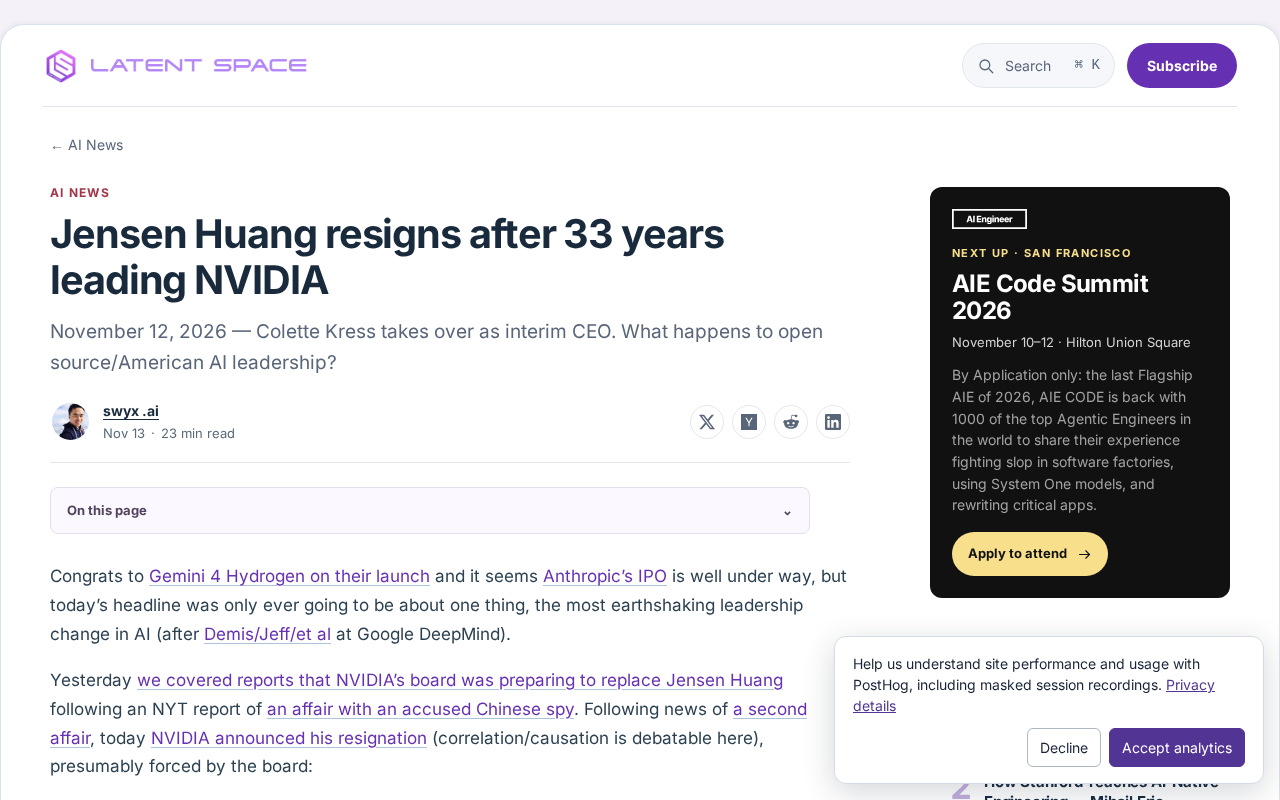
AINews claims Jensen Huang resigned as NVIDIA CEO with CFO as interim replacement, but lacks official confirmation and should be treated as unverified.
The article examines a short headline from AINews claiming Jensen Huang resigned after 33 years leading NVIDIA, with CFO Colette Kress as interim CEO, raising questions about open source and U.S. AI leadership. The author first delineates factual boundaries, noting the material contains only three hard facts—timing, person, and position change—lacking official statements and cross-verification, and should be treated as unverified. The piece then analyzes the dual signals of a CFO interim appointment—stabilizing capital market expectations and giving the board a window to select a permanent CEO—while warning of narrative discontinuity risks in NVIDIA's highly personalized leadership structure. It also deconstructs the nature of the open source and AI leadership questions, emphasizing they represent a concern framework rather than established facts. Finally, three reader recommendations and four follow-up observation indicators are provided.
A short headline from AINews dropped a bombshell on the tech world: "Jensen Huang resigns after 33 years leading NVIDIA," claiming that Colette Kress has taken over as interim CEO, while raising the question of "where open source and American AI leadership go from here." The message carries very little information but weighs heavily in meaning—it simultaneously touches three sensitive nerves: NVIDIA's governance, the AI compute supply chain, and the open-source ecosystem.
The Factual Boundaries of the Rumor
Let's first separate what can be confirmed from what cannot. According to this RSS source, the event is dated November 12, 2026, with Huang stepping down after 33 years at the helm of NVIDIA and current CFO Colette Kress assuming the role of interim CEO. These three elements—timing, person, and position change—constitute the entirety of the rumor's hard information.
The material itself provides no reason for the resignation, no board vote details, no indication of Huang's subsequent role, and no official statement or earnings call transcript as cross-corroboration. In other words, this reads more like a news flash headline awaiting verification than a complete report capable of supporting in-depth attribution. Any inference about a "forced departure" or "strategic disagreement" exceeds the boundaries of the original information.
It's worth emphasizing that the figure of 33 years aligns with the public timeline of Huang co-founding NVIDIA in 1993—one reason the rumor appears "plausible." But internal consistency of a timeline does not equal truth. Readers should treat this as a signal pending verification.
RSS aggregation sources refer to information channels that automatically crawl and aggregate content updates from multiple websites via the Really Simple Syndication protocol. Such sources typically retain only titles, summaries, and links, often lacking original context, journalist bylines, and editorial review—making them prone to clickbait, out-of-context excerpts, or unverified news flashes. In the tech news dissemination chain, RSS aggregators often serve as the first landing point, but their information granularity is extremely low. Readers who judge based solely on aggregation headlines face significantly higher risk than those reading original reports or official announcements directly.
SEC filings are legally mandated disclosure materials that U.S. public companies submit to the Securities and Exchange Commission (SEC), including 8-K (material events), 10-Q (quarterly reports), 10-K (annual reports), and others. A CEO resignation is a typical material event requiring 8-K disclosure, usually within four business days of the event. Therefore, after a rumor emerges, checking whether a corresponding 8-K filing exists in the SEC EDGAR database is the most direct official pathway to verify corporate governance changes.
What Colette Kress's Succession Means
If the interim CEO arrangement is accurate, Colette Kress is the most natural successor in line. As a long-serving CFO, she is familiar with the company's financial structure, capital allocation cadence, and investor communication language. Having the CFO serve as interim leader during a crisis or transition is a common practice among mature public companies.
This arrangement typically signals two things. One is stabilizing expectations: communicating to capital markets that daily operations and financial reporting cadence will not be disrupted. The other is creating a selection window: the word "interim" itself implies the board has not yet finalized a long-term choice and may be evaluating both internal and external candidates.
For NVIDIA, the real test lies not on the financial side but in the continuity of its technology roadmap and ecosystem relationships. Huang has long bound his personal image to the company's narrative—from GPU architecture roadmaps to keynote speeches at developer conferences, he himself has been NVIDIA's core interface for external communication. This highly personalized leadership structure inherently carries the risk of a narrative gap during transition periods.
Interim CEO is a transitional chief executive appointed by the board during a formal CEO vacancy, typically serving for weeks to months, with responsibilities focused on maintaining operational continuity and external communication stability rather than driving major strategic changes. CFOs transitioning to interim CEO is relatively common among U.S. tech companies, as CFOs are already deeply involved in capital allocation, investor relations, and financial disclosure—minimizing transition costs. However, interim CEOs generally do not hold full product and engineering decision-making authority; major technology roadmap adjustments are typically deferred until a permanent CEO is in place.
The Connected Questions About Open Source and American AI Leadership
The original headline pairs "open source" with "American AI leadership." This framing itself deserves unpacking.
On the open-source side, NVIDIA has deeply participated in the open-source AI toolchain in recent years through the CUDA ecosystem, inference framework adaptations, and model library contributions. Whether leadership changes will affect the priority of these investments cannot be judged from any available material. This can be understood as a concern framework posed by the questioner, not a factual change that has already occurred.
On the American AI leadership side, NVIDIA's compute supply capacity is widely regarded as part of the infrastructure underpinning U.S. AI industry competitiveness. A CEO transition would prompt external parties to reassess supply strategy, export compliance orientation, and long-term investment cadence. But again, the material provides no specific policy or strategic adjustment information—this can only be raised as an observation dimension, not treated as a conclusion.
CUDA (Compute Unified Device Architecture) is NVIDIA's parallel computing platform and programming model, introduced in 2006, through which developers access GPUs for general-purpose computing. After nearly two decades of accumulation, CUDA has formed a vast library, toolchain, and developer community, constituting one of NVIDIA's deepest moats in AI training. Its ecosystem stickiness comes not only from hardware performance but also from migration costs—a large number of AI frameworks and model codes are optimized for CUDA by default. Understanding this is essential to judging why leadership changes are thought to potentially affect investment priorities in the open-source AI toolchain.
How Readers Should Treat This News
The first recommendation is to wait for official sources. Major changes at the corporate governance level are typically confirmed through official press releases, SEC filings, or earnings calls. Before these channels appear, a single aggregator's short headline is insufficient as a basis for decision-making.
The second recommendation is to distinguish "event" from "interpretation." The event is the resignation and interim appointment; the interpretation is about open-source direction and AI leadership changes. The former requires verification, the latter requires time to validate—the two should not be conflated.
The third recommendation is to watch for follow-up indicators: whether the board announces a permanent CEO candidate, whether Huang retains a chairman or advisory role, who presents at the next quarterly earnings call, and whether developer conference roadmap announcements are adjusted. These are the reliable signals for judging the substantive impact of the transition.
Frequently Asked Questions
Is this news credible? Currently there is only a headline-level description from a single RSS aggregation source, lacking official statements and multi-source cross-verification. It should be treated as information pending verification.
Who is Colette Kress? According to the material, she has taken over as interim CEO. She has long served as NVIDIA's CFO and is a typical internal successor candidate.
What impact on open-source AI? The material only raises this question without providing any specific changes. It is premature to draw conclusions before official information emerges.
Will Jensen Huang remain at the company? The original material does not mention his subsequent role; any related claims lack basis.
Related articles
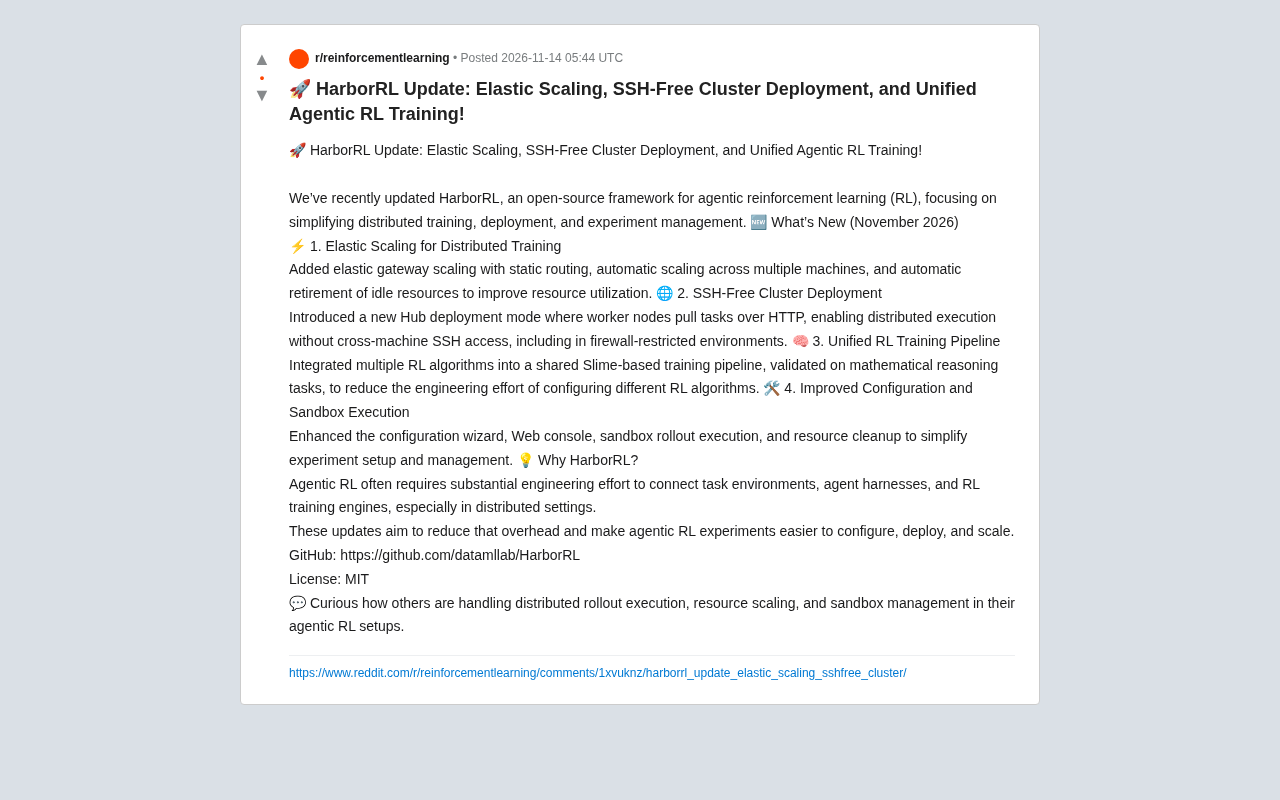
HarborRL Update: Elastic Scaling and SSH-Free Cluster Deployment
HarborRL, an open-source Agentic RL framework, releases an update: elastic gateway scaling with automatic idle resource reclamation, SSH-free cluster deployment via HTTP task pulling, a unified RL training pipeline based on Slime, and improvements to the configuration wizard and sandbox execution—lowering the engineering barrier for distributed agent reinforcement learning.

Tutu Livestream Transcript: A Real Snapshot of the Streamer-Fan Ecosystem
From Bilibili streamer Tutu's livestream transcript, observe a solo streamer's real survival state amid technical glitches, badge payment systems, and PK traffic competition, and analyze long-tail streamers' professional cognition and emotional labor.

Bilibili Live Streaming Ecosystem: Interaction, Tipping, and the Traffic Game in a Co-Streaming Session
From a Bilibili co-streaming session, we observe streamer interactions, the tipping economy, and PK gameplay, analyzing the complex relationship between authenticity and performance, traffic and emotion in the livestream ecosystem.