Jensen Huang Returns as NVIDIA CEO: Board Votes Unanimously
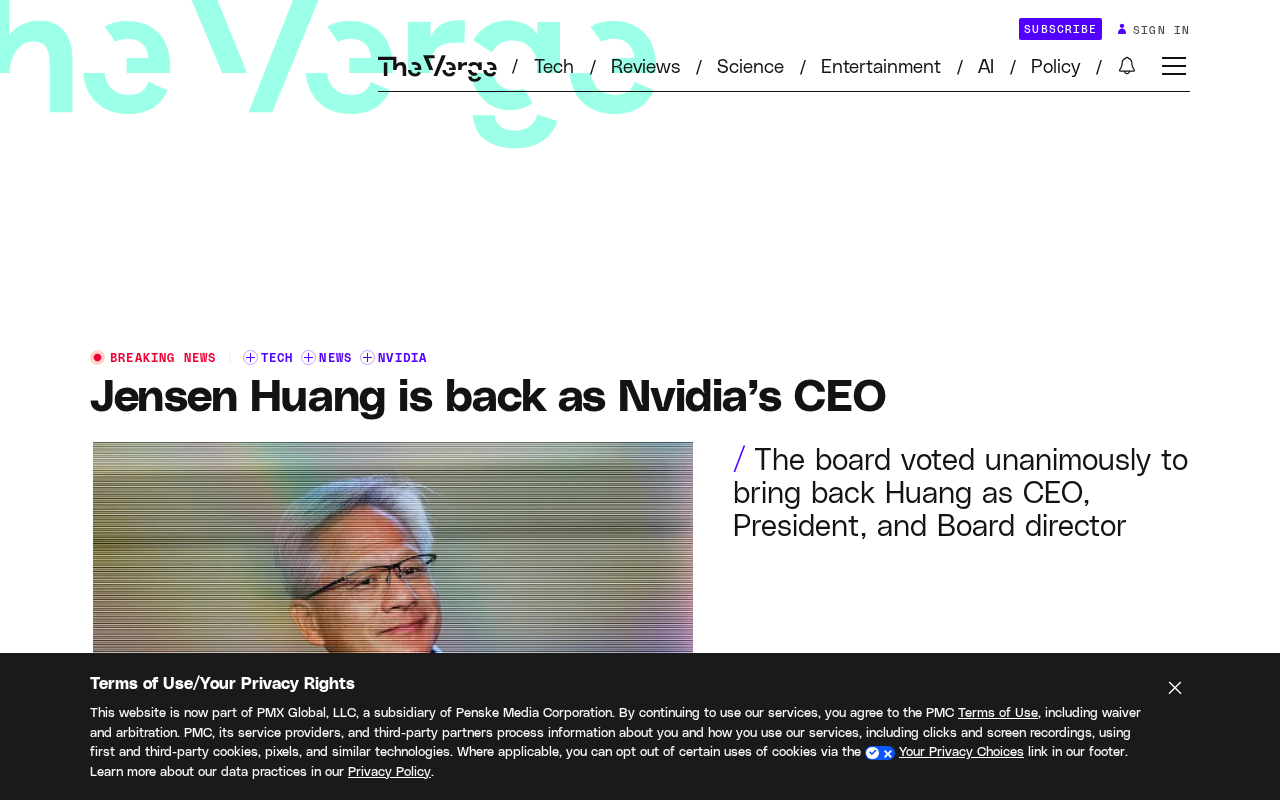
NVIDIA's board unanimously reappoints Jensen Huang as CEO, citing trust in his candor and leadership.
NVIDIA announced Monday morning that its board unanimously voted to reappoint co-founder Jensen Huang as CEO. The decision followed a series of discussions and meetings, with the board statement specifically emphasizing satisfaction with his "candor" and "leadership abilities," suggesting there may have been prior disagreements or concerns that Huang resolved through dialogue. The article analyzes the impact of this personnel change on NVIDIA's strategic direction, governance stability, and investor confidence, concluding that the founder's return helps maintain leadership stability and strategic continuity.
Event Overview
NVIDIA announced Monday morning that its board of directors has unanimously voted to reappoint Jensen Huang as the company's chief executive officer. The decision followed a series of discussions and meetings between the board and Huang, with the board expressing satisfaction with his candor and leadership abilities.
NVIDIA stated in its announcement: "The board unanimously voted to reappoint Mr. Huang after a series of discussions and meetings with him, following which the board felt satisfied with Mr. Huang's candor and his ability to lead NVIDIA."
NVIDIA was co-founded in 1993 by Jensen Huang, Chris Malachowsky, and Curtis Priem, initially focusing on the development of graphics processing units (GPUs). Huang has served as president and CEO since the company's founding, making him one of the longest-tenured founder-CEOs in Silicon Valley. NVIDIA invented the GPU in 1999, and under Huang's leadership gradually expanded from the gaming graphics card market into data centers, artificial intelligence, autonomous driving, and other fields. Since 2023, with the explosion of generative AI, NVIDIA's market capitalization briefly surpassed one trillion dollars, making it one of the world's most valuable semiconductor companies. Understanding the long-standing bond between Huang and NVIDIA is the essential backdrop for understanding the significance of this personnel change.
Board Decision Background
This personnel change came rather suddenly, but the board's statement indicates that after in-depth communication, members' trust in Huang has been restored. The statement specifically emphasized "candor" and "ability to lead," suggesting there may have been certain disagreements or concerns previously, and that Huang regained the board's support through dialogue.
As co-founder of NVIDIA, Huang has long been the company's iconic figure, and his leadership style and strategic vision have attracted considerable attention in the tech world. His return signifies the company's desire to maintain stability in leadership and strategic continuity.
In the governance structure of U.S.-listed companies, reappointing a CEO typically requires nomination by the corporate governance committee, a full board vote, and reporting of material personnel changes to the U.S. Securities and Exchange Commission (SEC) in disclosure filings such as Form 8-K. The word "candor" emphasized in the statement carries specific meaning in English corporate governance discourse, typically referring to management's transparency with the board regarding financial disclosures, strategic communications, and risk reporting. When a board publicly uses this term, it often implies there had been information asymmetry or insufficient communication, and the reappointment means both parties have reached a new consensus on the relevant matters.
Impact on NVIDIA's Future Development
Huang's return is expected to have a direct impact on NVIDIA's strategic direction. Against the backdrop of the continued evolution of the AI and GPU markets, founder leadership is often seen as key to maintaining a company's pace of innovation and market competitiveness. The unanimous board vote also sends a clear signal to the outside world: the entire company has high confidence in Huang's leadership abilities.
Although the statement did not disclose further details, this decision will undoubtedly influence investors' and partners' assessment of NVIDIA's governance stability. A close cooperative relationship between founder and board is crucial for a company at the forefront of technological change.
Conclusion
Jensen Huang's return as NVIDIA CEO marks a significant adjustment in the company's leadership. The board's unanimous support provides a legitimate foundation for this change, and Huang's return will inject familiar strategic vision into NVIDIA's future development. The market will closely watch the subsequent impact of this personnel arrangement on the company's operations and innovation.
One-line Summary
NVIDIA's board unanimously voted to reappoint Jensen Huang as CEO, emphasizing trust in his candor and leadership.
Related articles

AI Cracks the Riemann Hypothesis? The Million-Dollar Prize Battle
The Riemann Hypothesis million-dollar prize sparks a debate over scientific discovery in the AI era: Levent Alpoj's Claude-assisted 17-million-line Lean proof passes independent verification, while the manual draft still has errors. The Clay Institute's rules do not explicitly ban AI, but the gap between verifiability and understandability has become the core controversy.
AI Solves the 167-Year-Old Riemann Hypothesis? Formal Proof Sets the Math World Ablaze
The 167-year-old Riemann Hypothesis gets a formal proof: Levent Alpoge and Claude release 17 million lines of Lean code, verified by independent checkers. This article explains the link between prime counting and zeta zeros, the limits of machine verification, and AI's role in mathematical discovery.

AI and Humans Team Up to Crack the Riemann Hypothesis? The Truth Behind a 167-Year-Old Math Problem
The Riemann Hypothesis remains unsolved, yet rumors claim AI and humans have proven it. This article examines the conjecture, the AI rumors, and what a real proof requires.