Jensen Huang Returns to NVIDIA: Promises to Be a Better CEO
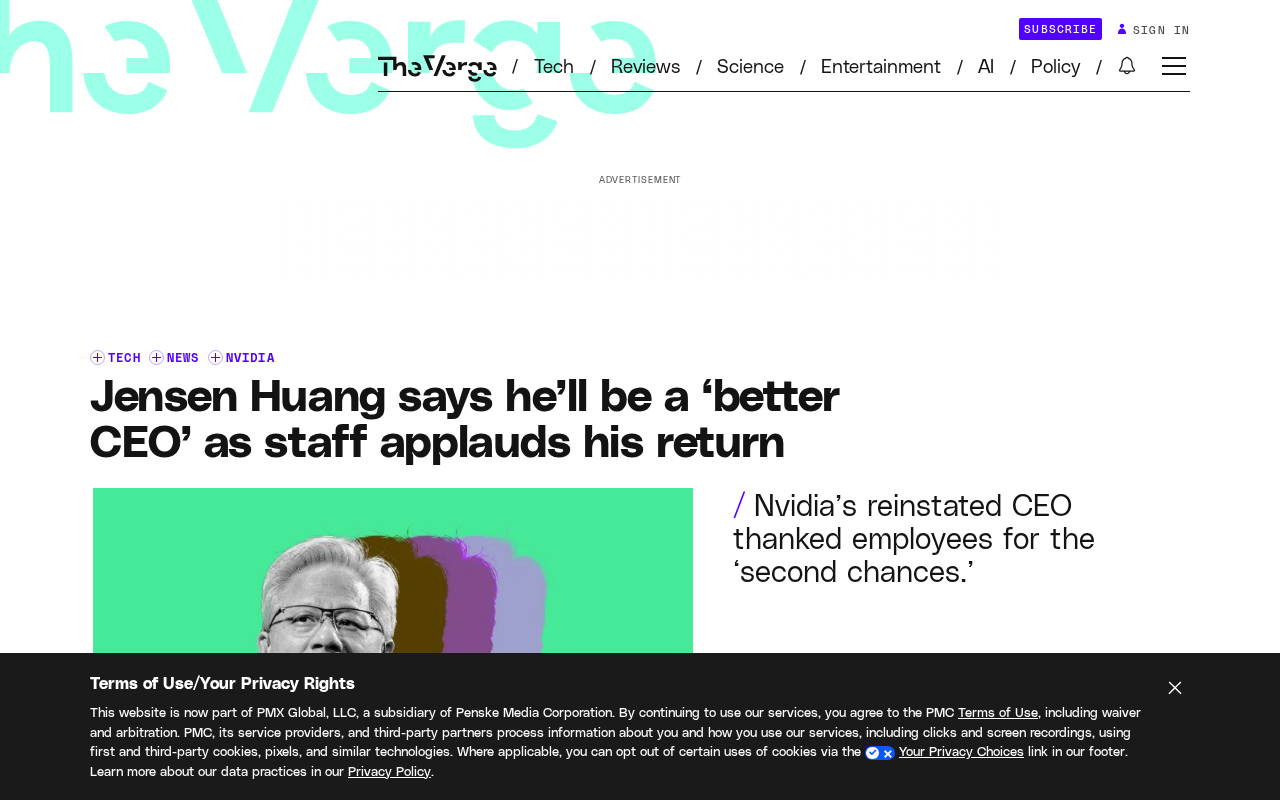
Jensen Huang returns to NVIDIA to resume the CEO role, promising to be a better CEO.
NVIDIA co-founder Jensen Huang returned to the office today, officially resuming the CEO role, and was welcomed by employees with a standing ovation and phone cameras. In the video, Huang said, 'Thank you for giving me a second chance. The second time, I'll be a better CEO.' The article analyzes the governance signals of a founder's return, noting it often accompanies strategic adjustments or crisis response, while employee enthusiasm shows internal recognition of his leadership. However, the source material is limited and does not disclose the reasons for resignation, timeline, interim management changes, or post-return strategy, making it hard to judge whether this is routine or special. Readers are advised to follow official announcements and earnings calls.
NVIDIA co-founder Jensen Huang returned to the office today, officially resuming the CEO role, and was welcomed by employees with a standing ovation and phone cameras. According to a return video, Huang told the gathered employees: "Thank you for giving me a second chance. The second time, I'll be a better CEO."
The Return Scene: Applause and a Promise
Huang's return was full of ceremony. In the video, employees stood up spontaneously and raised their phones to capture the founder's return. Huang's brief remarks focused on gratitude and self-improvement; he acknowledged the "second chance" and promised to be a "better CEO." This statement echoes the background of his earlier resignation from the CEO role, but the original information did not disclose the specific reasons for the resignation or the timeline.
Jensen Huang is one of the co-founders of NVIDIA (NVIDIA). He has served as president and CEO since the company's founding in 1993, making him one of the longest-serving CEOs in Silicon Valley. Under his leadership, NVIDIA transformed from a graphics chip (GPU) vendor into a core infrastructure supplier in the AI computing field; its CUDA parallel computing platform and DGX/HGX series AI systems became the de facto standard for deep learning training. Huang himself is known in the industry for his signature leather jacket image and "Huang's Law" (which argues that GPU performance doubles every two years). Understanding this background helps grasp the special weight of a "founder's return" in the NVIDIA context—he is not only a professional manager but also the shaper of the company's technology roadmap and culture.
Deeper Signals of Leadership Return
From a corporate governance perspective, a founder's return is often accompanied by strategic adjustments or crisis response. Huang's return, which received employee applause and support, shows internal recognition of his leadership. However, the material did not provide details on interim management changes during his resignation, board decision details, or the specific strategic direction after his return, so it is difficult to determine whether this is a routine rotation or a special arrangement.
Founder return is a classic phenomenon in corporate governance research. When a founder leaves for some reason and then takes charge again, the market usually interprets it as the board hoping to rely on the founder's personal authority, strategic intuition, and internal rallying power to cope with uncertainty. Compared with professional managers, founders have a stronger commitment to the company's long-term vision, but they may also bring governance risks such as concentration of power and ambiguous succession planning. Typical cases include Steve Jobs' return to Apple in 1997 and Google founders' return to daily management after Schmidt stepped down. The key to evaluating such events lies in: whether the return is accompanied by changes in board authorization, whether the term and succession arrangements are clear, and whether verifiable strategic adjustments appear after the return.
NVIDIA's Future Direction
Huang's return comes at a time of intensifying competition in the AI chip industry. Although the original text did not mention specific business plans, as a core figure at NVIDIA, his leadership style and decisions will directly affect the company's positioning in AI computing. The enthusiastic reaction of employees may suggest the team's expectation for a stable leadership, but the actual impact needs to be assessed in conjunction with subsequent product roadmaps and financial performance.
The competitive landscape of the AI chip industry is an important background for understanding the impact of NVIDIA's leadership changes. Currently, NVIDIA dominates the data center GPU market, but it faces multiple challenges: AMD's MI series accelerators and Intel's Gaudi chips continue to catch up; cloud vendors' in-house chips such as Google TPU and Amazon Trainium divert demand; U.S. export controls on China affect sales of its high-end products in the Chinese market. At the same time, the generative AI wave is driving rapid growth in AI computing demand, and NVIDIA's H100/H200 and Blackwell architecture products are in short supply. Leadership stability is directly related to the execution of the product roadmap, coordination of the supply chain (such as TSMC's CoWoS advanced packaging capacity), and maintenance of the developer ecosystem (CUDA), so the market is highly sensitive to CEO changes.
Key Information Gaps and Interpretive Boundaries
It should be noted that the original material contains limited information: it does not specify the start and end dates of Huang's resignation, whether the return was accompanied by position adjustments, or the specific management lessons referred to by the "second chance." Therefore, this article only objectively presents the confirmed on-site remarks and employee reactions, and does not over-speculate on undisclosed strategic changes.
For readers following NVIDIA, it is recommended to continue tracking official announcements and earnings calls to obtain authoritative information on leadership stability and corporate strategy.
One-line Summary
Jensen Huang returns to NVIDIA to resume the CEO role, promising to be a better CEO.
Paragraph Summary
NVIDIA co-founder Jensen Huang returned to the office today, officially resuming the CEO role, and was welcomed by employees with a standing ovation and phone cameras. In the video, Huang told the gathered employees: "Thank you for giving me a second chance. The second time, I'll be a better CEO." The article analyzes the signal significance of a founder's return at the corporate governance level, noting that it is often accompanied by strategic adjustments or crisis response, and that the enthusiastic reaction of employees shows internal recognition of his leadership. However, the original material contains limited information and does not disclose the specific reasons for Huang's resignation, the start and end dates, interim management changes, or the specific strategic direction after his return, so it is difficult to determine whether this is a routine rotation or a special arrangement. The article recommends that readers continue tracking official announcements and earnings calls to obtain authoritative information on leadership stability and corporate strategy.
Related articles

Developer Naming Woes: The Technical Names That Drive Us Crazy
Why is technical naming so maddening? From Nginx and Vite to Qt and Sudo, a YouTube creator rants about the chaos of developer naming and pronunciation, revealing the tug-of-war between creators' intentions and community habits, and the cultural roots behind spelling traps like PyPI and GNOME.

Figma Workplace Scandal: Employee Sues CEO for Forcing Confrontation with Harasser
Figma and its CEO are sued by a current employee alleging sexual harassment and discrimination, and forcing the victim to confront her harasser. This article outlines the background, potential impact, and industry reflection.

Jensen Huang and Nvidia: Elite Privilege Behind the Revolving Door of Business and Politics
An opinion piece uses Jensen Huang's reappointment as Nvidia CEO to examine business-government ties and elite impunity, questioning free-market ideals and AI industry governance.