Jensen Huang's "Affair" Buzz Sparks Debate: NVIDIA CEO's Private Life in the Spotlight

The Verge teases Jensen Huang's private-life rumors, sparking debate on tech leaders' privacy and celebrityization
The article examines how tech media outlet The Verge, in a teasing tone, discussed rumors about NVIDIA CEO Jensen Huang's private life. The short piece offered no specific details or reliable sources, merely using "affair singularity" to describe the trend of rumors appearing one after another, yet it quickly spread across communities. The article notes this reflects the tension between public curiosity and personal privacy as tech leaders become increasingly celebrityized; although the CEO's image is deeply tied to company reputation, NVIDIA's business fundamentals show no impact, and no official response has been made. The author urges readers to distinguish entertainment from factual reporting and avoid over-interpretation without evidence, while tech media should focus on products and innovation rather than the CEO's private life.
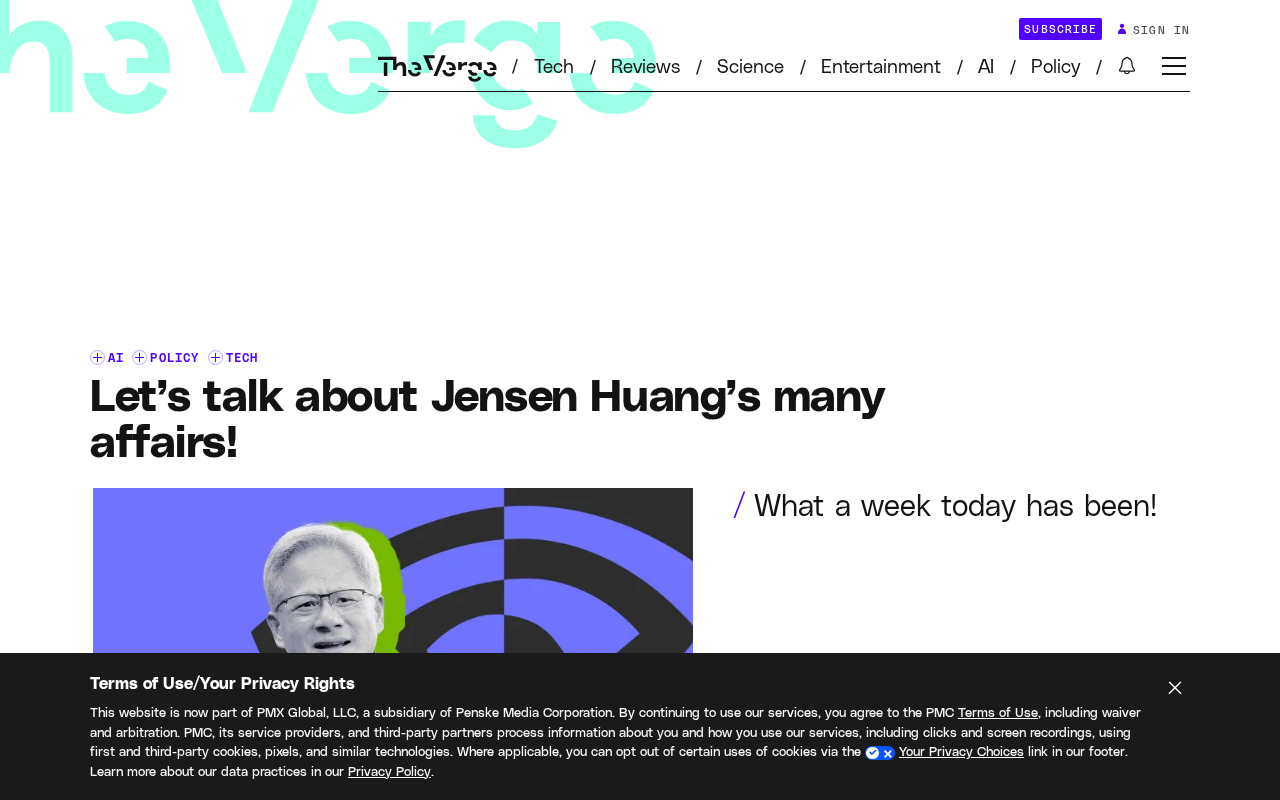
NVIDIA CEO Jensen Huang has recently become the center of public attention due to rumors about his private life. Tech media outlet The Verge, in a short piece written in a teasing tone, discussed his "multiple rumored partners" and even joked that things were "approaching the affair singularity." The story quickly spread across communities, sparking discussion about the privacy and public image of tech leaders.
Origins of the Story: The Verge's Tongue-in-Cheek Report
The Verge's short piece offered no specific details, instead saying in a bemused tone that "we don't know what's going on at NVIDIA either." The author noted that new "rumored partners" for Huang kept appearing, using the phrase "affair Singularity" to describe the trend. This half-joking framing suggests the rumors have already gained some traction on social media, but lack authoritative sourcing to confirm them.
"Singularity" is originally a mathematical and astrophysical concept, referring to a point where spacetime curvature tends toward infinity and existing laws of physics break down—such as the center of a black hole. In tech culture, the term became widely known through Ray Kurzweil's technological singularity theory, used to describe the critical moment when growth curves for technologies like artificial intelligence become nearly vertical and exceed human predictive capacity. The Verge grafted "singularity" onto "affair" to coin the playful phrase "affair Singularity," meaning that new rumored partners for Huang are appearing so densely that it seems to be approaching a critical point where the number of rumors explodes and can no longer be explained by common sense. This isn't a rigorous term but a rhetorical joke borrowing from tech vocabulary—which precisely shows that the topic functions more as a meme than as news on social media.
The Privacy Boundaries of Public Figures
As the head of the world's most valuable semiconductor company, Huang is already under constant scrutiny. But this discussion shifting from products and technology to private life reflects the growing celebrityization of tech leaders. The tension between the public's desire to pry into CEOs' personal lives and their right to privacy is once again brought to the fore. Currently, no mainstream media outlet or NVIDIA official has responded to the matter, and the veracity of the rumors remains in doubt.
The "celebrityization" of tech leaders has been a notable phenomenon over the past decade or so: Steve Jobs's product launches and Elon Musk's social media posts have turned CEOs from behind-the-scenes managers into public idols with fan economies. This shift has dual effects—on one hand, a founder's personal narrative can boost the company's brand and recruiting; on the other, the gossip media and fan scrutiny that come with celebrity follow. Privacy research typically distinguishes between "information relevant to the public interest" and "information that merely satisfies curiosity"—the former, such as financial fraud or health issues, may affect operations, while the latter, such as private romantic relationships, is generally unrelated to job performance. Spreading the latter in the absence of reliable sources can both harm the subject's reputation and easily steer public discussion away from truly important issues.
Potential Impact on NVIDIA
Although rumors about private life usually don't directly affect company operations, against the backdrop of white-hot competition in AI chips, the CEO's public image is deeply intertwined with the company's reputation. Investors and partners may be watching whether this distracts management or affects brand image. However, NVIDIA's business fundamentals currently show no signs of being affected.
"Key person risk" is a common concept in investment analysis, referring to a company's over-reliance on a single executive or founder, whose health, reputation, or departure could deal a major blow to share price and strategic continuity. NVIDIA currently dominates the AI accelerator chip market, and its CUDA software ecosystem and product roadmap rely heavily on Huang's personal judgment and external communication, so investors are naturally sensitive to changes in his image. However, key person risk is typically only seriously priced in when events involve job performance, legal compliance, or corporate governance; unverified rumors about private life are mostly noise, and institutional investors generally wait for official responses or substantive evidence rather than adjusting positions based on social media jokes.
Taking Unverified News Rationally
In an era of fragmented information, a teasing short piece can be amplified into "news." Readers should remain cautious and distinguish entertainment discussion from factual reporting. Regarding Huang's "affairs," in the absence of reliable evidence, it should not be over-interpreted. The role of tech media should be to focus on products and innovation, not the CEO's private life.
One-line Summary
The Verge teases Jensen Huang's private-life rumors, sparking discussion about tech leaders' privacy and celebrityization
Paragraph Summary
The article centers on tech media outlet The Verge's teasing discussion of rumors about NVIDIA CEO Jensen Huang's private life. The short piece provided no specific details or reliable sources, merely using "affair singularity" to describe the trend of rumors appearing one after another, yet it quickly spread across communities. The article notes that this reflects the tension between public curiosity and personal privacy as tech leaders become increasingly celebrityized; although the CEO's image is deeply tied to the company's reputation, NVIDIA's business fundamentals show no sign of impact, and officials have not responded. The author calls on readers to distinguish entertainment discussion from factual reporting, avoid over-interpretation without evidence, and for tech media to focus on products and innovation rather than the CEO's private life.
Related articles

HarborRL Update: Elastic Scaling and SSH-Free Cluster Deployment
HarborRL, an open-source Agentic RL framework, releases an update: elastic gateway scaling with automatic idle resource reclamation, SSH-free cluster deployment via HTTP task pulling, a unified RL training pipeline based on Slime, and improvements to the configuration wizard and sandbox execution—lowering the engineering barrier for distributed agent reinforcement learning.

Tutu Livestream Transcript: A Real Snapshot of the Streamer-Fan Ecosystem
From Bilibili streamer Tutu's livestream transcript, observe a solo streamer's real survival state amid technical glitches, badge payment systems, and PK traffic competition, and analyze long-tail streamers' professional cognition and emotional labor.

Bilibili Live Streaming Ecosystem: Interaction, Tipping, and the Traffic Game in a Co-Streaming Session
From a Bilibili co-streaming session, we observe streamer interactions, the tipping economy, and PK gameplay, analyzing the complex relationship between authenticity and performance, traffic and emotion in the livestream ecosystem.