Jensen Huang's Messy Moment: Inside Nvidia's Leadership Crisis
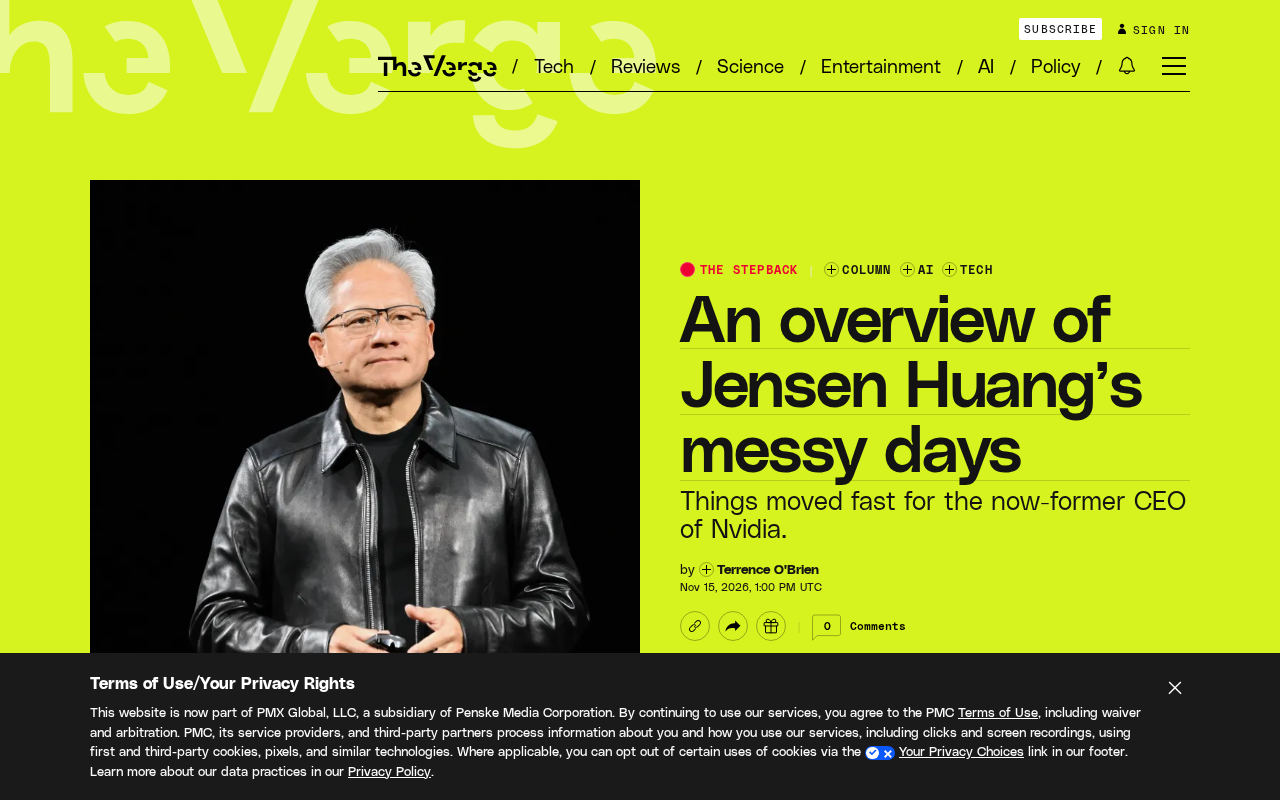
Tech media spotlight Jensen Huang's "messy days" as Nvidia's leadership crisis draws industry attention.
Engadget's newsletter The Stepback ran a piece titled "Jensen Huang's messy days," stating Nvidia is going through a leadership crisis. Anchored in October, it previews a breakdown of Huang's "resignation" rumors and fallout. The article argues Huang's personal style is deeply tied to Nvidia's ecosystem, so any talk of his future amplifies doubts about strategic continuity, and a substantive leadership change could affect customer confidence and accelerate industry diversification of compute supply.
Every move Nvidia CEO Jensen Huang makes tends to set the tech world on edge, but lately he has faced a situation that clearly goes beyond the usual product launch or earnings-call analysis. This week, The Stepback, a newsletter under Engadget, focused on "Jensen Huang's messy days" and stated bluntly that Nvidia is going through a "leadership crisis." Although the original piece offers only an opening and a subscription prompt, the limited clues and industry context are still enough to sketch the outline of this turmoil.
Where It Began: An Anchor Point in October
The original The Stepback piece leaves a cliffhanger with "How it started" and "On October...," firmly anchoring the timeline in October. Judging by the reporting rhythm of English-language tech media, this usually points to a public statement or company decision that triggered a chain reaction—for Nvidia, that could involve product roadmaps, supply chain arrangements, or executive personnel changes. The original article previews an in-depth breakdown of "Jensen Huang's resignation and the fallout from Nvidia's leadership crisis," and that phrasing alone is eye-catching enough: a CEO known for his forceful style and long regarded as the soul of the company—the word "resignation" appearing in a newsletter's introduction, whether it ultimately refers to resignation rumors, a role adjustment, or some kind of metaphor, means outside attention to Nvidia's governance structure has reached a new high.
GTC (GPU Technology Conference) is Nvidia's annual technology conference, held every year since 2009, and Huang's keynote has long been the core stage for unveiling new architectures, roadmaps, and ecosystem partnerships. The GTC keynote is not just a product launch but a key ritual through which Nvidia communicates its strategic direction and rallies developer and customer confidence. Huang almost single-handedly carries this external communication role, making GTC a bellwether for observing the continuity of Nvidia's strategy. Once the CEO's personal state or corporate governance fluctuates, the expectation-management function GTC bears is the first to be hit—which is one reason the media discusses the leadership issue alongside product roadmaps and supply chain arrangements.
Multiple Readings of the Leadership Crisis
"Leadership crisis" is not a light label. With Nvidia's market cap and industry influence at historic highs, any discussion about the CEO's future is amplified into doubts about the continuity of company strategy. On one hand, Huang's personal style is deeply intertwined with Nvidia's ecosystem—from GTC keynotes to developer relations, he is almost the sole core of the company's external communication; on the other hand, as the AI chip race reaches a fever pitch, competitors and customers are reassessing the risk of relying on a single supplier. The emergence of the phrase "messy days" at this moment suggests the problem may go beyond a single PR misstep to deeper issues such as decision-making transparency, succession planning, or internal power balance.
Why the Media Chose This Moment to Strike
The Stepback positions itself as "breaking down one key story in tech each week," and choosing Huang as its subject shows the matter has acquired public-discussion value beyond the semiconductor circle. The writing logic of a subscription newsletter often is not to chase breaking news but to provide context and judgment, so the value of this report lies not in scoops but in stringing scattered signals into a narrative line. For those watching the AI industry, this offers an opportunity to re-examine Nvidia's power structure.
Succession planning is a core issue in corporate governance, referring to the institutional arrangements through which a company identifies and develops successors for key executive positions (especially the CEO) in advance. For tech companies dominated by founder-type CEOs, succession planning is often absent for long periods, because the founder's personal authority is deeply tied to the company brand and boards find it hard to proceed with a transition without triggering market turmoil. Nvidia has long been led by Huang as CEO, and little is known externally about its succession arrangements, which makes any discussion of his future easily amplified into doubts about governance transparency. Mature succession planning usually includes an internal candidate pipeline, board oversight mechanisms, and a phased handover plan; the lack of these arrangements significantly raises the risk premium on the continuity of company strategy.
Potential Ripples for the AI Industry
Nvidia's stability is directly tied to expectations for global AI compute supply. If there is a substantive change in leadership, it could in the short term affect customer confidence and the pace of long-term agreements with partners; in the long term, it could accelerate the industry's exploration of "de-risking single-vendor dependence," including in-house chips and multi-supplier strategies. Of course, before more details are disclosed, these remain inferences based on limited information. The "fallout" emphasized in the original piece is precisely a reminder to readers that the real story may still be ahead.
For content creators and investors, the point of following this kind of narrative is to distinguish signal from noise. Whether Huang's "messy days" are a brief storm of public opinion or the starting point of a turning point in Nvidia's governance model depends on subsequent factual disclosures. When information is still incomplete, staying attentive to primary sources is more valuable than rushing to conclusions.
"De-risking single-vendor dependence" is a systemic strategy in the AI compute supply chain. Because Nvidia GPUs hold a dominant share of the training and inference markets, cloud providers and AI companies have long faced supply concentration risk: once capacity, pricing, or partnership relations change, downstream R&D and deployment pace are affected. As a result, large customers have accelerated in-house chip development in recent years (such as Google TPU and Amazon Trainium), brought in second suppliers like AMD, and locked in capacity through long-term agreements. This diversification effort is not meant to replace Nvidia but to lower switching costs and strengthen bargaining power. Leadership changes would reinforce customers' concerns about supply stability, thereby accelerating the implementation of these strategies.
One-line Summary
Tech media spotlight Jensen Huang's "messy days" as Nvidia's leadership crisis draws industry attention.
Paragraph Summary
This week, Engadget's newsletter The Stepback ran a piece titled "Jensen Huang's messy days," stating bluntly that Nvidia is going through a leadership crisis. Anchoring the timeline in October, the original article previews a breakdown of Huang's "resignation" rumors and the fallout; although it discloses only an opening and a subscription prompt, it is enough to draw outside attention to Nvidia's governance structure. The article argues that Huang's personal style is deeply tied to Nvidia's ecosystem, so any discussion of his future amplifies doubts about the continuity of company strategy; as the AI chip race intensifies, a substantive leadership change could affect customer confidence and accelerate the industry's exploration of diversified compute supply. The author reminds readers to stay attentive to primary sources when information is incomplete.
Related articles

Gemini 4 Neon Review: Benchmark Scores Rival Carbon, API Pricing and Quota Breakdown
Google Gemini 4 Neon is now live, benchmark scores closely tracking Carbon, API pricing 3/15 at twice Hydrogen's rate. This article compiles Bilibili creator testing: Neon can replace 90% of Carbon scenarios, AntiGravity quota consumption is only one-third of Carbon, plus subscription channel restrictions and 2API ban risks.

Gemini 4 Helium Coming Soon? Signals of Google Loosening Subscription Restrictions
Google team member hints releases will continue; community speculates Gemini 4 Helium (Flash Lite) may be next. Subscription ban controversy gets a response as product lead says "Soon," suggesting restrictions may be lifted. This article covers Gemini developments, OpenAI Coding Agent and risk management, Doubao real-time audio-video API, and compute business dynamics.

AI-Assisted React Development in Practice: Optimizing a Video App and Handling Errors
A 14-year veteran developer demonstrates AI-assisted React video app optimization: compressing video from 80MB to 5MB (~94%) via ImageKit, plus reliable error handling and retry mechanisms. Includes planning, code understanding, and verification methods for working with AI.