Jensen Huang Skips Both ElevenLabs and Anthropic Events, Nvidia Controversy Continues to Simmer

Jensen Huang pulls out of Anthropic and ElevenLabs events as Nvidia faces an unspecified controversy.
Nvidia CEO Jensen Huang recently canceled two major industry appearances: first withdrawing from an Anthropic-related event, then skipping the ElevenLabs Summit. The original report cites "Nvidia controversy" as context but discloses no specifics. Anthropic is a major large-model player and ElevenLabs a leading voice AI company, both closely tied to Nvidia's GPU ecosystem. Consecutive CEO-level absences are typically read as a sign of cautious assessment of public opinion or legal risk, and could affect partners' willingness to engage publicly and customers' supply chain concentration concerns. With controversy details, official explanations, and organizer responses all missing, the full picture awaits more sources—currently best treated as an industry signal rather than a complete narrative.
Jensen Huang Skips Two Major Events in a Row, Timing Raises Questions
Nvidia CEO Jensen Huang has recently and abruptly canceled appearances at two major industry events, prompting widespread attention to the current situation facing the AI chip giant. According to an RSS source report, Huang first withdrew from an Anthropic event and subsequently was absent from the ElevenLabs Summit. Both events are directly tied to the most closely watched companies in the AI space, and Huang's consecutive withdrawals are being interpreted as a sign that Nvidia is facing some kind of controversy requiring cautious handling.
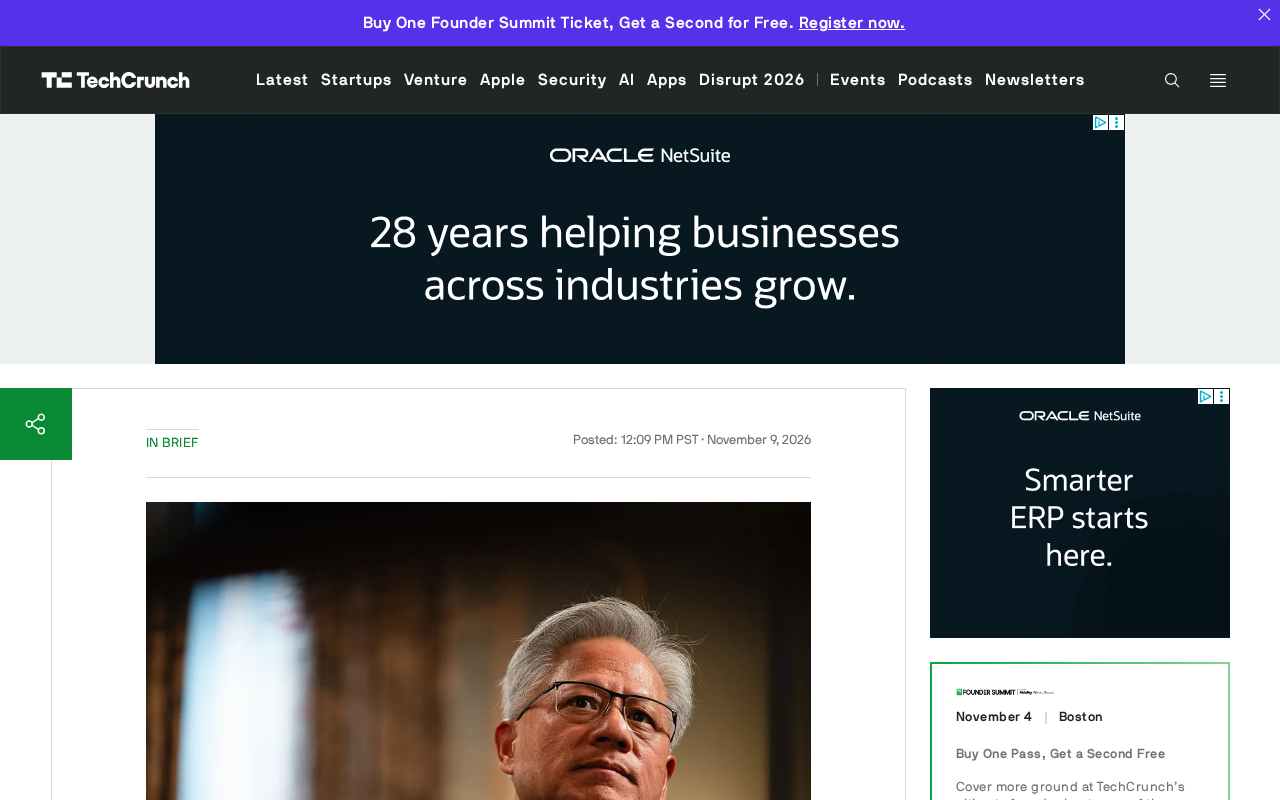
According to the original report, Huang's withdrawals were not isolated incidents. He first canceled his appearance at an Anthropic-related event, then pulled out of the ElevenLabs Summit. ElevenLabs is a representative company in the voice AI space, while Anthropic is a major player in the large model arena—both have deep ties to Nvidia's AI ecosystem.
The report uses "amid Nvidia controversy" to describe the backdrop of these withdrawals, but the original material does not specify the nature or details of the controversy. From a communications perspective, a top chip company CEO canceling public appearances in quick succession typically signals that his team has made a cautious assessment of the public opinion environment or legal risks.
Anthropic is an AI safety and research company headquartered in San Francisco, founded in 2021 by former OpenAI VP of Research Dario Amodei and others. Its core product is the Claude series of large language models, known for its "Constitutional AI" training approach that emphasizes model controllability and safety. Anthropic has received billions of dollars in investment from giants like Google and Amazon, and is a top-tier player in the large model race alongside OpenAI, as well as a major purchaser of Nvidia GPUs.
ElevenLabs is a startup focused on generative voice AI, founded in 2022 and known for highly realistic text-to-speech (TTS) and voice cloning technology. Its products are widely used in audiobook production, game voiceover, accessible reading, and other scenarios, and it has expanded into multilingual dubbing and voice agent capabilities. As generative AI evolves from text toward multimodality, ElevenLabs is regarded as a representative company in the voice track, and its model training and inference similarly rely on large-scale GPU compute.
Where Does Nvidia's "Controversy" Come From?
The original material only mentions "Nvidia controversy" in passing without elaborating on the specifics. This means that public information about the controversy itself is currently limited, and excessive speculation is not warranted. What can be confirmed is that Huang's withdrawals are directly related to this controversy, and the impact has already reached important AI industry events.
For those following the AI industry, Nvidia's every move is a bellwether. As the core supplier of AI compute, its CEO's public schedule is often seen as a thermometer for industry relationships. Consecutive withdrawals from AI company-related events at least suggest that Nvidia is currently in a phase requiring a low profile.
Nvidia's dominant position in the AI compute market is key to understanding the backdrop of its "controversy." According to industry estimates, Nvidia's share of the data center AI accelerator market has long exceeded 80%, and its CUDA software ecosystem creates extremely high migration barriers. This highly concentrated market structure places Nvidia at the intersection of antitrust scrutiny, customer bargaining dynamics, and discussions about supply chain allocation fairness. In recent years, regulators in the US, EU, and China have all kept a close eye on Nvidia's M&A transactions and market behavior, and some cloud providers and AI companies are pushing for in-house chips or diversified procurement to reduce dependence. Therefore, any "controversy" rumors surrounding Nvidia are easily interpreted within this broader industrial tension, and changes in Jensen Huang's public schedule are naturally viewed as a window into observing these tensions.
Potential Impact on the AI Ecosystem
ElevenLabs and Anthropic represent two key directions—voice AI and large models—and both are important users or ecosystem partners of Nvidia GPUs. While CEO-level absences do not directly equate to changes in partnerships, they are easily amplified by the market during sensitive periods.
From an industry analysis perspective, the impact of such events is more about confidence levels. If Nvidia's controversy continues to simmer, it could affect partners' willingness to interact with the company publicly and may prompt some customers to reassess supply chain concentration risks. Of course, these are reasonable inferences based on available information; the original report does not provide specific details about the controversy.
Information Gaps and What to Watch Next
It must be noted that this report contains fairly limited information. The specifics of the controversy, the official explanation for Huang's withdrawals, and responses from the event organizers are all absent from the original material. Readers consuming this news should treat it as a signal rather than a complete narrative.
Key developments to watch include: whether Nvidia issues a formal statement about the controversy, whether Huang resumes public appearances, and whether ElevenLabs or Anthropic make any related comments. Until more information surfaces, any characterization of the "Nvidia controversy" is premature.
Related articles

Gemini 4 Neon Review: Benchmark Scores Rival Carbon, API Pricing and Quota Breakdown
Google Gemini 4 Neon is now live, benchmark scores closely tracking Carbon, API pricing 3/15 at twice Hydrogen's rate. This article compiles Bilibili creator testing: Neon can replace 90% of Carbon scenarios, AntiGravity quota consumption is only one-third of Carbon, plus subscription channel restrictions and 2API ban risks.

Gemini 4 Helium Coming Soon? Signals of Google Loosening Subscription Restrictions
Google team member hints releases will continue; community speculates Gemini 4 Helium (Flash Lite) may be next. Subscription ban controversy gets a response as product lead says "Soon," suggesting restrictions may be lifted. This article covers Gemini developments, OpenAI Coding Agent and risk management, Doubao real-time audio-video API, and compute business dynamics.

AI-Assisted React Development in Practice: Optimizing a Video App and Handling Errors
A 14-year veteran developer demonstrates AI-assisted React video app optimization: compressing video from 80MB to 5MB (~94%) via ImageKit, plus reliable error handling and retry mechanisms. Includes planning, code understanding, and verification methods for working with AI.