JetBrains Air: A Deep Dive into Its Agentic Software Development Product System

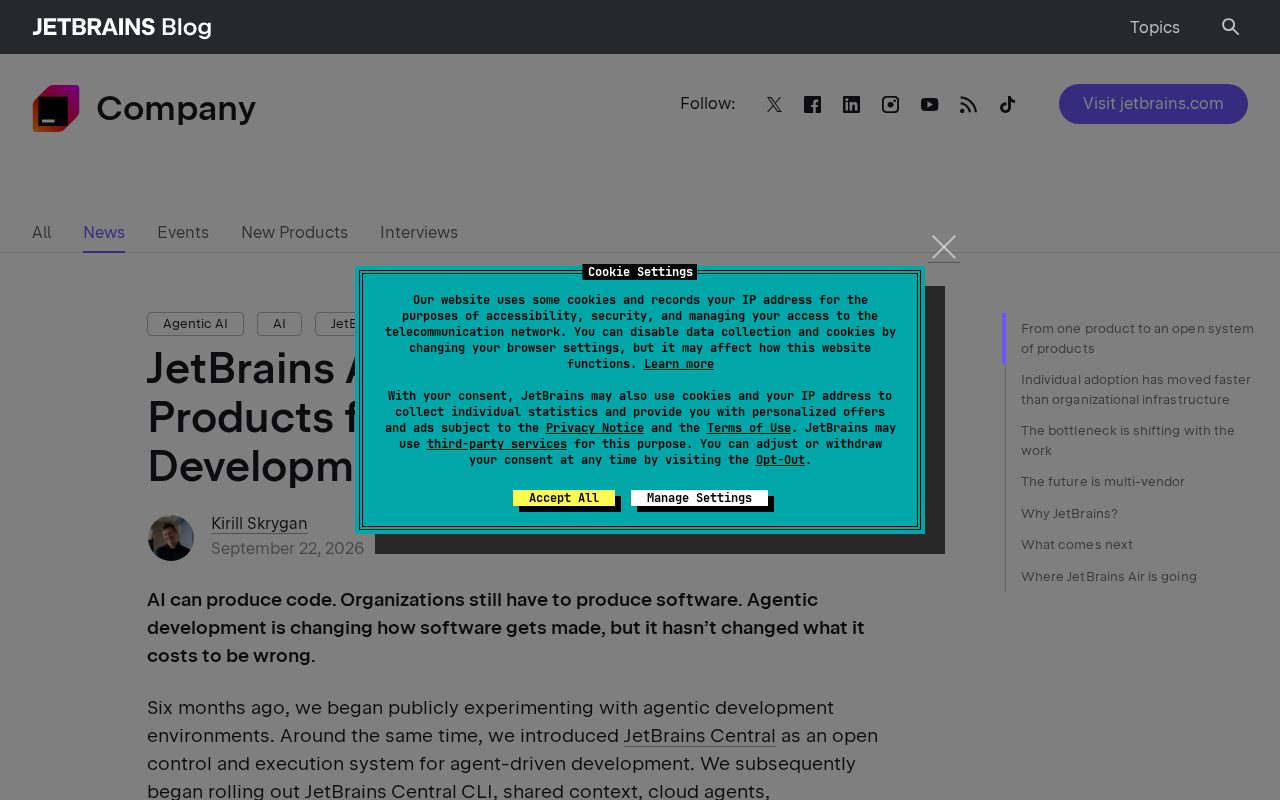
JetBrains Air combines mature code analysis with AI agents to autonomously handle complex development tasks.
JetBrains Air is an established IDE vendor's systematic response to the agentic software development wave, targeting the third stage of AI coding evolution — where AI doesn't just passively autocomplete but autonomously plans, refactors across files, fixes bugs, and writes tests. Its core competitive logic lies in embedding JetBrains' deep code semantics and static analysis capabilities directly into the agent execution layer, addressing the reliability gaps that tools relying purely on LLM "guesses" face in complex projects. Community concerns around local model support, data privacy, pricing, and real-world agent performance — alongside the risk of losing change control to over-autonomous AI — remain the key tests this direction must pass.
What Is JetBrains Air
JetBrains Air is not a standalone IDE — it's a comprehensive product system built around "Agentic Software Development." In this paradigm, AI is no longer a passive assistant that completes a single line of code or answers an isolated question. Instead, it understands task objectives, autonomously plans steps, invokes tools, and executes continuously. JetBrains — the company behind IntelliJ, PyCharm, GoLand, and other mainstream IDEs — is placing a major bet on deeply embedding AI throughout the entire development workflow.
The name itself signals JetBrains' ambition: "Air" evokes something lightweight and omnipresent, suggesting an experience where AI capability is woven into every aspect of coding like the air around you — not bolted on as a plugin. This represents a fundamental departure from the AI code completion tools (think Copilot-style autocomplete) that have dominated the conversation over the past few years.
From Code Completion to Agentic Collaboration
Over the past two years, AI programming tools have evolved through roughly three stages: single-line completion, conversational Q&A, and now autonomous agentic execution. JetBrains Air targets that third stage, emphasizing AI that can understand project structure across files and modules, then independently handle complex tasks like refactoring, bug fixing, and test writing.
The framing as a "System of Products" is worth noting. It signals that JetBrains isn't responding to market competition with a single feature, but rather building an interconnected matrix of tools — likely including an agent runtime, a code comprehension engine, and deep integration with existing IDEs. For developers who have long relied on the JetBrains ecosystem, the appeal of this integrated approach lies in continuity: AI capabilities built directly on top of JetBrains' existing code indexing and static analysis infrastructure — precisely the kind of technical foundation that many lightweight AI editors lack.
What is an "Agent"? In AI engineering, an agent specifically refers to a system with a perceive-plan-act loop: it reads environmental state (such as a codebase file tree, test results, or compiler errors), formulates multi-step plans, invokes external tools (file I/O, terminal commands, search engines), and dynamically adjusts its next action based on execution results. The fundamental difference from single-turn Q&A models is persistence — an agent can iterate repeatedly within a task until the goal is achieved or a human intervenes. Current mainstream implementations include the ReAct (Reasoning + Acting) framework, OpenAI's Function Calling / Tool Use, and Anthropic's Claude tool-calling protocol. In software development contexts, agents typically also need the ability to understand code symbol trees (ASTs) — which is exactly where JetBrains' existing static analysis engine can contribute directly.
Strategic Considerations in a Competitive Landscape
The AI coding space is intensely competitive, with Cursor, GitHub Copilot, and a growing array of open-source-model-based editors constantly emerging. JetBrains' core challenge is converting its deep language toolchain expertise into a differentiated competitive advantage in the agentic era.
JetBrains' traditional moat is its deep understanding of code semantics — its IDEs perform precise type inference, cross-reference navigation, and safe refactoring. These are exactly the capabilities that allow agents to execute tasks reliably. By contrast, tools that rely purely on large language models to "guess" code structure tend to make errors in complex projects. If Air can effectively combine this deterministic code analysis with AI's generative capabilities, it could theoretically establish a meaningful reliability advantage.
That said, the Hacker News discussion (39 points, 26 comments) reflects a wait-and-see attitude among developers. Common concerns in the community around agentic development tools include: local model support, data privacy, subscription pricing, and whether agents actually perform as advertised in real-world, large-scale codebases.
Competitive Context: Cursor is currently the most prominent AI-native code editor on the market — a heavily customized fork of VS Code, built around its "Composer" multi-file editing and Codebase semantic indexing features. It has rapidly accumulated a large user base and secured significant funding. GitHub Copilot, backed by Microsoft and OpenAI's model resources, reaches nearly every major IDE as a plugin and commands the largest subscriber base. Both share a common limitation: their code comprehension layer relies primarily on large model vector embeddings, lacking the deterministic semantic analysis that traditional IDEs achieve through Language Server Protocol (LSP) and compiler frontends. This translates to a predictable error rate for refactoring, cross-language projects, or precise operations in strongly typed languages like Kotlin or Scala. If JetBrains can use IntelliJ Platform's symbol resolution capabilities as a reliable "map" for its agents — rather than letting the model guess at code topology — it would create a structural advantage on the reliability dimension.
What This Means for Developers
For teams already embedded in the JetBrains ecosystem, Air reduces the motivation to migrate to a standalone AI editor — they can gain agentic capabilities within a familiar environment. For teams still evaluating their options, a few practical questions deserve attention: How controllable is the agent's autonomy? Can it request confirmation before critical operations? And how broad is its understanding of the code context?
The core risk of agentic development is excessive autonomy. When AI can independently modify multiple files and run commands, the developer's ability to review and control changes becomes critical. A mature agentic product system must strike a balance between automation efficiency and human oversight — not simply race toward "full automation."
Conclusion
JetBrains Air represents an established IDE vendor's formal response to the agentic development wave. Its technical starting point — a mature, battle-tested code comprehension engine — is its greatest asset. But whether that advantage can truly translate into an agentic experience that is useful, reliable, and controllable remains to be proven in real-world use. For developers tracking where AI-assisted programming is headed, this is a product direction well worth following closely.
Related articles

Free Unlimited Claude Code Solution: Agnes AI + CC Switch Setup Guide
No paid subscription needed — pair the free AI platform Agnes AI with the open-source tool CC Switch to provide a backend for Claude Code, enabling unlimited free calls to text, image, and video models. This guide covers the full setup, test results, and usage boundaries.

A Complete Zero-Cost Guide to Getting Started with Claude Code for Beginners in China
A beginner's guide to Claude Code for users in China: two installation methods (command line and IDE plugin), full configuration steps for replacing the official API with the free domestic LongCat model, and a hands-on demo of building a small tool with natural language, plus tips.

When the NSA Gets Involved: The AI Supply Chain Crisis Behind Open-Source CVEs and API Key Hijacking
Multiple open-source projects disclosed severe CVEs in one day, PHP flaws alarmed the FBI, and Railway and OpenCode were breached with API keys stolen. This article breaks down the vulnerability window, AI-accelerated exploitation, and the AI supply chain crisis behind the API key black market, with a developer defense checklist.