Jev: A New Frontier Model Claiming 40–400x Lower Cost and 20–200x Faster Inference

Jev claims 40–400x lower cost and 20–200x faster inference — but the wide ranges demand independent verification.
A new frontier model called Jev has drawn attention on Hacker News for claiming 40–400x cost reduction and 20–200x faster inference compared to existing frontier models. The article argues that cost and latency have overtaken raw capability as the key bottlenecks for AI deployment at scale, with low latency directly enabling voice interaction, real-time code completion, and Agent systems. However, such wide numeric ranges are highly condition-dependent, and readers should scrutinize baselines, capability parity, and reproducibility. Likely efficiency sources include MoE architecture, speculative decoding, quantization, and vertical specialization. Developers are advised to run independent evaluations against real workloads rather than trusting marketing figures.
Jev Arrives: Redefining the Price-Performance Bar for Frontier Models
A new frontier model called Jev has sparked heated discussion on Hacker News, with a striking core pitch: compared to existing frontier models, it claims to reduce costs by 40 to 400x and improve inference speed by 20 to 200x. The post garnered 104 upvotes and 21 comments — a clear signal that the developer community is paying close attention to efficiency breakthroughs in AI.
As large language model capabilities continue to advance, cost and latency are increasingly becoming the critical bottlenecks that determine whether a technology can scale in production. By leading with such aggressive quantitative comparisons, the Jev team has zeroed in on the two most acute pain points in the industry right now: inference economics and response speed.
Why Cost and Speed Have Become the New Battleground
Over the past two years, the frontier model race has gradually shifted from "who's smarter" to "who's more cost-effective." As model quality converges, enterprises deploying AI at scale quickly discover that inference cost — not raw capability — is often what breaks the budget. An application handling millions of calls per day can save enormously even from a modest reduction in token pricing, let alone the tens-to-hundreds-of-times gap Jev is claiming.
Speed matters just as much. A 20 to 200x reduction in latency means that many real-time interaction scenarios previously deemed impractical — voice conversations, real-time code completion, high-frequency Agent calls — could suddenly become viable. Low latency doesn't just improve user experience; it directly affects the usability of Agent-based systems, where each step in a multi-turn reasoning chain compounds the overall delay.
How to Think About These "Jaw-Dropping Numbers"
Faced with wide-range figures like 40–400x and 20–200x, technically minded readers should stay appropriately skeptical. The wider the range, the more the results depend on specific testing conditions — peak figures may only be achievable under particular tasks, specific baseline comparisons, or favorable batch-processing setups.
Some key questions worth asking:
- What is the comparison baseline? Whether Jev is benchmarked against top-tier closed-source frontier models or against a specific smaller model makes a huge difference.
- Is capability held constant? Efficiency gains that come at the cost of significant quality degradation make "cheap and fast" a much weaker value proposition.
- Are the test scenarios reproducible? Marketing figures are often drawn from best-case conditions; real-world production performance requires independent validation.
Hacker News is famously critical, and those 21 comments likely contain sharp challenges to methodology, benchmarks, and real-world usability. That kind of community scrutiny is precisely the best lens through which to assess any new model's credibility.
Possible Paths to Such Efficiency Gains
Although the original announcement doesn't disclose Jev's technical details, industry trends suggest that efficiency improvements of this magnitude typically come from a combination of several approaches:
Architecture and Model Scale Optimization
Through more efficient model architectures, sparse activation (such as MoE), or targeted model distillation, a model can approach comparable capability with far fewer active parameters per inference — dramatically reducing compute cost per call.
MoE (Mixture of Experts) is one of the most impactful architectural innovations for efficiency in recent years. The idea is to split the model into multiple "expert" sub-networks, activating only a small subset (typically 2–8) per inference rather than the full parameter set as in dense models. This means the model's total parameter count can be large (preserving capability headroom), while the actual compute per inference represents only a fraction — significantly reducing the per-call resource footprint. GPT-4, Mixtral, DeepSeek, and other leading models have all adopted MoE or similar sparse-activation approaches. Model distillation offers another path: training a smaller "student" model on outputs from a larger "teacher" model, allowing the student to approximate the teacher's performance on specific tasks at a fraction of the inference cost. Used together, these techniques can compress inference costs by one to two orders of magnitude without significant quality loss.
Inference Systems Engineering
System-level techniques such as quantization, speculative decoding, KV cache optimization, and batching schedulers can substantially increase throughput and reduce costs without changing the model itself. Order-of-magnitude speed improvements frequently originate from exactly this kind of engineering work.
Speculative Decoding is a widely adopted inference acceleration technique worth highlighting specifically. The core idea: a lightweight "draft model" rapidly generates several candidate tokens, which the main model then verifies and accepts or rejects in parallel — delivering significantly higher throughput compared to serial token-by-token generation. KV Cache (Key-Value Cache) addresses the Transformer attention mechanism by reusing previously computed key-value pairs, avoiding redundant computation over historical context — especially beneficial in long-context or multi-turn conversation scenarios. Quantization refers to compressing model weights from FP32/FP16 to INT8 or even INT4 representations, dramatically reducing memory footprint and compute bandwidth requirements at acceptable precision loss. These engineering techniques stack on top of one another, and their combined effect has been the primary driver of rapid inference cost reduction over the past two years — making them the most likely technical source behind any claimed tens-of-times speed improvement from Jev.
Specialization Trade-offs
If Jev targets specific tasks rather than pursuing general-purpose breadth, achieving extreme efficiency through a more focused design in a vertical domain is a perfectly rational product strategy.
What This Means for Developers
Regardless of whether Jev ultimately delivers on all its claims, the trend it represents deserves attention from every practitioner: efficiency is becoming the primary competitive dimension for frontier models. For teams building AI applications, this means future model selection will offer more flexibility to trade off cost, speed, and capability based on actual needs.
Developers who are curious should go beyond the marketing numbers and run their own evaluations on tasks that closely match their real workloads — using actual data and realistic traffic patterns to verify whether "cheaper" and "faster" hold up in practice. Only efficiency gains that survive independent reproduction represent genuine technical progress.
Conclusion
Jev has entered the scene with a bold price-performance claim that directly addresses the core pain points of deploying large models at scale. Whether it turns out to be another round of marketing-inflated numbers or a genuine efficiency paradigm shift will require more technical detail, independent benchmarks, and community-driven testing to determine. Until then, staying engaged while maintaining healthy skepticism is exactly the right posture toward numbers this dramatic.
Related articles
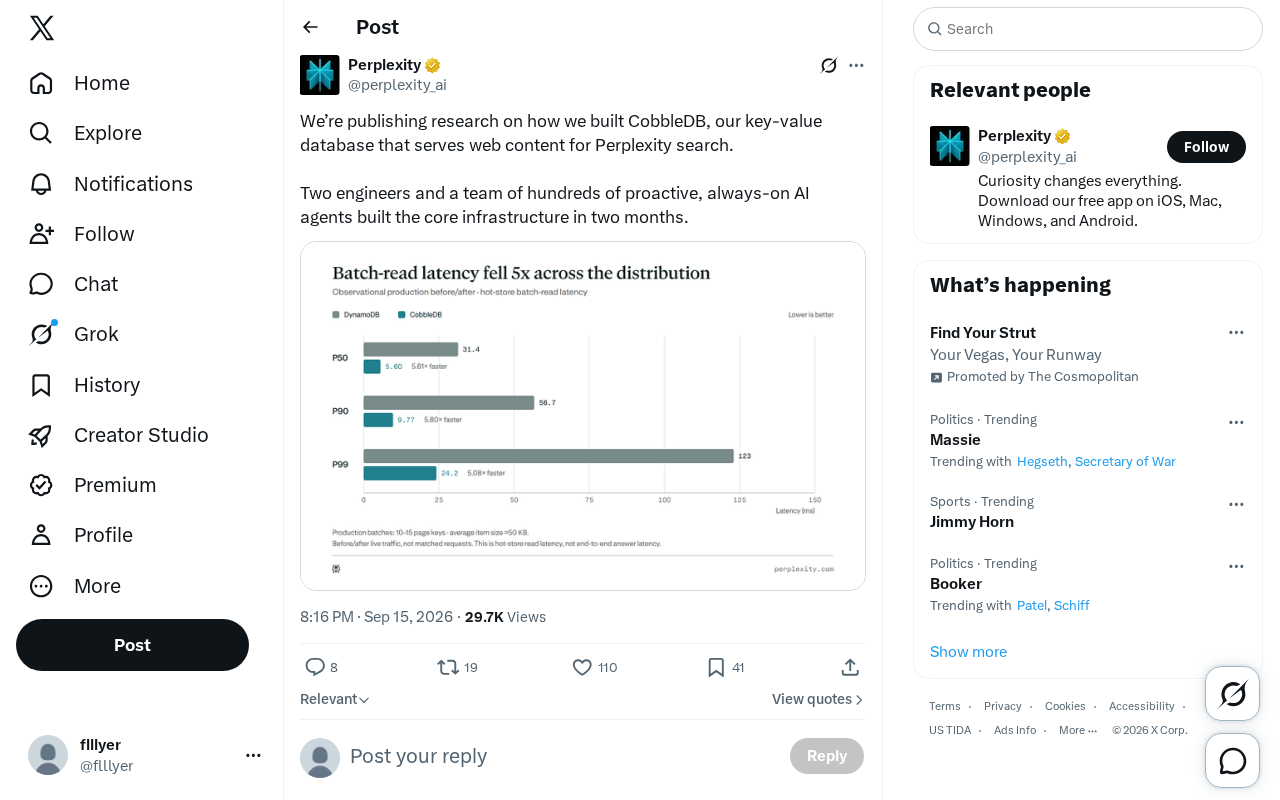
Perplexity's In-House CobbleDB: 2 Engineers + Hundreds of AI Agents Built Search Infrastructure in 2 Months
Perplexity reveals CobbleDB, an in-house key-value database built by just 2 engineers and hundreds of AI agents in two months, signaling a new era of AI-driven software development.

Complete Guide to Running Your Own Local DeepSeek: Web Access, Knowledge Base & Privacy
Step-by-step guide to deploying a private DeepSeek locally using Ollama, Chatbox, and AnythingLLM — with web access, RAG knowledge base, and full privacy.
AI Agent Development: A 4-Stage Learning Roadmap from Beginner to Enterprise-Level Practice
A complete AI Agent learning roadmap from zero to enterprise-level: covering ReAct, multi-agent collaboration, Prompt tuning, RAG, MCP, and real-world projects.