Jev + LangGraph: Building AI Agents with Complex Systems Thinking

LangGraph handles macro orchestration while Jev accelerates micro-decisions — a practical architecture for production AI agents.
This article explores an architectural insight from social media: modeling AI agents as complex systems rather than linear pipelines better reflects real-world task branching and looping. LangGraph uses a graph abstraction — nodes, edges, and global state — to describe agent workflows, naturally supporting cyclic reasoning and conditional branching. Jev handles the numerous small, frequent micro-judgments inside those workflows, replacing expensive large-model calls with fast responses to turbocharge the overall system. Together, LangGraph builds the macroscopic skeleton while Jev accelerates its internal decision capillaries — directly addressing the core production challenge of maintaining flexibility while controlling inference cost and latency.
Modeling Agents as Complex Systems
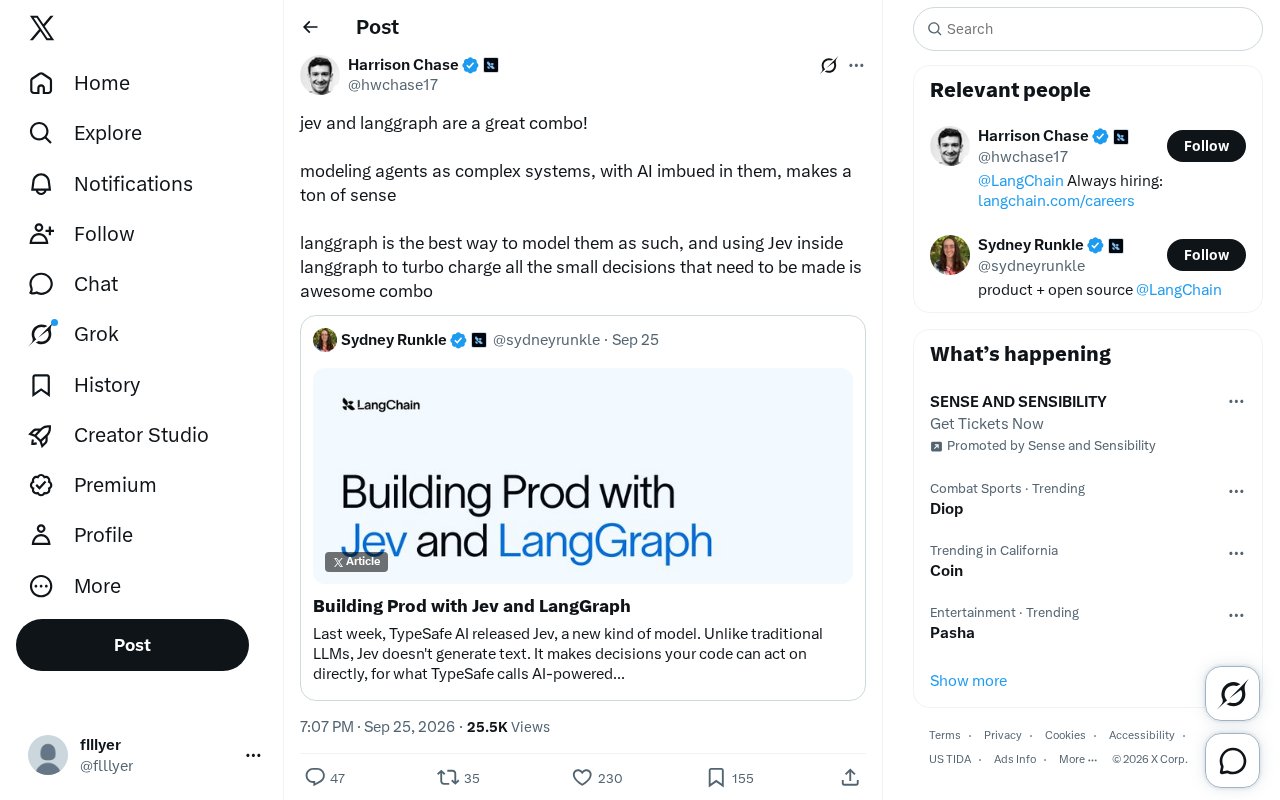
As AI agents evolve from simple question-answering tools into systems capable of autonomous decision-making and multi-step task execution, designing their architecture has become a central challenge for developers. A perspective shared on Twitter offers a compelling paradigm worth examining: modeling agents as complex systems and injecting AI capabilities throughout — a design approach that makes a lot of sense.
Traditional agent development tends to rely on linear workflow orchestration, calling models one step at a time. But real-world tasks are full of branches, loops, and conditional logic — linear thinking simply can't cover it. Treating an agent as a complex system composed of multiple interacting nodes is far closer to reality: each node handles one stage, nodes collaborate through state transitions, and intelligent behavior emerges from the whole.
LangGraph: Built for Modeling Agents
The original post makes it clear: LangGraph is the best tool for modeling agents as complex systems. LangGraph's core idea is to describe an agent's workflow using a "graph": nodes represent specific processing steps, edges represent transition paths, and state is passed and updated as it flows through the graph.
This graph-based abstraction offers several key advantages:
- Supports loops and branches: Unlike one-shot chain calls, graph structures naturally support cycles, allowing agents to reason iteratively and self-correct.
- Controllable state: Global state is explicitly passed between nodes, making it easier to debug and trace decision processes.
- Modularity: Each node has a single responsibility, can be tested and replaced independently, and aligns with the compositional principles of complex systems.
Once an agent is decomposed into a decision graph, developers can clearly see how "intelligence" flows through different parts of the system and ultimately produces results.
From a technical implementation standpoint, LangGraph is a graph orchestration framework built on top of the LangChain ecosystem. It defines an agent's runtime state as a serializable Python TypedDict object, where each node is a function that receives state and returns state updates, and edges are divided into regular edges and conditional edges — the latter allowing dynamic selection of the next execution node based on current state, which is the key mechanism for implementing branches and loops. Compared to LangChain's earlier AgentExecutor, LangGraph's biggest breakthrough is turning "control flow" from an opaque framework-internal black box into a graph structure that developers can explicitly define, making complex patterns like interruption, rollback, and human-in-the-loop possible. This design shares similarities with directed acyclic graph (DAG) scheduling systems like Airflow, but is specifically designed to support the "cyclic" reasoning loops that AI inference requires.
Jev's Role: Accelerating Micro-Decisions
Another key point from the original post: use Jev inside LangGraph to accelerate the large number of small decisions that exist throughout. A complex agent workflow doesn't just have one or two "brain-level" reasoning points — it's scattered with countless minor judgments: which branch to take, whether an intermediate result meets the bar, which tool to call next, and so on.
If all of these micro-decisions rely on large models, the cost is high and latency adds up. Jev's value lies in providing fast responses for these small, frequent decision points — effectively "turbo charging" the entire system. The original post's use of "turbo charge" vividly captures this acceleration effect.
In other words, LangGraph builds the agent's macroscopic skeleton, while Jev fills in and accelerates the dense decision-making capillaries running through that skeleton. The two have clearly defined roles and complement each other well.
The concept of "micro-decisions" has a specific meaning in agent architecture. A production-grade agent workflow may trigger dozens or even hundreds of classification, routing, or validation calls during a single task execution — for example: input intent classification, compliance checks on tool call results, loop termination condition evaluation, and more. These operations are logically simple but called frequently. If all of them are routed to a GPT-4-class large model, inference latency accumulates across nodes, overall response time degrades significantly, and token costs multiply. The industry's common solution is a "small model routing" strategy — using smaller, faster specialized models to handle these lightweight judgments, while large models focus exclusively on tasks that genuinely require deep reasoning. In the context of the original post, Jev plays exactly this role: its core value is trading speed and cost for improved overall system throughput.
Why This Combination Is Worth Paying Attention To
Combining the two directly addresses a real pain point in current agent development: how to maintain system flexibility while controlling inference costs and latency.
- LangGraph provides the structured capability to express complex logic;
- Jev provides the means to efficiently execute a large volume of small decisions within that structure;
- Together, they make the vision of "AI embedded throughout a system" genuinely achievable in practice.
For teams exploring production-grade agents, this pattern of "macro graph orchestration + micro decision acceleration" offers a concrete architectural direction worth referencing.
Conclusion
Though brief, the original tweet identifies a core trend in agent engineering — no longer treating AI as a single black-box call, but embedding it into every decision point of a carefully designed complex system. The pairing of LangGraph and Jev is a concrete implementation of this thinking. As agent applications grow more complex and scale up, similar composable toolchains may well become the mainstream approach.
A note: this article is based on a brief social media post, and technical implementation details about Jev are limited. Readers are encouraged to consult the official documentation for a deeper understanding.
Related articles

DeepCell: One-Click AI Generation of Documents, Spreadsheets, and Slides
DeepCell tops Product Hunt with one-click generation of documents, spreadsheets, and slides, using the .deepcell format for linked updates, designed for System 2 tasks like modeling and sales reviews.

Doneas: 15-Minute Daily Accountability Calls That Keep Indie Developers From Procrastinating
Doneas is a daily accountability tool for indie developers: plan tasks on Monday, join a 15-minute call with five builders each day, and log deliveries on a public progress page. This article analyzes its core mechanics, effectiveness, and potential issues around retention and matching.

Fastlane 2.0: Fully Automated AI Ad Campaigns, From Creative to Optimization
Fastlane 2.0 is an AI ad automation tool: enter your website and it learns your brand, generates video and image ads, and runs and optimizes them on Meta, TikTok, Instagram, and YouTube.