Jev with Vision: New Possibilities for Document Image Understanding
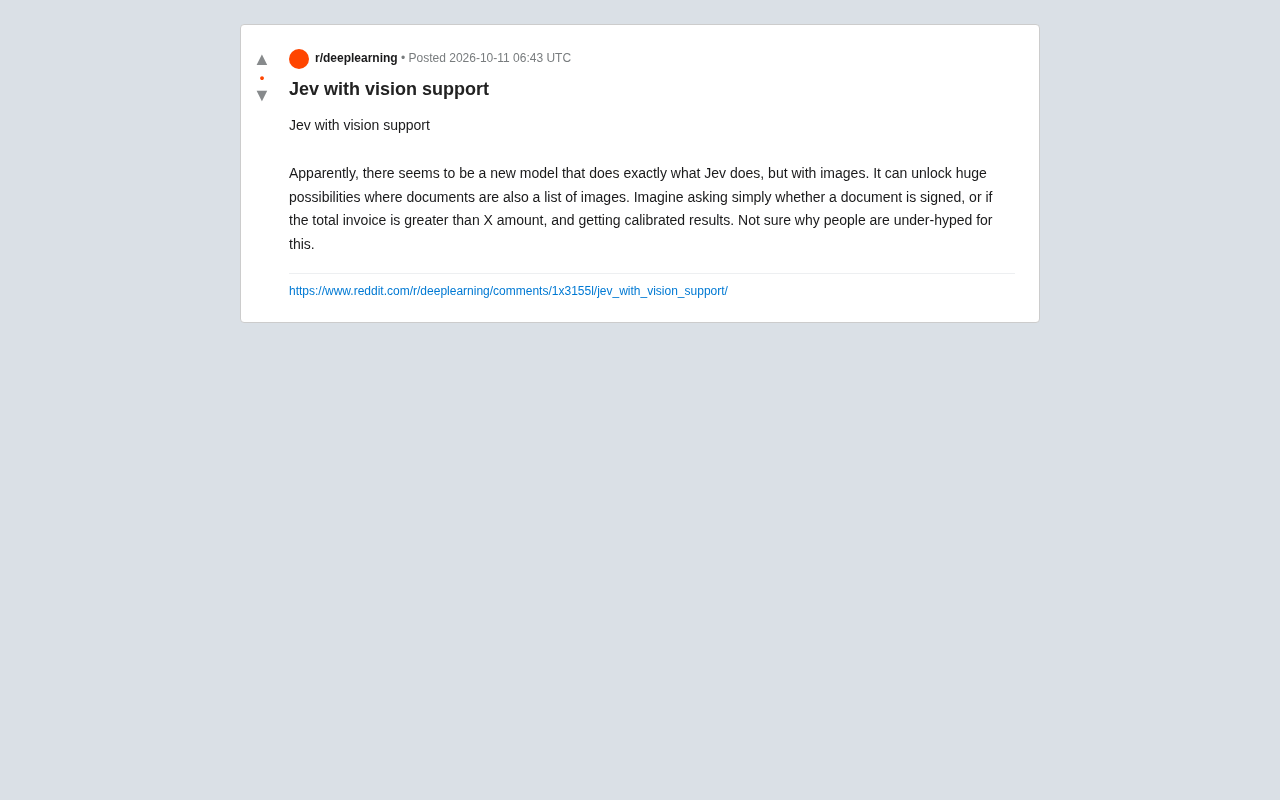
Vision-enabled models can process document images directly, delivering calibrated outputs for finance and compliance workflows.
This article explores a Reddit discussion about vision-enabled document processing models — a direction the community has largely overlooked. The core argument: many documents are fundamentally images, and traditional OCR pipelines discard critical visual signals like signatures, stamps, and layout. Multimodal models that reason directly from images can answer questions like "Is this document signed?" or "Does this invoice exceed a threshold?" without OCR preprocessing. The article emphasizes that "calibrated results" — confidence scores that genuinely reflect correctness probability — are essential for enterprise use cases like financial auditing and compliance review. While the source model lacks public technical details, the capability direction itself has significant real-world potential.
An Underrated Direction: Teaching Models to "Read" Document Images
A recent Reddit discussion caught attention by describing a new model — referred to as "Jev with vision support." The core pitch is straightforward: building on Jev's existing capabilities, the model can directly process images rather than text alone.
The poster seemed genuinely puzzled: this kind of capability should unlock enormous application potential, yet community response has been relatively muted (the original post used the word "under-hyped"). This article aims to unpack the real value behind this direction — while being honest about the limitations of the available information.
It's worth noting upfront that the source material is sparse. Specific technical details, the model's origins, and benchmark data were not provided. The analysis below is based on the capability vision described by the original poster.
What It Means to Treat Documents as "Lists of Images"
The original post offers an insightful framing: many documents are fundamentally just a collection of images. Scanned files, photographed invoices, contracts with handwritten signatures — in a traditional text-only pipeline, these typically require an OCR (Optical Character Recognition) step before a language model can analyze them.
This pipeline has two key pain points. First, OCR accuracy is unreliable when dealing with complex layouts, handwritten content, or low-quality scans. Second, once text is extracted from an image, visual signals — layout structure, stamp placement, whether a signature is present — are lost.
A model with visual understanding can bypass this intermediate step entirely and read information directly from the image layer. The poster gave two grounded examples:
- Asking directly: "Has this document been signed?"
- Determining: "Does the total on this invoice exceed a certain amount?"
What these questions share is that they both rely on a holistic visual assessment of the document's form — not simple text matching.
OCR technology has existed since the last century, but it has always had notable weaknesses in non-standard scenarios. Modern OCR engines can achieve 99%+ accuracy on printed English or Chinese text, but error rates climb significantly with handwriting, skewed angles, low-resolution scans, or multi-column layouts. The more fundamental limitation is that OCR outputs a "flattened text stream" — it discards the semantic information embedded in two-dimensional space. The relative position of two numbers (column header vs. table cell), the spatial correspondence between a stamp and a signature field, deliberately blank areas in a document — this structural visual information is critical for understanding document meaning, yet it is irreversibly lost after OCR conversion. Multimodal vision-language models take an image-first approach to reasoning, treating layout structure as an intrinsic feature rather than post-processing noise.
Why "Calibrated Results" Is the Key Phrase
There's an easy-to-overlook but important detail in the original post: the poster specifically wants "calibrated results."
In document review, financial reconciliation, and compliance checking, a model giving an answer is nowhere near enough — what matters more is how trustworthy that answer is. Calibration means that a model's output confidence genuinely reflects its probability of being correct. When it says "I'm 90% confident this document has been signed," that probability should actually be reliable.
For enterprise applications, this is especially critical. An uncalibrated model that "confidently gets things wrong" can create real business risk when handling invoice amounts or contract signing status. A visual document model that provides trustworthy confidence scores is the one that can actually be deployed.
"Model Calibration" is a technical concept in machine learning that measures how well a model's predicted probabilities align with actual outcome frequencies. A perfectly calibrated model that assigns 80% confidence to predictions should be correct roughly 80% of the time. However, extensive research shows that deep learning models naturally tend to be "overconfident" — even when wrong, they tend to assign near-100% confidence. This phenomenon exists in large language models as well. Common calibration techniques include post-processing methods like Temperature Scaling and Platt Scaling. For document review scenarios, the practical significance of calibration is this: the system can set thresholds to automatically approve high-confidence cases and route low-confidence edge cases to human reviewers — building a reliable human-in-the-loop workflow rather than letting the model make final decisions alone.
Potential Application Scenarios
If we map out these capabilities more broadly, they could cover a wide range of document-intensive workflows:
Financial and Invoice Processing
Automatically reading invoice images, extracting amounts, and comparing them against thresholds or purchase orders — work that currently relies heavily on manual effort or brittle OCR pipelines. Vision models can handle format variation across different invoice types more robustly.
Contract and Compliance Review
Determining whether a signature is present, whether stamps are complete, or whether key clause pages are intact — these are classic "you know it when you see it" tasks that are difficult to cover with pure text-based rules.
Batch Document Classification and Quality Control
When documents arrive as batches of images, vision models can quickly classify them, flag anomalies, and perform initial screening — focusing human attention on the genuinely ambiguous edge cases.
Why Has Community Response Been Muted?
The poster's puzzlement points to a common pattern: technical capability breakthroughs and community buzz don't always move in sync.
There are several likely reasons. First, "document intelligence" capabilities don't sound exciting — compared to the dazzling demos of generative AI, determining an invoice amount seems dull. Second, multimodal models with vision capabilities have become fairly common in recent years, so simply "adding image support" might feel like incremental progress. Third, the real value only emerges within actual workflows, and short demos struggle to convey that long-term utility.
But from an enterprise and developer perspective, this "unsexy but useful" kind of capability is often exactly what generates real commercial return.
This phenomenon is sometimes called the "Infrastructure Paradox" in technical communities: the underlying capabilities that truly drive business value often fail to receive attention proportional to their importance, simply because they lack visual impact. Document intelligence applications are inherently back-office processes — they optimize accounts payable, contract archiving, and compliance auditing within enterprises. These workflows are invisible to outside observers and difficult to demonstrate in a short video. By contrast, image generation and code generation produce immediately visible, easily shareable results. Beyond this, multimodal capability has become table stakes for large models — GPT-4V, Gemini, Claude, and other mainstream models all support image input, which reduces the marginal news value of "adding vision." Real differentiation hides in the details: accuracy on specific document types, inference speed, stability in batch processing — metrics that only reveal themselves after real deployment, making them poor candidates for viral content.
Summary
The original discussion is brief, but it points to a trend worth watching: enabling models to directly understand document images and produce calibrated, trustworthy results. This has clear practical value in finance, compliance, and document review scenarios.
That said, it's important to stay grounded — the model's specific name, technical implementation, and performance data are not publicly available. This discussion remains largely at the level of capability speculation. Readers interested in this direction should look for corroborating evidence and real-world benchmark data from additional sources before drawing firm conclusions.
Related articles

Free Unlimited Claude Code Solution: Agnes AI + CC Switch Setup Guide
No paid subscription needed — pair the free AI platform Agnes AI with the open-source tool CC Switch to provide a backend for Claude Code, enabling unlimited free calls to text, image, and video models. This guide covers the full setup, test results, and usage boundaries.

A Complete Zero-Cost Guide to Getting Started with Claude Code for Beginners in China
A beginner's guide to Claude Code for users in China: two installation methods (command line and IDE plugin), full configuration steps for replacing the official API with the free domestic LongCat model, and a hands-on demo of building a small tool with natural language, plus tips.

When the NSA Gets Involved: The AI Supply Chain Crisis Behind Open-Source CVEs and API Key Hijacking
Multiple open-source projects disclosed severe CVEs in one day, PHP flaws alarmed the FBI, and Railway and OpenCode were breached with API keys stolen. This article breaks down the vulnerability window, AI-accelerated exploitation, and the AI supply chain crisis behind the API key black market, with a developer defense checklist.