JOVE ICE: Intent-Guided Cloud-Edge-Device Collaboration for More Efficient AI Glasses
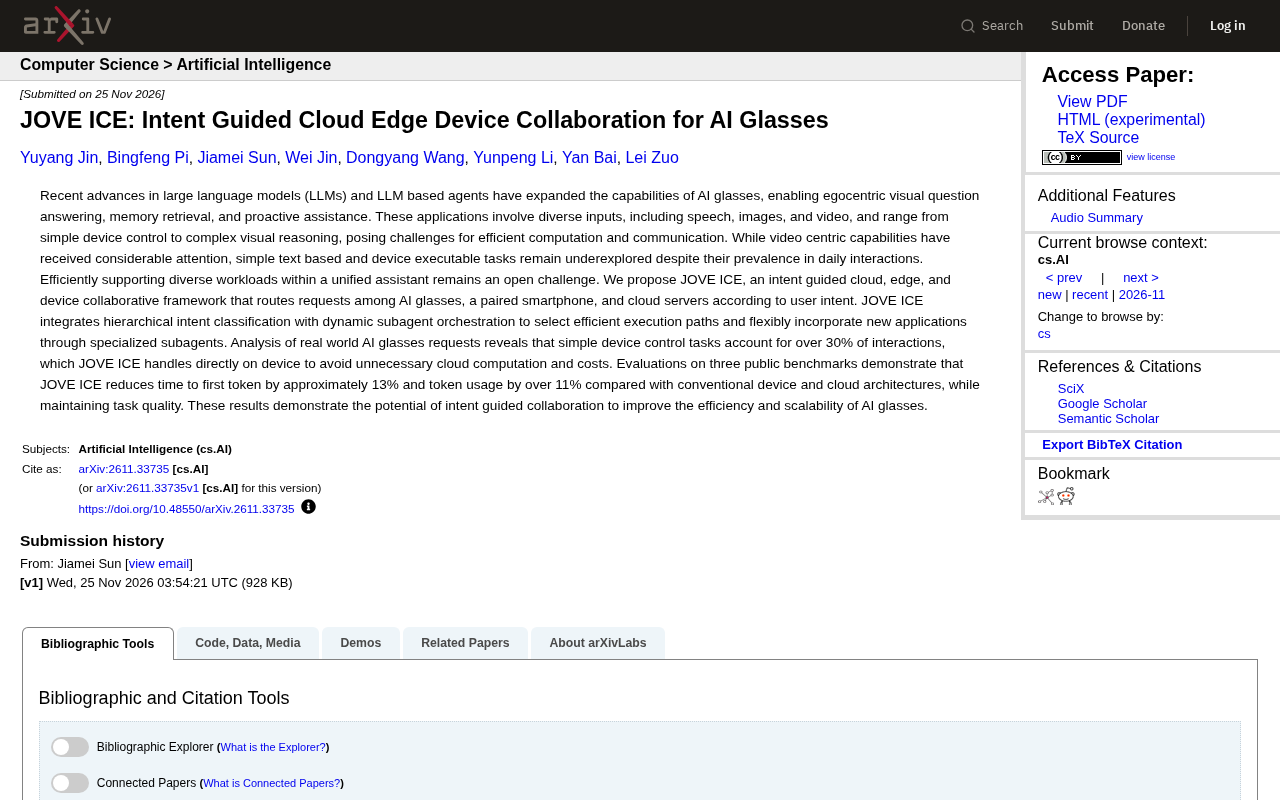
JOVE ICE uses intent-guided cloud-edge-device collaboration to keep simple AI glasses tasks on-device and send complex ones to the cloud, cutting latency and token overhead.
The article introduces JOVE ICE, a study addressing AI glasses' efficiency challenges across diverse inputs and tasks. Noting that over 30% of real requests are simple device control tasks, it proposes an intent-guided cloud-edge-device framework with hierarchical intent classification and sub-agent orchestration, keeping simple tasks on-device, offloading medium ones to the phone, and complex reasoning to the cloud. On three benchmarks, TTFT drops ~13% and token usage over 11% while maintaining quality.
AI glasses are evolving from simple audio devices into intelligent assistants capable of visual question answering, memory retrieval, and proactive assistance. However, behind these features lie diverse inputs such as voice, images, and video, as well as a broad task spectrum ranging from device control to complex visual reasoning—posing serious challenges to computational and communication efficiency. A paper titled "JOVE ICE: Intent Guided Cloud Edge Device Collaboration for AI Glasses" proposes an intent-guided cloud-edge-device collaboration framework that aims to efficiently support diverse workloads within a unified assistant.
Overlooked Simple Tasks and Efficiency Bottlenecks
Existing research mostly focuses on video-centric capabilities, but a large number of simple tasks in everyday interactions—such as text queries and device-executable commands—remain underexplored. The paper's analysis of real AI glasses requests shows that simple device control tasks account for more than 30% of total interactions. If all these tasks were handled in the cloud, they would incur unnecessary computational overhead and cost. The core insight of JOVE ICE is that not all requests require equally complex processing paths.
Time to First Token (TTFT) is a key latency metric in large language model serving, referring to the time from when a user sends a request to when the model returns the first output token. It directly determines the user-perceived response speed: in interactive scenarios such as voice QA and visual QA, high TTFT creates a noticeable "laggy" feeling. TTFT is the sum of multiple stages including network round trips, request queuing, and model prefill. Therefore, in a cloud-edge-device architecture, keeping simple requests on the device side can significantly compress network round trips and queuing time—this is precisely the main lever JOVE ICE uses to optimize TTFT.
Token usage refers to the total number of tokens the model reads and generates in a single request, and is typically a direct measure of pay-as-you-go billing and compute consumption. More tokens mean higher cloud inference costs and greater energy consumption. For battery-constrained devices like glasses, reducing unnecessary cloud calls and token overhead also means lower power consumption and longer battery life.
Three-Tier Collaborative Architecture: Routing by Intent
JOVE ICE builds a collaboration framework among AI glasses, a paired smartphone, and cloud servers. At its core are hierarchical intent classification and dynamic sub-agent orchestration: the system first identifies user intent hierarchically, then selects an efficient execution path based on intent type—simple tasks are handled directly on the device, medium-complexity tasks can be offloaded to the phone, and complex reasoning is delegated to the cloud. Meanwhile, the framework flexibly integrates new applications through dedicated sub-agents without restructuring the overall architecture. This design allows a unified assistant to cover a wide range of tasks while avoiding one-size-fits-all cloud dependence.
Cloud-edge-device collaboration is a system paradigm that places computing tasks in layers according to demand: the device (glasses) handles low-latency, privacy-sensitive lightweight processing; the edge (paired phone) takes on medium-complexity inference and aggregation; and the cloud provides nearly unlimited compute at higher latency and cost. The design difficulty lies in "routing decisions"—how to determine which layer should execute a request. JOVE ICE uses intent classification as the routing basis, i.e., first understanding what the user "wants to do" (such as device control, text query, or visual reasoning), then matching it to the corresponding execution layer, thereby avoiding the crude approach of sending all requests to the cloud.
Sub-agent orchestration refers to splitting a unified assistant into multiple modules with specialized responsibilities, dynamically invoked by an upper-level scheduler according to intent. Compared with a monolithic assistant, a sub-agent architecture facilitates independent development and integration of new applications (such as adding navigation or translation capabilities) without changing the overall framework, thus balancing a unified entry point with scalability.
Quantified Benefits: Faster Responses and Lower Overhead
Evaluations on three public benchmarks show that, compared with a conventional device-cloud architecture, JOVE ICE reduces time to first token by about 13% and token usage by more than 11%, while maintaining task quality. These gains stem directly from the intent-guided routing strategy: keeping high-frequency simple tasks on the device side reduces round-trip latency to the cloud and token consumption. For latency- and battery-sensitive devices like AI glasses, this efficiency optimization is practically meaningful.
Implications for the AI Glasses Ecosystem
The value of JOVE ICE lies not only in its performance numbers. It reveals a pragmatic system design approach: in a context where on-device compute is limited and cloud costs are sensitive, intent understanding enables precise allocation of computational resources. As AI glasses application scenarios expand from consumer-grade to professional domains, this cloud-edge-device collaboration framework is expected to become infrastructure supporting diverse workloads. The authors believe that intent-guided collaboration can improve the efficiency and scalability of AI glasses, providing a paradigm for future research.
One-line Summary
JOVE ICE uses intent-guided cloud-edge-device collaboration to handle simple AI glasses tasks on-device and complex tasks in the cloud, significantly reducing latency and token overhead.
Paragraph Summary
This article introduces a study called JOVE ICE, which addresses the efficiency challenges AI glasses face under diverse inputs such as voice, images, and video and a broad task spectrum by proposing an intent-guided cloud-edge-device collaboration framework. The study notes that existing work mostly focuses on video-centric capabilities, while more than 30% of real requests are simple device control tasks; sending them all to the cloud would cause unnecessary overhead. JOVE ICE builds a three-tier architecture among glasses, a paired phone, and cloud servers, using hierarchical intent classification and dynamic sub-agent orchestration to keep simple tasks on-device, offload medium tasks to the phone, and delegate complex reasoning to the cloud. On three public benchmarks, it reduces time to first token by about 13% and token usage by more than 11% while maintaining task quality, offering a pragmatic paradigm for efficient and scalable AI glasses design.
Related articles
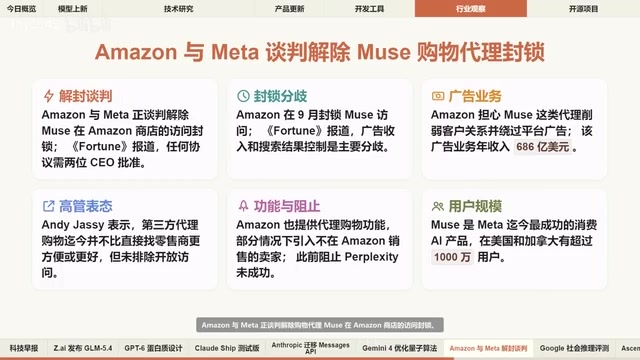
GLM-5.4 Debuts Loop Transformer as AI Coding Tool Race Heats Up
Z.ai launches GLM-5.4, claimed as the first Loop Transformer model; OpenAI drops preprints on protein design and math proofs; AI coding tools update densely; cloud robot inference and off-grid data centers emerge.

GLM-5.4 Loop Transformer Explained: Separating Mechanism from Evidence
Zhipu GLM-5.4 uses Loop Transformer to run trained layers for an extra round. This article breaks down gated updates, hybrid KV cache, and separates official claims from 30B experimental evidence.
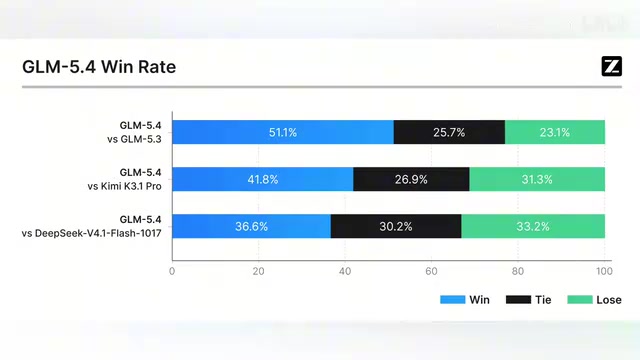
Zhipu GLM-5.4 Launches: First Commercial Loop Transformer Flagship
Zhipu launches GLM-5.4, China's first commercial Loop Transformer flagship: 750B params, 28-layer network looped twice for ~36% more compute depth, native vision for 3D modeling and industrial simulation, now fully available on Coding Plan.