Zhipu GLM-5.4 Launches: First Commercial Loop Transformer Flagship
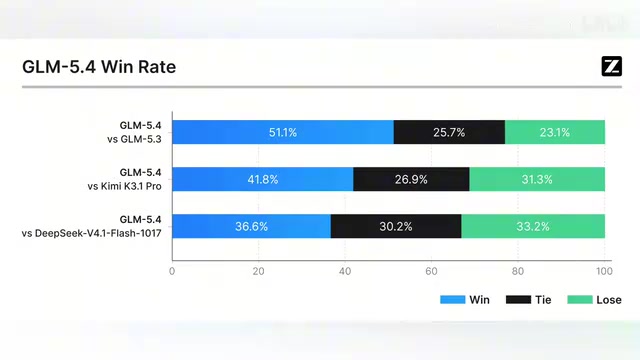
Zhipu releases 750B-parameter GLM-5.4, China's first commercial Loop Transformer flagship.
Zhipu AI has launched GLM-5.4, China's first commercially deployed Loop Transformer model. It keeps 750B parameters while running a 28-layer network twice, boosting computational depth by ~36%, and claims intelligence rivaling 2T-3T models. Cross-round KV Cache sharing and absorbed attention index reuse cut output tokens by 10-14%, with up to 200T/S off-peak. Native vision covers 3D modeling, mechanical structures, digital twin scripts, and industrial simulation pipelines. It is fully available on GLM Coding Plan with Team Edition quotas raised to 1.5x, and a ~3T-parameter GLM-5.5 is planned for December.
Zhipu GLM-5.4 Launches: First Commercial Loop Transformer Flagship
Zhipu AI has released its flagship large model GLM-5.4, the first Loop Transformer architecture model to reach commercial deployment in China. With 750 billion parameters, its core innovation lies in executing a 28-layer network twice, increasing computational depth by roughly 36% without adding parameters. This design approach addresses an industry-wide challenge: when the marginal returns of parameter scaling diminish, how can model intelligence continue to improve?
Loop Transformer: Trading Loops for Computational Depth
In a traditional Transformer, depth is determined by the number of layers, and increasing depth means more parameters and memory overhead. GLM-5.4's approach is to run a 28-layer network through two passes, keeping the parameter count at 750 billion while boosting computational depth by about 36%. Zhipu claims its intelligence level matches that of 2T and 3T parameter models—in other words, approaching the performance of much larger models with a smaller parameter footprint.
There is a clear engineering motivation behind this architectural choice. The real pain point for enterprises is the tension between high compute costs and the need to deploy complex Agent tasks. The Loop architecture amplifies the value of a single machine through iterative inference, reducing compute investment for private deployment and batch engineering tasks compared with the previous generation.
The direct problem with looping is that memory and compute overhead double. GLM-5.4 introduces cross-round KV Cache sharing and absorbed attention index reuse to control memory usage. In practice, average output tokens for some complex tasks are shortened by 10-14%, with inference speeds reaching up to 200T/S during off-peak hours and holding steady at 70-80T/S during peak load.
The challenge of KV Cache and cross-round sharing: During Transformer inference, every generated token requires caching the Key/Value tensors of historical tokens—the KV Cache—which grows linearly with sequence length and is the primary memory bottleneck for long-context inference. The Loop architecture executes the same set of layers twice; if the second pass recomputed all KV, memory and compute overhead would nearly double. The idea behind cross-round KV Cache sharing is to let the second pass reuse part of the key-value representations already computed in the first pass, applying incremental updates only to representations that change. Combined with "absorbed attention index reuse"—reusing attention indices (such as positional encodings or sparse index structures) rather than recomputing them—the extra overhead from looping is compressed into an acceptable range. These engineering optimizations are precisely what determines whether a looping architecture can be commercialized, rather than theoretical innovation at the paper level.
Decoupling parameter scale from computational depth: In a traditional Transformer, depth (layer count) and parameter count grow roughly in tandem—deeper means more layers, more parameters, and more memory. Loop Transformer separates "weight layers" from "computational graph depth": the weights remain 28 layers, but the forward computation traverses the same set of weights twice, effectively increasing computational depth. This shares lineage with Universal Transformer and recurrent neural network ideas, except that modern large models leverage residual streams and attention mechanisms so that multiple loops do not suffer gradient decay as early RNNs did. The cost is that backpropagation during training must traverse two forward passes, making memory and gradient checkpointing strategies more complex—hence commercial deployment requires supporting engineering solutions.
From Code to 3D: Native Vision and Engineering Scenarios
GLM-5.4 adds native vision capabilities, covering 3D modeling, mechanical structures, digital twin scripts, and industrial simulation video pipeline automation. The target scenarios are R&D efficiency needs in manufacturing, engineering, and digital content enterprises.
The officially demonstrated cases are quite representative: from a single requirement, it can generate a 3D bird page model that blinks with fluff swaying with the camera; use FreeCAD to model a six-axis robotic arm, then call Blender to generate joint motion sequences and directly output engineering files importable into production line simulation; and create code-driven music videos with real-time frontend rendering, or build a playable 3D block game by writing logic while laying out the map.

These cases point in the same direction: the model no longer merely generates text or code snippets, but outputs structured artifacts that can directly enter engineering pipelines. For industrial digitalization scenarios, an engineering file importable into production line simulation is more valuable than a beautiful piece of code.

The difference between native vision and "structured artifacts": Multimodal models generally fall into two categories—those that attach external vision encoders for image-text understanding, and those that natively unify image and text tokens. GLM-5.4's emphasis on native vision focuses on connecting visual understanding with code/script generation: directly producing executable 3D scene descriptions, CAD modeling scripts (FreeCAD), animation sequences (Blender Python API), and more from images or requirements. Such artifacts are fundamentally different from "generating an image"—they must satisfy geometric constraints, coordinate system conventions, and file format specifications, and be correctly parsed by downstream engineering software. This is the core threshold for judging whether a model can enter industrial pipelines, not merely visual recognition accuracy.
Commercialization: Coding Plan Fully Opened
GLM-5.4 is now fully available to all GLM Coding Plan users, with development workbenches including SCOTE, TRADE, and WorkBody launched simultaneously. Quotas for Coding Plan V2, V3, and Team Edition have been raised to 1.5 times the original. The standalone model API will open weights after security assessment is complete, with subsequent release under a responsible open-source plan.
For enterprise batch task scheduling, the model balances normal-temperature processing, stability of multi-turn tool calls, and throughput. The significance of this combination: the bottleneck for Agent tasks often lies not in single-inference quality but in stability and cost controllability during batch scheduling.
Next Stop: 3 Trillion Parameters and Engineered Agents
According to official plans, a new flagship model GLM-5.5 with roughly 3 trillion parameters is expected to be released in December to validate the Loop architecture's effectiveness at larger parameter scales. This is a key signal—if loop depth can continue to deliver returns at larger parameter scales, Loop Transformer will be more than an architectural experiment and could become a new scaling path.

As multimodal capabilities, loop-depth reasoning, and general-purpose programming mature together, engineered agents are expected to become the main competitive front in the next stage, driving large models from auxiliary tools to R&D collaboration foundations. GLM-5.4's positioning is clear: it is not competing on general conversation leaderboards, but betting its chips on engineered deployment in enterprise R&D scenarios. Whether the Loop architecture can sustain this logic on GLM-5.5 will be an important window for observing the next stage of model competition.
The bottleneck of engineered agents and batch scheduling: An Agent refers to a model that autonomously calls tools, reads and writes files, and executes code across multiple turns to complete long-horizon tasks. Single-inference quality only determines the per-step ceiling; what truly constrains enterprise deployment is stability under batch concurrency—including retry and rollback after tool call failures, context management for long tasks, and per-task token cost. Therefore, throughput metrics like "200T/S off-peak, 70-80T/S peak" and the 10-14% output token reduction may be more valuable for Agent scenarios than leaderboard scores. Responsible open source typically means conducting security assessments first, then releasing weights in stages, to balance ecosystem building with misuse risk.
One-line Summary
Zhipu releases 750-billion-parameter GLM-5.4, China's first commercial Loop Transformer flagship.
Paragraph Summary
Zhipu AI has launched its flagship large model GLM-5.4, the first commercially deployed Loop Transformer architecture model in China. It keeps the parameter count at 750 billion while executing a 28-layer network through two passes, increasing computational depth by about 36%. Zhipu claims its intelligence level rivals 2T to 3T parameter models, aiming to address the industry challenge of diminishing marginal returns from parameter scaling. To control the memory and compute overhead of looping, the model introduces cross-round KV Cache sharing and absorbed attention index reuse, shortening output tokens by 10-14% on some complex tasks and reaching up to 200T/S off-peak inference speed. The model adds native vision capabilities covering 3D modeling, mechanical structures, digital twin scripts, and industrial simulation pipelines, and is fully available on GLM Coding Plan with Team Edition quotas raised to 1.5 times. Zhipu plans to release GLM-5.5 with roughly 3 trillion parameters in December to validate the Loop architecture at larger scales.
Related articles

GLM-5.4 Released: How a 750B Model Achieves Stronger Reasoning
Zhipu AI releases GLM-5.4, a 750B model that boosts reasoning by running the middle 28 layers twice. GPQA Diamond rises from 47.58 to 56.26, with 1M token context and weights to be open-sourced after safety hardening.

Understanding GLM 5.4 in 8 Minutes: How Loop Transformer Makes AI Smarter Without More Parameters
GLM 5.4 didn't grow its parameters yet got smarter. Using the memorizer-vs-reasoner analogy, this article explains how Loop Transformer runs the middle 28 steps twice, how gated progressive update and two other techniques stabilize the second pass, and how generalized Coding uses code to command 3D, mechanical design, and game development — with official comparison data and open questions.
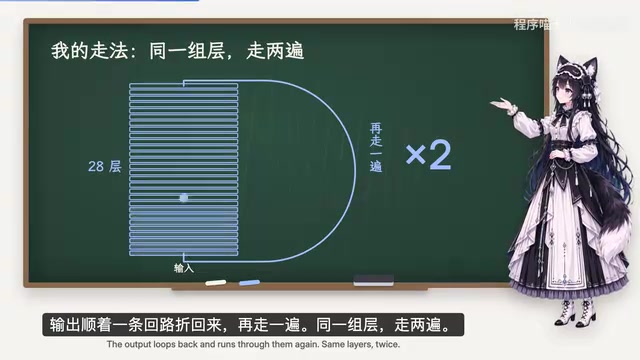
GLM-5.4 Released: An In-Depth Look at Zhipu's First Loop Transformer Flagship Model
Zhipu releases GLM-5.4, its first Loop Transformer flagship. Built on GLM-5 with 28 layers looped twice—no extra params, ~10% more compute, stronger math and long-context reasoning.