July 24 AI Daily Brief: Flux 3 Multimodal Release, Kimi K3 Lags in Testing, Qwen Tops TTS Rankings

Flux 3 goes multimodal, Kimi K3 lags in gov tests, Qwen tops TTS, and AI chip investment surges.
Key AI developments on July 24: Black Forest Labs released Flux 3, expanding into video, audio, and motion prediction. US-UK government testing showed Kimi K3 significantly trailing frontier models. Alibaba's Qwen-Audio 3.0 topped the TTS leaderboard. Etched raised $300M at a $10.3B valuation for Transformer inference chips, while AMD unveiled the MI430X accelerator. Alphabet's capex doubled to $44.9B, and Beijing introduced AI agent policies covering token economics.
Introduction
The AI industry continued its rapid pace of updates on July 24. From Black Forest Labs' multimodal model Flux 3, to U.S.-UK government evaluation results for Kimi K3, to Alibaba's Qwen audio model topping the TTS leaderboard — all these developments point to an increasingly clear trend: AI capabilities are rapidly expanding beyond text and image generation into more complex domains such as video, audio, motion prediction, and even genomics research. Here are the key highlights and analysis from today's AI daily brief.
Model Capabilities: Multimodal Upgrades and the Global Competitive Landscape
Black Forest Labs Releases Flux 3 Multimodal Model
Black Forest Labs, renowned for its image generation models, has released Flux 3, significantly expanding its capabilities into video, audio, motion prediction, and other modalities. According to the announcement, the model can jointly understand and generate content across multiple modalities, with enhanced modeling of real-world dynamics.
Black Forest Labs was founded in 2024 by Robin Rombach and other core developers of Stable Diffusion, having already built a strong reputation with its Flux series of image generation models. The upgrade direction of Flux 3 is particularly noteworthy. Previously, image generation models focused primarily on the aesthetic quality of static images, but Flux 3's move toward "dynamic modeling" means the model is no longer just depicting a single snapshot of the world — it's beginning to understand physical laws and temporal evolution.
This aligns closely with the industry's broader pursuit of "World Models." A World Model refers to an AI system capable of understanding and simulating the operating principles of the physical world — not just generating visual content, but predicting object trajectories, mechanical interactions, and time-series changes. This concept was systematically articulated by Meta's Chief AI Scientist Yann LeCun, who argues that true general intelligence must be built on causal understanding of the world, rather than mere pattern matching. Flux 3's expansion into motion prediction and multimodal generation represents a substantive step in this direction.
U.S.-UK Government Joint Testing: Kimi K3 Significantly Lags Behind American Frontier Models
Joint testing by the U.S. and UK governments shows that Moonshot AI's Kimi K3 significantly lags behind American frontier models in overall performance. The tests reveal a considerable gap in comprehensive model capabilities between the two sides.
This conclusion should be viewed rationally. Both the U.S. and UK have relatively mature mechanisms for AI safety evaluation — the UK established its AI Safety Institute (AISI) in 2023, and the U.S. created a similar body through an executive order the same year. Government evaluations of this nature typically employ Red Teaming methods, focusing on model performance in high-risk scenarios such as biosecurity, cybersecurity, and persuasion/manipulation, while also testing general capabilities like mathematical reasoning, programming, and multi-step planning. Evaluation benchmarks may include standard test suites like MMLU, GPQA, and HumanEval, as well as non-public tests designed by the governments themselves.
Therefore, government testing tends to emphasize safety, reliability, and specific benchmark tasks, which doesn't necessarily equate to real-world user experience. However, the existence of this gap serves as a reminder that Chinese teams are still in catch-up mode when it comes to cutting-edge comprehensive reasoning and complex task-handling capabilities.
Microsoft's MAI Model Improves Token Efficiency
Microsoft reports that its in-house MAI model can complete tasks with significantly fewer tokens in scenarios like GitHub Copilot, delivering notable efficiency improvements. MAI will be made available to enterprises through Microsoft Foundry.
Tokens are the basic units that large language models use to process text — typically one English word corresponds to 1-2 tokens, and one Chinese character corresponds to 1-3 tokens. In practical deployment, token count directly determines inference cost and response latency, as API calls are typically billed by input/output token volume. MAI's ability to complete the same tasks with fewer tokens essentially means the model has made progress in information compression and context utilization efficiency. This is especially critical for scenarios like GitHub Copilot that require frequent calls and are latency-sensitive, directly impacting user experience and operational costs. Microsoft Foundry is Microsoft's enterprise-facing AI model deployment platform, allowing enterprise customers to use Microsoft's proprietary models on Azure infrastructure.
This marks a further step in Microsoft's strategy to reduce dependence on third-party models and build its own model capabilities.
On-Device AI and Specialized Domain Applications
Cactus Edge-Cloud Hybrid Model: Tiered Inference Approach
Cactus has released an edge-cloud hybrid model based on Gemma 4 that generates confidence assessments on-device, automatically routing low-confidence requests to more powerful cloud models for processing. The model and code have been open-sourced.
Edge-cloud hybrid inference is an important trend in current AI deployment architecture. "On-device" or "edge" refers to running models locally on user devices (phones, PCs, edge servers), offering advantages of low latency, privacy protection, and no network dependency — but with the disadvantage of limited device compute power constraining model capability. Gemma 4 is Google's open-source lightweight model series, optimized for on-device deployment. Confidence Estimation refers to the model quantitatively scoring the certainty of its own outputs — when the model is "not very confident" that an answer is correct, the request is automatically uploaded to the cloud for processing by a more powerful model.
This "tiered inference" approach effectively balances the cost-speed-quality triangle by ensuring responsiveness and privacy while calling upon stronger compute power when needed — a pragmatic solution for large-scale on-device AI deployment.
NVIDIA Releases Genomic Foundation Model JEPA-DNA
NVIDIA has released the genomic foundation model JEPA-DNA on Hugging Face, focused on understanding DNA structure, semantics, and potential functions to support genomics research.

JEPA (Joint Embedding Predictive Architecture) is a self-supervised learning framework proposed by Yann LeCun. Its core idea is to make predictions in latent space rather than directly predicting pixels or tokens, thereby learning more abstract, structured representations of the world. NVIDIA has applied this architecture to DNA sequence analysis, enabling the model to understand structural information and functional semantics encoded in nucleotide sequences. Traditional genomics research relies on sequence alignment and statistical methods, whereas AI-based genomic foundation models can capture long-range dependencies, identify functional elements in non-coding regions, and demonstrate significant advantages in tasks such as variant pathogenicity prediction and gene regulatory network inference.
AI entering fundamental life sciences research is nothing new, but having a compute giant like NVIDIA directly releasing a foundation model signals that "AI for Science" is evolving from an application tool into infrastructure.
XBOW: AI Autonomously Discovers Bing Zero-Day Vulnerability
Security company XBOW disclosed that its autonomous agent discovered a critical zero-day vulnerability in Bing's image service. This case demonstrates that AI can continuously test real-world systems, though full-process auditing and disclosure standards still need improvement.
A zero-day vulnerability is a security flaw not yet known to or patched by the software vendor, named because attackers can exploit it with "zero days" of preparation time, typically making it extremely dangerous and economically valuable. Traditional vulnerability discovery relies on the experience and manual testing of human security researchers, whereas XBOW's AI autonomous agent can perform 24/7 continuous fuzzing, logic analysis, and attack surface enumeration against target systems, dramatically improving vulnerability discovery efficiency.
This is yet another example of AI's growing capabilities on both sides of cybersecurity offense and defense — it's both a defensive weapon and a potential attack tool. The industry is actively discussing ethical standards for AI-driven vulnerability discovery, including Responsible Disclosure processes and regulation of automated attack tools. Establishing security boundaries is becoming increasingly urgent.
Product Updates: Voice Interaction and Multi-Agent Collaboration
ChatGPT Desktop Adds Voice Control and Multi-Agent Collaboration
The ChatGPT desktop app has added voice control and multi-agent collaboration features, enabling coordination of multiple agents to execute tasks. Powered by GPT Lab, it is rolling out globally to paying and enterprise users on macOS and Windows.
Multi-Agent Collaboration is an important evolutionary direction in current AI application architecture. Unlike single-model conversations, multi-agent systems use an "Orchestrator" to coordinate multiple AI agents with different specializations to collaboratively complete complex tasks — for example, one agent handles information retrieval, another handles code writing, and another handles result verification. OpenAI's GPT Lab is the underlying engine that implements this coordination. The advantage of this architecture lies in task decomposition and parallel processing, enabling it to handle multi-step workflows that a single model would struggle with. The addition of voice control allows users to verbally command multiple agents using natural language, further lowering the barrier to using complex AI systems.
Claude Voice Mode Now Supports Three Model Tiers
Claude's voice mode now supports three model tiers: Opus, Sonnet, and Haiku, with expanded multilingual capabilities. The feature is open for testing to all users and can connect to tools like Gmail and Slack; free users can use Haiku and connect one tool. The combination of voice interaction and tool calling is moving AI assistants from the chat box toward becoming true "digital employees."
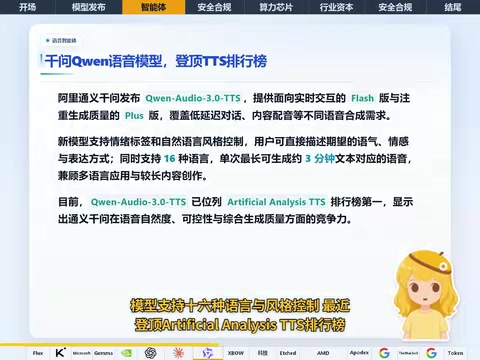
Alibaba's Qwen-Audio 3.0 Tops TTS Leaderboard
Alibaba's previously released Qwen-Audio 3.0 TTS comes in two versions: a low-latency Flash edition and a high-quality Plus edition, supporting 16 languages and style control. It has recently topped the Artificial Analysis TTS leaderboard.
TTS (Text-to-Speech) technology has undergone leapfrog development in recent years, progressing from concatenative synthesis and parametric synthesis to end-to-end neural network synthesis. Artificial Analysis is a widely recognized independent AI evaluation platform whose TTS leaderboard provides cross-comparisons of mainstream speech synthesis systems across dimensions including naturalness, emotional expressiveness, multilingual capability, latency, and cost. The Flash version optimizes latency for real-time conversation scenarios, while the Plus version optimizes audio quality for content production. This product tiering strategy reflects the differentiated demands for latency versus quality across different speech AI application scenarios. Supporting 16 languages and style control means the model can adjust speech rate, emotion, accent, and other dimensions to meet global deployment needs.
This once again confirms the strong capabilities of Chinese teams in the speech synthesis vertical.
AI Chips and Compute: Capital Continues to Pour In
Etched Completes $300 Million Series C
AI chip startup Etched has completed a $300 million Series C round, raising its valuation to $10.3 billion. Its first products have been delivered, with signed contracts exceeding $1 billion in value.
Etched is a chip company focused on Transformer inference acceleration. Its core product, Sohu, "burns" the Transformer architecture directly into chip hardware (i.e., ASIC — Application-Specific Integrated Circuit) rather than running it through general-purpose compute units like GPUs. This highly specialized design can achieve orders-of-magnitude performance/power advantages on specific workloads, but at the cost of flexibility — if model architectures undergo fundamental changes, the chip could face obsolescence. The $10.3 billion valuation and over $1 billion in contracts reflect the market's strong expectations for an explosion in large model inference demand. Inference cost has become one of the primary bottlenecks for scaling AI applications, and the rise of dedicated inference chips is challenging the market dominance of general-purpose GPUs.
AMD Releases MI430X Accelerator and Disaggregated Inference Architecture
AMD has unveiled the Instinct MI430X accelerator, equipped with 432GB of memory, targeting high-performance computing and sovereign AI, with shipments planned for the first half of 2027.

Additionally, AMD and Cerebras have introduced a disaggregated AI inference architecture that separately handles the prefill and decode phases, planned to go live on Cerebras Cloud later this year.
The inference process for large language models consists of two phases: Prefill and Decode. The prefill phase processes all input tokens at once, is highly parallelizable, and is compute-intensive. The decode phase generates output tokens one at a time, computing only one token per step, making it memory bandwidth-intensive. The two phases have fundamentally different hardware requirements. Traditional deployment runs both on the same GPU, leading to poor resource utilization. The disaggregated architecture proposed by AMD and Cerebras assigns prefill and decode to the hardware best suited for each — for example, using high-compute chips for prefill and high-bandwidth chips for decode — thereby maximizing throughput and cost efficiency at the system level. Cerebras's wafer-scale chips are known for their ultra-large on-chip memory and extremely high bandwidth, making them particularly well-suited to the decode phase's workload characteristics.
This "prefill/decode separation" architectural design is an important direction in current large model inference optimization.
Industry Developments and Policy
Alphabet Revenue Grows 24%, Capital Expenditure Doubles
Alphabet's Q2 revenue grew 24% year-over-year to $119.8 billion, driving capital expenditure to double to $44.9 billion, with free cash flow turning negative for the first time in over a decade.
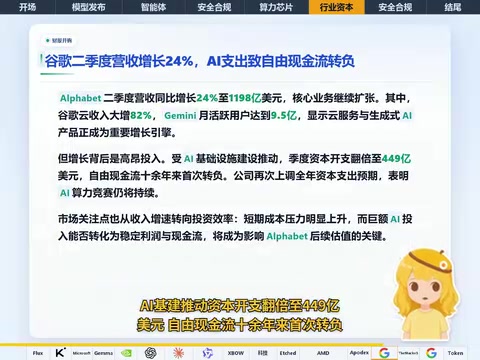
Alphabet's (Google's parent company) $44.9 billion in quarterly capital expenditure is primarily directed toward data center construction, AI-specific chip (TPU) procurement, and network infrastructure expansion. Negative free cash flow means the company's operating cash generation is insufficient to cover investment spending, requiring the use of cash reserves or external financing. This is extremely rare in Alphabet's history. For comparison, Microsoft's capital expenditure in the same period was approximately $22 billion, and Meta's was about $13.5 billion — the three giants combined are investing nearly $80 billion per quarter into AI infrastructure. This scale of investment makes it virtually impossible for small and medium enterprises to independently build comparable compute infrastructure, further reinforcing the pattern where "AI as infrastructure" is dominated by a handful of tech giants.
The massive investments by tech giants into AI infrastructure, even at the expense of free cash flow, underscore the intensity of this compute arms race.
Open-Source Code Dataset The Stack V3 Released
Hugging Face has released the open-source code dataset The Stack V3, containing approximately 5 trillion code tokens after cleaning, supporting model training and cybersecurity defense research. Google and DeepMind have published the Atlas v1.0 report, analyzing 15 million Gemini interaction records covering more than 800 occupations, providing an empirical foundation for assessing AI's economic impact.
Beijing Releases New Policy on AI Agent Development
Beijing has released new policies for AI agent development, marking the first time concepts such as "value layer engineering," "Token economy," and OPC have been written into policy text. The new policy encourages value-based pricing and diverse service models, driving the industrialization of AI agents.
"Token economy" refers to a new economic model that uses the number of tokens consumed by AI models as the basis for metering and billing. Traditional software charges by license or subscription, while agent services can be billed based on actual computational resources consumed (token count), more closely resembling the metering model of utilities like water and electricity. "Value layer engineering" goes further, proposing that billing should not be based solely on token consumption but should also consider the value of task completion — for example, successfully completing a transaction and casual conversation might consume the same number of tokens but should be priced differently. OPC aims to address interoperability issues between different agents. Having these concepts written into policy text signals that policymakers are beginning to formally recognize the new business models of the agent economy, building an institutional framework for agent industrialization.
Conclusion
Today's brief once again confirms that AI competition has expanded from single-point model capabilities to an all-encompassing contest spanning multimodal systems, on-device AI, specialized scientific research, chip architecture, and business models. Whether it's Flux 3's multimodal leap, Qwen's rise to the top in speech synthesis, or the gaps exposed by Kimi K3's evaluation — all serve as reminders that this technology race is far from over and deserves continued attention.
Related articles

MLOps Hands-On Project: A Complete End-to-End Breakdown of Building a Laundry Care Recognition System
A detailed walkthrough of building an end-to-end MLOps laundry care recognition system, covering automated data collection, model retraining, Docker containerization, AWS deployment, and Grafana+Prometheus monitoring.

Deep Dive into Row-Bot's Multi-Agent Orchestration Architecture: Parent-Child Agent Collaboration and Concurrency Control
Deep analysis of Row-Bot's multi-agent orchestration: parent-child Agent collaboration, Git worktree concurrency safety, state persistence, and fault recovery design for production AI Agent systems.

Unsloth Desktop Released: An All-in-One Desktop App for Local Model Inference and Training
Unsloth Desktop is an open-source cross-platform app combining model inference, fine-tuning, and deployment. Supports Mac/Windows/Linux with 2x training speed, 70% VRAM savings, and zero telemetry.