Unsloth Desktop Released: An All-in-One Desktop App for Local Model Inference and Training

Unsloth Desktop: an open-source app unifying local LLM inference, training, and deployment across all platforms.
Unsloth Desktop is a new open-source, cross-platform desktop application that integrates model inference, fine-tuning training, and deployment into a single tool. Supporting Mac, Windows, and Linux, it delivers 2x training speedups with 70% VRAM reduction, supports MLX and GGUF formats across NVIDIA/AMD/Intel/Apple Silicon hardware, and includes RAG, MCP integration, OpenAI-compatible API, and remote deployment via Cloudflare — all with zero telemetry.
Unsloth's Leap from Library to Desktop App
The Unsloth team recently announced Unsloth Desktop on the LocalLlama community — their first desktop application aimed at general users. Previously, Unsloth was known for its highly efficient model fine-tuning library that significantly reduces VRAM usage and accelerates the training process for large language models. Originally released as a Python library in 2023, its core technical approach involves manually writing CUDA kernels (rather than relying on PyTorch's autograd mechanism) to optimize memory allocation during backpropagation. While traditional LoRA/QLoRA fine-tuning already drastically reduces the number of trainable parameters, VRAM waste still occurs during gradient computation and intermediate activation storage. Unsloth rewrites the forward and backward passes of attention mechanisms, eliminating unnecessary memory copies and redundant computations to achieve VRAM savings and speed improvements without sacrificing training accuracy. Now, the team has packaged these capabilities into an open-source, cross-platform desktop client, making local model inference and training more accessible than ever.
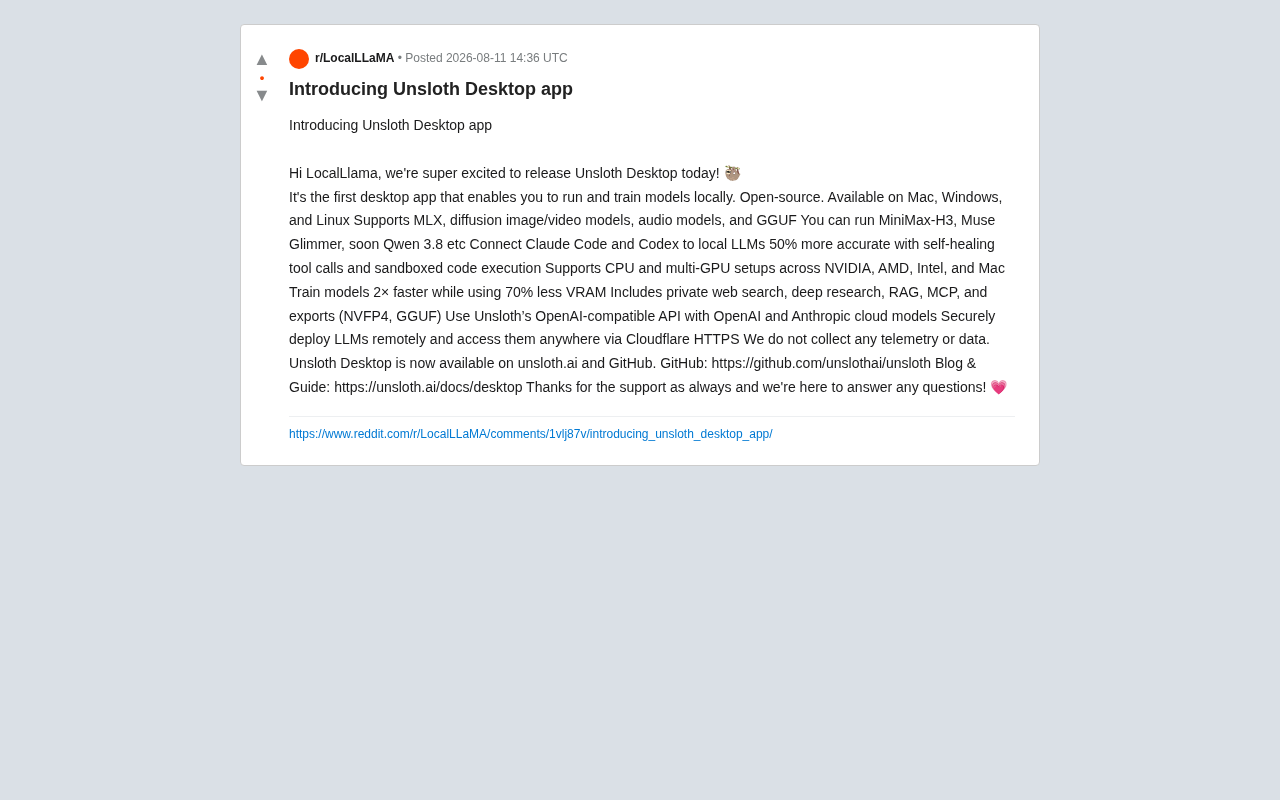
The app supports Mac, Windows, and Linux and is fully open-source. For local AI enthusiasts who have long relied on command-line tools, Docker environments, or cloud APIs, a graphical tool that integrates inference, training, and deployment undeniably lowers the barrier to entry. More importantly, the team emphasizes that no telemetry data or user information is collected — a significant advantage in privacy-sensitive local deployment scenarios.
Broad Model Format and Hardware Support
One of Unsloth Desktop's highlights is its compatibility with multiple model formats and hardware. On the format side, it supports Apple's MLX ecosystem, diffusion-based image/video generation models, audio models, and the community-favorite GGUF format.
MLX is a machine learning framework open-sourced by Apple in December 2023, specifically optimized for Apple Silicon's (M1/M2/M3/M4 series chips) unified memory architecture. Unlike traditional GPU inference, Apple Silicon's CPU and GPU share the same physical memory, meaning model weights don't need to be copied between CPU memory and GPU VRAM. MLX fully leverages this characteristic, allowing the available memory for running LLMs on Mac devices to equal the entire system RAM (up to 192GB) — far exceeding the VRAM capacity of consumer-grade discrete GPUs. This makes Mac an exceptionally cost-effective platform for running large-parameter models.
GGUF (GPT-Generated Unified Format) is a model file format designed by Georgi Gerganov, the creator of the llama.cpp project, which replaced the earlier GGML format in 2023. GGUF's core advantage lies in packaging model weights, tokenizer configurations, metadata, and all other inference-related information into a single file, with native support for multiple quantization precisions (from Q2_K to Q8_0, etc.). This design allows users to load models without additional configuration files, greatly simplifying local deployment. GGUF has become the de facto standard format in the local AI community, with virtually all major local inference engines (such as llama.cpp, Ollama, LM Studio) using GGUF as their preferred format.
Users can directly run models like MiniMax-H3 and Muse Glimmer, with the team previewing upcoming support for newer models like Qwen 3.8.
On the hardware side, the app covers CPU and multi-GPU configurations across NVIDIA, AMD, Intel, and Apple Silicon platforms. This hardware universality means that whether users have a consumer-grade GPU, an Apple M-series chip, or a multi-GPU workstation, they can find a suitable execution path. This "hardware-agnostic" design philosophy is a crucial step toward bringing local AI tools to the mainstream.
Significant Training Efficiency Improvements
Continuing the core advantages of the Unsloth library, the desktop version claims to achieve 2x speed improvements while reducing VRAM usage by 70% during model training. For individual developers constrained by VRAM, these numbers mean that fine-tuning tasks that previously required professional-grade GPUs may now be achievable on consumer-grade devices. For example, QLoRA fine-tuning of a 7B parameter model typically requires about 12-16GB of VRAM, which under Unsloth's optimizations could drop to 4-6GB — exactly within the capability range of mainstream consumer GPUs like the RTX 4060. This has always been Unsloth's technical signature — using engineering optimizations to make model training affordable for more people.
Developer-Focused Utility Integrations
Unsloth Desktop isn't just a model runner; it deeply integrates with developer workflows. The app supports connecting Claude Code and Codex to local LLMs, allowing developers to use AI coding assistants while maintaining code privacy.
Notably, it features self-healing tool calls with sandboxed code execution, which the team claims improves tool call accuracy by 50%. Tool Calling (or Function Calling) refers to the mechanism where an LLM outputs structured instructions in a predefined JSON Schema format, which external programs parse and execute. Local small models frequently encounter issues like JSON format errors, missing parameters, or type mismatches during tool calls, causing failures. The "self-healing" mechanism typically detects tool call failures, feeds the error information back to the model, and has it correct the output format in a second generation pass. Combined with sandboxed code execution — running generated code in an isolated environment, catching exceptions, and requesting model corrections — this can significantly improve end-to-end task completion rates. While this retry-correction loop adds latency, the reliability improvements are substantial.
Additionally, the app comes with a suite of out-of-the-box features:
- Private web search and deep research capabilities
- RAG (Retrieval-Augmented Generation) support
- MCP (Model Context Protocol) integration
- Model export to NVFP4, GGUF, and other formats
RAG (Retrieval-Augmented Generation) is a technical architecture that combines information retrieval with text generation. Its workflow has three steps: first, knowledge base documents are split into chunks and converted into vectors via embedding models, stored in a vector database; when a user asks a question, the system vectorizes the query using the same embedding model and retrieves the most semantically similar document chunks from the vector database; finally, the retrieved relevant chunks are sent as context along with the user's question to the LLM for answer generation. RAG's core value lies in enabling models to reference up-to-date, private knowledge base content without retraining the model itself, while significantly reducing model "hallucination" issues.
MCP (Model Context Protocol) is a protocol standard open-sourced by Anthropic in late 2024, designed to provide AI applications with a unified interface specification for external data sources and tools. Think of MCP as "the USB port for AI applications" — it defines a standardized communication protocol that allows LLMs to connect to databases, file systems, API services, development tools, and other external resources through a unified approach. Before MCP, every AI application needed custom integration code for each data source; with MCP, as long as a data source implements the MCP Server interface, any MCP-supporting client can plug and play. MCP has already gained support from major AI companies including OpenAI, Google, and Microsoft, and is rapidly becoming an industry standard.
Regarding model export, NVFP4 is a 4-bit floating-point quantization format introduced by NVIDIA, specifically designed for its latest Blackwell architecture (such as RTX 5090/5080) GPUs. Unlike traditional integer quantization (INT4), NVFP4 retains the exponent bits of floating-point numbers, better representing outliers in weight distributions, thereby maintaining better model accuracy at extremely low-bit quantization. The Unsloth team is among the earliest open-source tools to support exporting models to NVFP4 format, enabling users with the latest NVIDIA GPUs to run large-parameter models with minimal VRAM usage.
These features cover the complete pipeline from data retrieval and knowledge base Q&A to model export, making the desktop version closer to a "local AI workstation" rather than a single-purpose tool.
Hybrid Cloud and Remote Deployment Capabilities
Despite positioning itself as a local tool, Unsloth Desktop isn't limited to offline scenarios. It provides an OpenAI-compatible API, allowing users to simultaneously connect to OpenAI and Anthropic cloud models within the same interface. An OpenAI-compatible API refers to a local service that follows OpenAI's REST API interface specifications (including request and response formats for endpoints like /v1/chat/completions and /v1/embeddings). Since OpenAI was the first company to commercialize LLM APIs at scale, its interface format has become the de facto industry standard. A large number of third-party applications, IDE plugins, and automation tools use the OpenAI API format for integration. When a local inference tool provides an OpenAI-compatible API, it means users only need to change the API address (from api.openai.com to localhost) to seamlessly switch all applications that originally depended on cloud services to local models, without modifying any business code. This "local + cloud" hybrid mode allows users to flexibly switch compute sources based on task complexity.
For deployment, the app supports securely deploying LLMs remotely via Cloudflare HTTPS and accessing them from anywhere. This means users can turn their home workstations into private model service nodes, callable anytime and anywhere, without handing data over to third-party cloud providers. Cloudflare's tunnel service (such as Cloudflare Tunnel) can securely publish local services to the internet without exposing public IPs or configuring port forwarding, while providing DDoS protection and TLS encryption — significantly lowering the operational barrier for self-hosted AI services.
Significance for the Local AI Ecosystem
The release of Unsloth Desktop can be seen as a signal that local AI tools are maturing. In the past, running models locally often required piecing together multiple open-source projects — one for inference (like llama.cpp or vLLM), one for fine-tuning (like Axolotl or PEFT), and one for deployment (like text-generation-webui or Open WebUI). Unsloth aims to integrate these stages into a single application while maintaining its open-source and zero-telemetry stance.
For privacy-conscious enterprise users, budget-limited independent developers, and enthusiasts who want complete control over their AI stack, the value of such tools is rapidly becoming apparent. The current local AI tools market has established a certain landscape — Ollama excels with its minimalist command-line experience, LM Studio markets its graphical inference capabilities, and Open WebUI focuses on multi-model conversation management — while Unsloth Desktop's differentiation lies in its full-pipeline coverage of "training + inference + deployment" and its deep performance optimization heritage. Of course, real-world stability, breadth of model compatibility, and whether performance claims hold up still need to be verified by the community through actual use.
Interested readers can try it through official channels:
- Website: unsloth.ai
- GitHub: github.com/unslothai/unsloth
- Documentation & Guides: unsloth.ai/docs/desktop
Key Takeaways
Related articles

Bilibili's Hit Dify Tutorial: A Practical Guide to Building 20+ AI Apps from Scratch
A distilled guide to Bilibili's top-rated Dify tutorial: Windows + Docker deployment, MySQL connection, five app types, model integration strategy, and publishing.

Agent Skills Beginner's Guide: From Concepts to Multi-Agent Collaboration in Practice
A comprehensive guide to Agent Skills: core concepts, components, the importance of Description, standardization, beginner learning paths, and multi-agent collaboration.

One Neuron Detects Both Cats and Cars? We Reproduced It and Found a New Explanation
The cat-car neuron reinterpreted: researcher Cammarata argues it distinguishes pointy from round, not cats from cars. We reproduced the experiment and found the new explanation holds on most inputs—but cars are the exception. The interpretability debate continues on language models.