MLOps Hands-On Project: A Complete End-to-End Breakdown of Building a Laundry Care Recognition System

End-to-end MLOps project walkthrough: from automated data scraping to cloud deployment and monitoring.
A Reddit developer shared a complete MLOps project—a clothing washability recognition system—covering automated data scraping, model retraining, Docker containerization, AWS cloud deployment, and Grafana+Prometheus monitoring. This article breaks down the architecture, explains key concepts like data drift, and discusses why a complete engineering loop matters more than model accuracy for MLOps job seekers.
A Noteworthy MLOps Practice Project
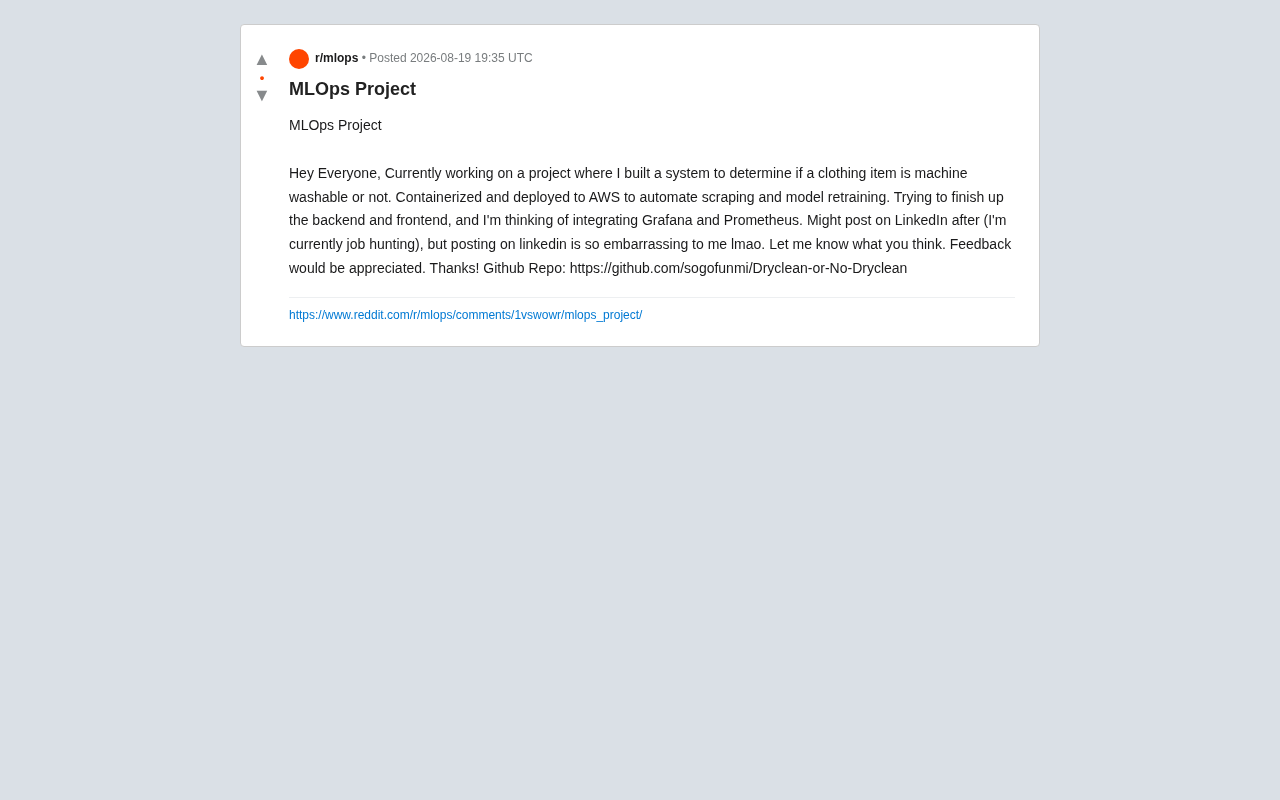
In the field of Machine Learning Operations (MLOps), many learners face a common challenge: they've mastered the theory behind model training but don't know how to turn a model into a production system that's actually runnable and maintainable. MLOps as a concept emerges from the intersection of DevOps and machine learning, with the core goal of using engineering practices to shorten the distance from experimentation to production and ensuring models continue to deliver value reliably after deployment. Recently, a Reddit developer shared their hands-on project—an intelligent recognition system for determining whether clothing is machine-washable or requires dry cleaning (Dryclean or No Dryclean)—providing an excellent engineering reference for MLOps beginners.
Though the project appears lightweight, it covers multiple core components of a modern MLOps workflow: data collection, model training, containerized deployment, cloud automation, and monitoring observability. The author is currently job hunting and hopes to fully demonstrate their engineering implementation capabilities through this complete end-to-end project.
Project Architecture and Tech Stack Breakdown
Core Function: Clothing Washability Classification
The system's business objective is crystal clear—given a piece of clothing information, the system determines whether it's machine washable or needs dry cleaning. While this classification task seems simple, real-world scenarios involve significant challenges around labeled data acquisition, feature engineering, and iterative model optimization. Washability determination involves fabric composition (such as ratios of silk, wool, and polyester), garment structure (presence of linings, decorations), care label interpretation, and other multi-dimensional features. How to transform this unstructured information into effective machine learning features is itself an engineering problem worth deep exploration.
Automated Data Collection and Model Retraining
One of the project's most noteworthy highlights is the author's implementation of automated data scraping and model retraining pipelines. In real production environments, data distribution drifts over time (data drift), and if a model isn't updated for extended periods, prediction accuracy will gradually decline.
Data drift refers to significant changes in the statistical distribution of input data received by a model in production compared to the data used during training. This phenomenon is virtually inevitable in real business scenarios—for example, in the clothing recognition context, new fabric materials appearing, brand label format changes, and seasonal style shifts can all cause input feature distribution to shift. Data drift is typically categorized into three types: Covariate Shift (input feature distribution changes while the input-output relationship remains the same), Label Shift (the prior distribution of output labels changes), and Concept Drift (the mapping relationship between inputs and outputs itself changes). Common methods for detecting data drift include the KS test, PSI (Population Stability Index), and sliding-window-based statistical monitoring.
By containerizing the entire pipeline and deploying it to AWS, the author achieved closed-loop automation from data collection to model updates. This is precisely what distinguishes MLOps from traditional machine learning experiments—it emphasizes not one-time model delivery, but sustainable, automatable model lifecycle management.
Docker Containerization and AWS Cloud Deployment
The author chose to containerize the system with Docker and deploy it to AWS, which is the current industry-standard approach for machine learning deployment. Docker container technology fundamentally solves the notorious environment dependency problem in machine learning systems by packaging an application and all its dependencies (including system libraries, Python versions, CUDA drivers, etc.) into a standardized image. The dependency complexity of ML projects far exceeds that of traditional web applications—different deep learning framework versions, NumPy/SciPy ABI compatibility, GPU driver matching, and other issues often consume days of environment configuration time.
Containerization not only ensures consistency across development, testing, and production environments, effectively avoiding the classic "it works on my machine" problem, but also natively supports horizontal scaling and orchestration (e.g., Kubernetes), enabling model inference services to auto-scale based on traffic. Additionally, the immutability characteristic of containers ensures that every deployment is fully reproducible, which is critical for auditing and rollback in ML systems. AWS, as a mature cloud computing platform, provides complete infrastructure from compute (EC2/ECS) and storage (S3) to task scheduling (EventBridge/Step Functions), making it well-suited for hosting automated training and inference workloads.
Monitoring and Observability: Grafana + Prometheus
An important direction the project is currently advancing is the integration of Grafana and Prometheus for system monitoring. This technology choice reflects the author's deep understanding of MLOps completeness.
Prometheus, as the industry-standard metrics collection and alerting system, uses a pull model to periodically scrape time-series data from target services via HTTP endpoints, storing it in a local time-series database. Its powerful PromQL query language supports aggregation, filtering, and mathematical operations on metrics, enabling collection of various runtime metrics including request latency, error rates, and resource utilization. Grafana provides powerful visualization dashboard capabilities, presenting these metrics as intuitive charts with support for multiple data sources and flexible panel configurations.
For machine learning systems, the significance of monitoring extends far beyond the operational level. Beyond traditional system metrics (CPU, memory, network I/O), model-specific business metrics also require attention: prediction confidence distributions, feature value range anomalies, inference latency P99, batch prediction throughput, and more. Through continuous monitoring of model prediction distributions, accuracy changes, and input data characteristics, teams can promptly detect model performance degradation or data anomalies, triggering automatic retraining or manual intervention. A more advanced approach is to expose model performance metrics (such as rolling-window accuracy, F1-Score) as Prometheus metrics, combined with Alertmanager threshold alerts that automatically trigger retraining pipelines when model performance falls below preset baselines. This "observability" is the dividing line between production-grade ML systems and lab prototypes.
What This Project Means for MLOps Job Seekers
A Complete Engineering Loop Matters More Than Model Accuracy
Many early-career machine learning engineers fall into a common trap: over-focusing on the model algorithm itself, relentlessly pursuing accuracy number improvements while neglecting the accumulation of engineering implementation skills. This project demonstrates an alternative approach—using a straightforward business scenario to build a complete MLOps engineering loop.
From data collection, model training, containerization, and cloud deployment to monitoring and alerting, this project covers the full MLOps workflow. For hiring managers, a project like this is far more convincing than a high Kaggle score alone, because it proves the candidate can "get a model running and keep it alive" in practice. In real industrial environments, the business value of improving model accuracy from 95% to 96% is often far less than what a stable, reliable automated deployment and monitoring system delivers—the latter determines whether a model can serve users continuously and reliably 24/7.
The Importance of Proactively Showcasing Your Work
Notably, the author admitted in their post: "I plan to post it on LinkedIn after finishing, but posting stuff on LinkedIn makes me cringe (lmao)." This sentiment is quite common among technical professionals.
But in reality, proactively showcasing project outcomes during a job search is a key pathway to building a personal technical brand and gaining visibility. A well-structured open-source GitHub repository with comprehensive project documentation can often stand out among countless resumes. Technical professionals don't need to wait for "perfection" before sharing—demonstrating the process of continuous learning and iterative improvement is itself extremely valuable. In today's competitive ML engineer job market, "visibility" is an often-underestimated dimension of competitiveness.
Further Optimization Directions for MLOps Projects
Based on the currently available project information, if you want to make this MLOps project even more polished, consider the following directions:
-
CI/CD Pipeline Integration: Introduce tools like GitHub Actions or Jenkins to enable automated testing and deployment upon code commits, further enhancing automation levels. Traditional software CI/CD primarily focuses on code building, testing, and deployment, while ML system CI/CD (sometimes called CT—Continuous Training) also needs to handle three additional dimensions: data validation, model validation, and model deployment. Google's MLOps maturity model categorizes this into Level 0 (manual processes), Level 1 (ML pipeline automation), and Level 2 (CI/CD pipeline automation). GitHub Actions, as a CI/CD tool natively integrated into code repositories, is particularly suitable for personal projects and small teams, capable of automatically executing data validation, model training, performance evaluation, and container image building on code push or scheduled triggers.
-
Model Version Management: Use MLflow or DVC to version-track model files and datasets, ensuring experiment reproducibility. MLflow is an open-source ML lifecycle management platform developed by Databricks, offering four core components: experiment Tracking, Model Registry, Projects packaging, and Models serving. It particularly excels at recording hyperparameters, metrics, and output models from each training run, supporting model stage management (Staging→Production→Archived). DVC (Data Version Control) adopts a Git-like design philosophy, tracking version changes of large datasets and model files through lightweight metadata files, with actual data stored remotely (S3, GCS, etc.). The two are not mutually exclusive—DVC is better suited for managing data and pipeline versions, while MLflow is better for managing experiment and model lifecycles. In mature MLOps systems, they're often used together.
-
A/B Testing and Canary Releases: During model updates, use traffic allocation mechanisms to compare the actual performance of new and old models, reducing deployment risk. In practice, service meshes (such as Istio) or API gateways can implement proportional traffic splitting—first routing a small percentage of traffic (e.g., 5%~10%) to the new model, monitoring its prediction quality and system stability, then gradually increasing the traffic ratio after confirming no anomalies, and finally completing full cutover.
-
Comprehensive Technical Documentation and README: Clear architecture diagrams and execution instructions significantly enhance a project's professionalism and readability.
Summary: Small but Complete MLOps Engineering Thinking
This "Laundry Care Recognition" project may be modest in business scale, but it's a fully-featured end-to-end MLOps case study. It reminds us that the core value of MLOps lies not in choosing the flashiest tech stack, but in the holistic thinking and implementation capability of engineering, automating, and making machine learning systems observable.
For developers currently learning MLOps or preparing for job interviews, rather than pursuing grandiose projects that are difficult to complete, it's better to start with a small but complete scenario and solidify every engineering component. As this author demonstrates—true capability is reflected in whether you can keep a model running continuously and stably in a production environment. The project's open-source repository has been shared publicly on Reddit, and interested readers can check it out for reference and learning.
Related articles

Apple HomeView Hands-On Review: Is the $300 Smart Home Hub Worth It?
Apple HomeView hands-on: a $300 smart home hub with facial recognition for quick account switching, but no App Store or voice recognition. Is the wall-mounted version worth it? Should you buy the first generation?

Meta Muse Wonder Launch: What It Means for Meta's Return to the Frontier AI Race
Meta releases Muse Wonder and WonderFull, benchmarks reach the frontier, community feedback is polarized. An in-depth look at Meta's return to the frontier AI race, its personal agent strategy, and Zuckerberg's different path.

Apple Home Smart Home Lineup Leaked: LG and Schneider Team Up, UWB Door Lock on Board
Apple Home ecosystem gains new LG and Schneider devices: UWB smart lock with proximity unlock, 2.5K dual-camera doorbell, privacy indoor camera, and AirPods-like seamless pairing.