KeyDeck: A Framework for Cross-Paper Synthesis and Personalized Slide Generation

KeyDeck is the first multi-paper-to-slides generation framework, combining cross-paper synthesis and reference-guided personalization with the KeyBench benchmark.
The article introduces multi-paper-to-slides generation (multi-PTSG) and its two core challenges: cross-paper relationship identification and multi-source content integration, plus speaker personalization differences. It presents KeyDeck, which integrates single-paper and cross-paper analysis to build coherent narratives and uses reference-guided mechanisms to infer speaker intent across narrative, content, text, and visual dimensions. The team also built the KeyBench benchmark with 100 expert-written presentations and a complete evaluation framework. Experiments show KeyDeck outperforms existing methods in generation quality, personalization adherence, and conversational goal satisfaction.
Title
KeyDeck: A Framework for Cross-Paper Synthesis and Personalized Slide Generation
Meta Description
KeyDeck is the first multi-paper-to-slides generation framework. Through cross-paper synthesis and reference-guided personalization, it integrates multiple research papers into coherent presentations, accompanied by the KeyBench benchmark to evaluate generation quality and personalization adherence.
Article Content
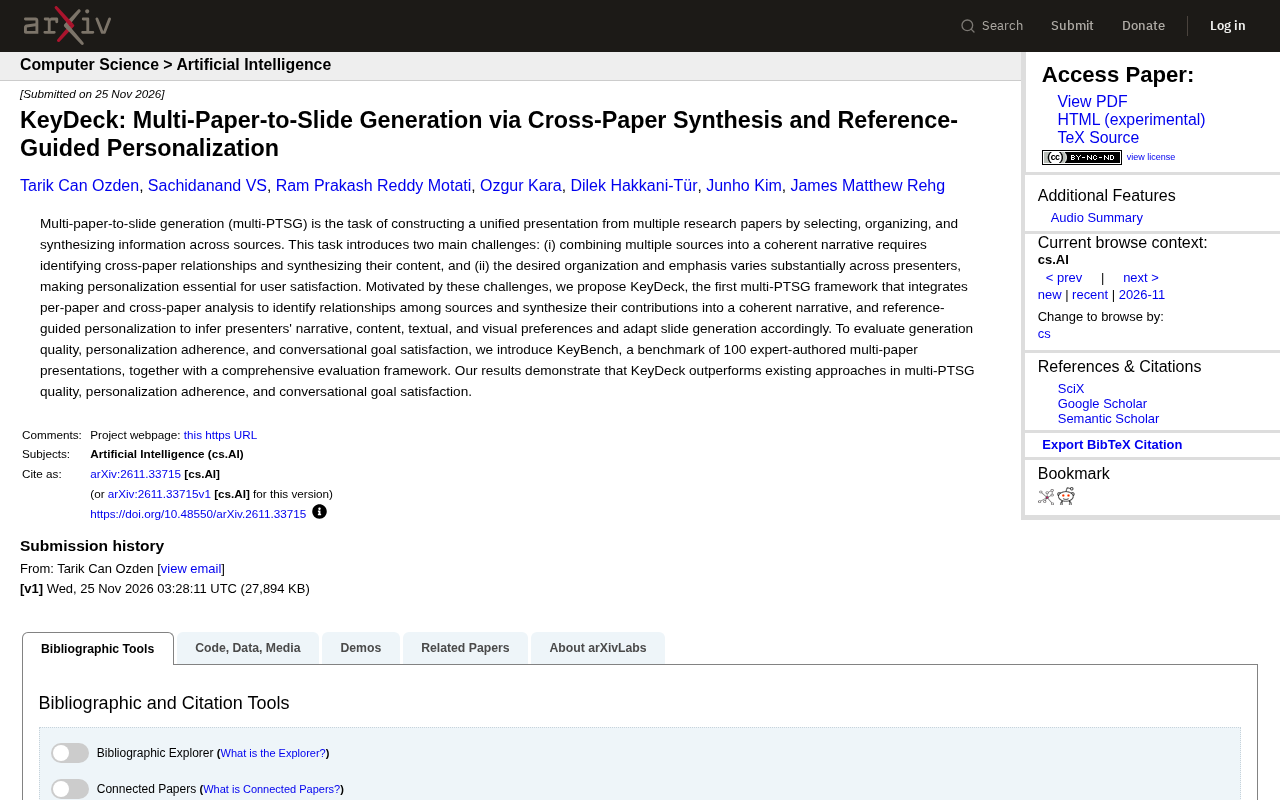
Multi-paper-to-slides generation (multi-PTSG) is an emerging research direction that requires systems to select, organize, and synthesize information from multiple research papers to construct a unified presentation. This task faces two core challenges: first, how to identify cross-paper relationships and integrate multi-source content into a coherent narrative; second, different speakers vary greatly in their preferences for content organization and emphasis, making personalization key to improving user satisfaction.
To address these issues, researchers propose KeyDeck—the first multi-paper-to-slides generation framework. The framework integrates single-paper analysis with cross-paper analysis to discover relationships among the literature and synthesize their contributions; it also introduces a reference-guided personalization mechanism that infers speaker intent from their narrative structure, content selection, text style, and visual preferences, and adjusts slide generation results accordingly. To systematically evaluate generation quality, personalization adherence, and conversational goal satisfaction, the team also built the KeyBench benchmark, containing 100 expert-written multi-paper presentations along with a complete evaluation framework. Experimental results show that KeyDeck outperforms existing methods in multi-paper generation quality, personalization adherence, and conversational goal satisfaction.
Core Challenges of Multi-Paper Synthesis
Generating a slide deck from multiple papers is not simply concatenating their abstracts. The real difficulty lies in identifying cross-paper relationships—which works complement each other, which have methodological conflicts, and which conclusions corroborate one another. KeyDeck's design approach combines the internal structure of each paper with cross-paper relational analysis: first understand the contribution boundaries of each paper, then organize the narrative at a higher level.
This "local first, global second" processing approach aligns with how human experts prepare review-style reports: first read each paper closely, then decide which content enters the main thread and which serves as comparison or background. KeyDeck formalizes this process, enabling the system to maintain narrative consistency across multi-source information.
Narrative coherence in the context of slide generation refers to multi-page content maintaining unity in logical thread, terminology usage, and argument progression, rather than each page standing independently yet disconnected from the others. In multi-paper synthesis, papers from different sources often adopt different problem definitions, notation systems, and evaluation metrics; direct concatenation causes concept drift and argumentative gaps. Therefore, the system needs to establish a unified cross-paper concept mapping before generation and maintain a consistent narrative thread throughout generation, so that listeners can smoothly transition from one paper's contributions to another's comparison or extension.
Reference-Guided Personalization Mechanism
Personalization is what distinguishes multi-PTSG from ordinary summarization. For the same set of papers, different speakers may produce completely different slides: some emphasize methodological details, some highlight application prospects, some prefer rich visuals, and some prefer bullet lists. KeyDeck infers speaker preferences across four dimensions—narrative, content, text, and visual—through a reference-guided approach and injects these preferences into the generation process.
The advantage of this design is that personalization does not rely on users repeatedly filling out configuration forms but instead learns implicitly from existing reference materials. For researchers who frequently prepare group meetings, defenses, or conference reports, this means the system can progressively approach their personal style, reducing post-generation adjustment costs.
Reference-guided is an implicit preference learning paradigm: the system does not require users to explicitly declare preferences but instead infers style characteristics from reference materials provided by the user (such as past slides, scripts, or example demonstrations). Compared with explicit personalization based on configuration forms or questionnaires, reference guidance reduces user burden but requires the model to extract narrative structure, content selection tendencies, text tone, and layout visual patterns from a small number of examples. In KeyDeck, this mechanism is decomposed into four dimensions—narrative, content, text, and visual—modeled separately and then uniformly injected into the generation process.
KeyBench Benchmark and Evaluation Framework
Evaluating multi-paper slide generation is not easy: there is no standard answer, and there are many quality dimensions. The KeyBench constructed by the KeyDeck team contains 100 expert-written multi-paper presentations, covering three evaluation directions—generation quality, personalization adherence, and conversational goal satisfaction—along with a complete evaluation framework.
The value of this benchmark lies in decomposing "whether slides are good" into operational dimensions, enabling relatively fair comparisons among different methods. Experimental results show that KeyDeck achieves advantages in the above dimensions, indicating that the two design threads—cross-paper synthesis and reference-guided personalization—indeed bring practical benefits.
Conversational goal satisfaction is one of the three evaluation directions of KeyBench. It measures whether generated slides serve the speaker's communication goals in specific scenarios—for example, group meeting reports need to highlight progress and problems, defenses need to emphasize contributions and innovations, and conference reports need to balance background setup with conclusion impact. This dimension goes beyond traditional text similarity or fluency metrics, requiring the evaluation framework to judge whether content organization aligns with speaker intent. Because goal satisfaction is subjective, KeyBench's accompanying evaluation framework typically combines expert ratings with structured criteria to reduce scoring variance.
Significance for Research Workflows
From a broader perspective, KeyDeck represents a tooling trend: delegating repetitive labor between literature review and content organization to the system, allowing researchers to focus on judgment and expression. Multi-paper-to-slides generation is essentially automating the mechanical parts of the "read—think—present" chain.
Of course, such systems still rely on high-quality reference materials to learn preferences, and evaluation itself requires expert participation. The proposal of KeyDeck and KeyBench provides a reusable framework and comparison baseline for future research, and the direction of cross-paper synthesis and personalized generation deserves continued attention.
One-line Summary
KeyDeck is the first multi-paper-to-slides generation framework, combining cross-paper synthesis with reference-guided personalization, accompanied by the KeyBench benchmark.
Paragraph Summary
The article introduces multi-paper-to-slides generation (multi-PTSG) as an emerging research direction and its two core challenges: cross-paper relationship identification and multi-source content integration, as well as differences in speaker personalization preferences. To address these issues, researchers propose the KeyDeck framework, which integrates single-paper analysis with cross-paper analysis to build coherent narratives and uses a reference-guided mechanism to infer speaker intent across narrative, content, text, and visual dimensions. The team also built the KeyBench benchmark containing 100 expert-written presentations and a complete evaluation framework. Experiments show that KeyDeck outperforms existing methods in multi-paper generation quality, personalization adherence, and conversational goal satisfaction, providing a reusable framework and comparison baseline for future research.
Related articles

Pure-Code Video Generation Tested: Which AI Model Actually Follows Instructions?
A Bilibili creator tested three AI models' pure-code video generation with unified prompts and three revisions each: Xiaonaomao has a high ceiling but lacks stability, GPT 6.2 Extra models well but only follows half the instructions, and OPAS 5.5 remains the benchmark.

GPT-6 Six-Tier Hands-On Test: Astra Ultra Dominates but Bills Double
GPT-6 six-tier test: Astra Ultra sweeps 3:0 in 3D tasks thanks to sub-agents and runs 14% faster, but hidden backend bills make its real cost 2.6x single-threaded.

GPT-6.2 Astra vs Fable 5.2: Huge Cost-Efficiency Gap Across 12 Real-World Tests
Bilibili creator tests GPT-6.2 Astra vs Fable 5.2 across 12 real tasks: Fable wins 7-5 but costs 7.2x more and takes nearly 5x longer. Token efficiency emerges as the key selection metric.