Keystroke Open-Source Platform: A One-Stop Solution for Building AI Agents with Natural Language

Keystroke is a YC-backed open-source platform for building AI agents using natural language descriptions.
Keystroke is a YC-backed open-source platform that lets users build AI agents by simply describing requirements in natural language. It automatically handles building, tool connection, testing, and deployment. Key features include memory, workflows, triggers, approval mechanisms, and 1000+ integrations. Positioned in the intent-first development paradigm alongside tools like LangChain and Dify, it offers $20 free trial credits and open-source transparency.
From Description to Deployment: A New Paradigm in AI Agent Development
As AI agents become the buzzword in tech circles today, reducing the development barrier for building agents has become the core problem that numerous development tools are racing to solve. An AI agent refers to an artificial intelligence system capable of autonomously perceiving its environment, making decisions, and executing actions. Unlike traditional large language model (LLM) single-turn Q&A, agents possess capabilities such as goal decomposition, tool invocation, multi-step reasoning, and environmental interaction—models can not only think but also operate external tools to complete real-world tasks. Since 2023, with the significant improvement in reasoning capabilities of models like GPT-4 and Claude, along with the maturation of agent architectures like ReAct and Plan-and-Execute, AI agents have rapidly transformed from academic concepts into industry hotspots.
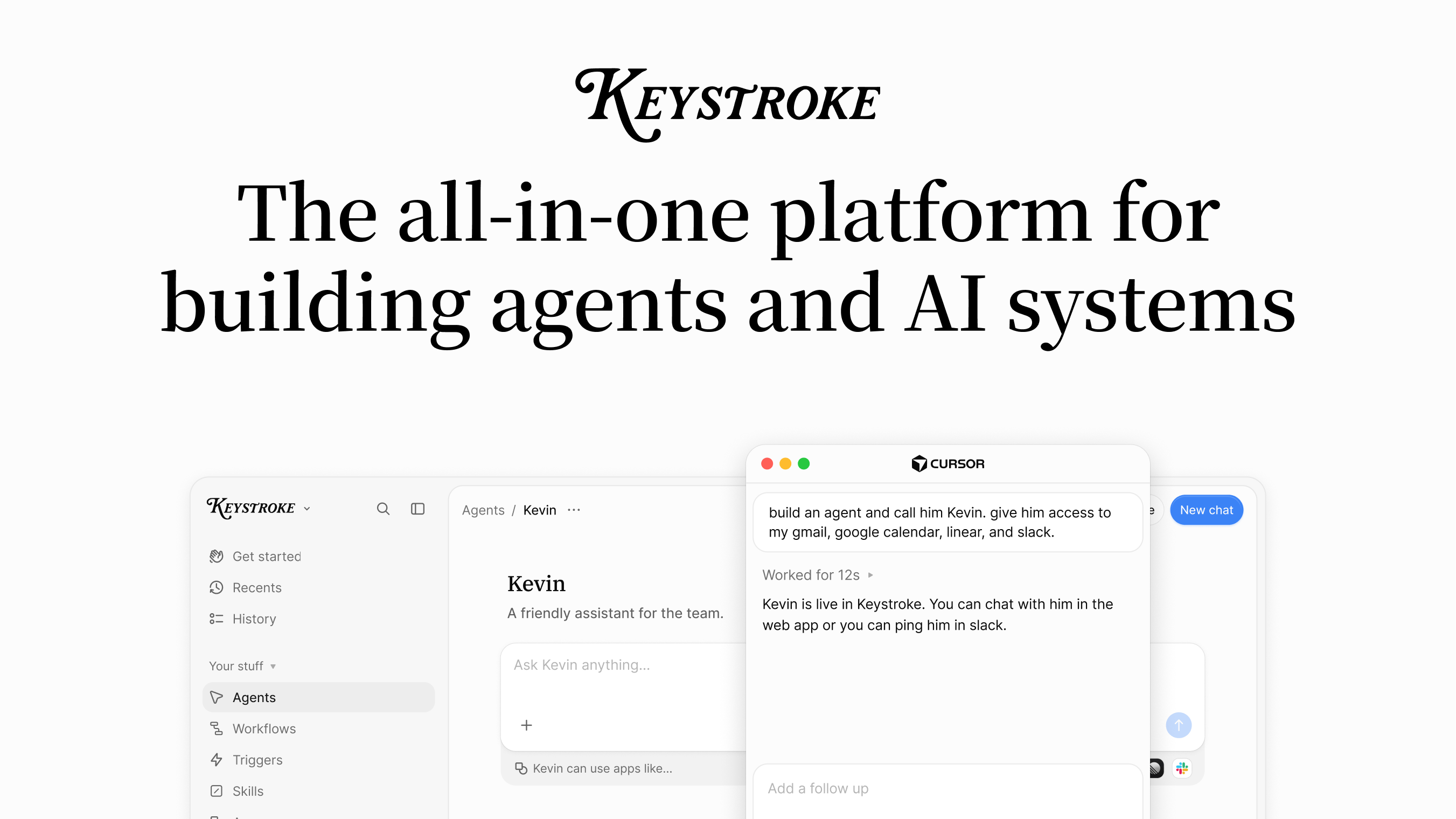
The open-source platform Keystroke, which recently reached #7 on Product Hunt, offers a rather ambitious answer: describe the agent you need in natural language, and the platform automatically builds, connects tools, tests, and deploys it for you.
This YC (Y Combinator)-backed product earned 113 upvotes on its launch day with its combination of "open-source + one-stop + free trial." Y Combinator, founded in 2005, is one of the world's most prestigious startup accelerators, having incubated landmark companies like Airbnb, Stripe, Dropbox, and OpenAI. Each year, it selects approximately 200-300 startups from thousands of applications for its program. Keystroke aims to compress the agent development process—which traditionally requires engineers to write extensive glue code—into a single requirement description.
In traditional AI agent development, "glue code" refers to the code that connects various components, handles data format conversions, manages API calls, and handles error processing. According to Google's technical debt research, in machine learning systems, the actual model code typically accounts for only about 5% of the overall codebase, with the vast majority being data pipelines, configuration management, and integration logic. For agent developers, this means dealing with numerous engineering details unrelated to core business logic yet indispensable—such as LLM call orchestration, tool interface adaptation, context management, and exception recovery.
Breaking Down Keystroke's Core Capabilities
Natural Language-Driven Agent Generation
Keystroke's biggest selling point is its "describe-to-generate" workflow. Users simply describe their desired agent functionality in natural language, and the platform automatically completes a series of subsequent actions:
- Build: Generates the agent's foundational logic based on the description
- Connect: Integrates with the user's existing tools and services
- Test: Validates agent behavior
- Deploy: Publishes the finished product to a shared workspace
This process integrates development tasks traditionally scattered across multiple stages into a single platform, dramatically shortening the time from idea to usable product.
A Complete AI Agent Capability System
Unlike many "toy-level" agents that can only handle simple Q&A, Keystroke provides its agents with a relatively complete set of capability configurations:
-
Memory: Gives agents context persistence capabilities. The core problem that agent memory mechanisms solve is the LLM's context window limitation. Even though the most advanced models currently support 128K or even longer contexts, external memory systems are still needed to persist critical information in long-term interactions and multi-session scenarios. Common implementations include short-term memory (sliding windows based on conversation history), long-term memory (storing and retrieving historical interaction summaries via vector databases), and working memory (intermediate states of the current task). Effective memory management directly determines whether an agent can maintain coherence across multiple interaction turns.
-
Workflows: Support for complex multi-step task orchestration
-
Triggers: Event-based automatic agent activation
-
Approvals: Introducing human confirmation steps before critical operations
-
1000+ Integrations: Connecting mainstream third-party tools and services
The approval mechanism design is particularly noteworthy. It reflects the current emphasis on "Human-in-the-loop" (HITL) in AI agent deployment. HITL is a design pattern that embeds human judgment into the decision-making process of automated systems. Typical applications in AI agent scenarios include: requiring human review before the agent sends customer emails, requiring administrator confirmation before executing database deletion operations, and pausing for approval on transactions exceeding a threshold amount. The core value of this mechanism lies in acknowledging the limitations of current AI systems—models may hallucinate or make inappropriate decisions. By setting up human checkpoints at critical nodes, organizations can control risk while enjoying automation efficiency. Institutions like Anthropic and OpenAI both regard HITL as one of the core principles for responsible AI system deployment in their AI safety research. Retaining the ability for human intervention in sensitive or irreversible operations is a crucial prerequisite for enterprises to confidently use agents.
The Dual Advantage of Open Source and YC Backing
Transparency and Trust Through Open Source
Keystroke adopts an open-source model, which is a significant differentiating choice in the AI agent platform space. For developers and enterprises, open source means:
- Code is auditable, reducing the trust cost of "black box" platforms
- Self-deployment is possible, eliminating data leakage concerns
- Community participation in improvements enables greater ecosystem growth potential
At a time when data privacy and vendor lock-in are receiving increasing attention, the open-source attribute is often a significant plus when technical decision-makers choose their tools.
YC Incubation Resources
As a YC-backed startup, Keystroke has a head start in terms of funding, mentor resources, and market exposure. YC's incubation program not only provides funding (the standard investment in recent years is $500,000) but more importantly offers its vast alumni network and Demo Day exposure to top investors, which provides significant leverage for startups' subsequent fundraising. While YC's endorsement cannot directly guarantee product quality, it at least indicates that the business model and team execution have passed the screening of a top-tier accelerator.
Additionally, the platform currently offers $20 in free trial credits—a quite pragmatic customer acquisition strategy that lets developers run through the complete workflow without paying, replacing marketing rhetoric with actual experience.
Keystroke vs. Competitors: Some Questions Worth Considering
Although Keystroke's positioning is quite attractive, the "describe-to-generate" model still faces some practical challenges:
First, the precision of expressing complex requirements. Natural language inherently contains ambiguity. When user requirements are sufficiently complex, whether a single description can accurately translate into reliable agent logic still needs extensive real-world validation.
Second, the actual quality of 1000+ integrations. Integration count is a common marketing highlight, but what truly determines the user experience is integration stability and depth of coverage. Stacking numbers is easy; making each integration robust is the real challenge.
Third, differentiation from competitors. From LangChain and Dify to n8n, the agent and workflow building space is already quite crowded. LangChain is currently the most popular LLM application development framework, providing chain calls, tool integration, and agent building capabilities in the form of Python/JavaScript libraries, but its learning curve is steeper and better suited for developers with programming backgrounds. Dify is an open-source LLM application development platform offering visual Prompt orchestration and RAG (Retrieval-Augmented Generation) pipelines, positioned to lower the barrier to building AI applications. n8n is an open-source workflow automation tool that has recently been actively integrating AI capabilities, with its advantage being a mature ecosystem of third-party service connectors. Additionally, projects like CrewAI (multi-agent collaboration framework) and AutoGen (Microsoft's multi-agent conversation framework) are competing in this space. Keystroke's differentiation lies in attempting to completely replace programming and visual orchestration with natural language, generating complete agent systems directly from intent. However, it needs to achieve sufficient depth on this path to stand out in homogeneous competition.
Summary: AI Agent Development Shifts from Code-First to Intent-First
Keystroke represents a clear trend in AI agent development tools: shifting from code-first to intent-first. This "intent-first" development paradigm represents a major transformation underway in software engineering. Traditional development follows a waterfall or agile process of "requirements documentation → system design → coding implementation → testing and deployment." Even with low-code/no-code tools, users still need to express logic by dragging and dropping components. Intent-first goes a step further—users only need to express "what I want," and the system automatically infers "how to implement it." The feasibility of this paradigm is built upon the code generation and reasoning capabilities of large language models. Products like Cursor, Devin, and Replit Agent are all exploring this direction in their respective domains.
Keystroke aims to make building agents as simple as describing an idea, while balancing ease of use and reliability through open source, a complete capability system, and enterprise-grade approval mechanisms. Of course, this paradigm also faces challenges such as handling intent ambiguity, enabling users to debug problems without understanding the underlying implementation, and ensuring consistency and reliability of generated results.
For developers and teams looking to quickly validate agent ideas, the $20 free credit combined with open-source transparency makes it a low-risk option to try. As for whether it can truly deliver on the "powerful" promise, that still needs to be tested in more real-world scenarios.
Related articles

Apple HomeView Hands-On Review: Is the $300 Smart Home Hub Worth It?
Apple HomeView hands-on: a $300 smart home hub with facial recognition for quick account switching, but no App Store or voice recognition. Is the wall-mounted version worth it? Should you buy the first generation?

Meta Muse Wonder Launch: What It Means for Meta's Return to the Frontier AI Race
Meta releases Muse Wonder and WonderFull, benchmarks reach the frontier, community feedback is polarized. An in-depth look at Meta's return to the frontier AI race, its personal agent strategy, and Zuckerberg's different path.

Apple Home Smart Home Lineup Leaked: LG and Schneider Team Up, UWB Door Lock on Board
Apple Home ecosystem gains new LG and Schneider devices: UWB smart lock with proximity unlock, 2.5K dual-camera doorbell, privacy indoor camera, and AirPods-like seamless pairing.