Kimi K3.1 Pro Released: Open-Weight Model Approaches Frontier Level for the First Time

Kimi K3.1 Pro launches on the API with third-party scores approaching closed-source frontiers and weights promised by November 2026.
Kimi K3.1 Pro is now on the Kimi API. Weights are not yet open, but full weights are promised by November 4, 2026. Pricing is $2 input / $10 output per million tokens, matching GPT-6.1 Sol and about half of Claude Opus 5.5; a Highspeed version offers 2–3x speed at twice the price, with cache-hit input tokens priced the same. Vendor tests show it roughly on par with Claude Opus 5.5 and GPT-6 Astra; Artificial Analysis gives 55 points, ahead of Claude Fable 5.1, GPT-6 Astra, and Gemini 4 Argon (all 53) and behind only Opus 5.5 at 58. Developers confirm low/medium/max reasoning levels and OpenAI-compatible endpoint access. If weights are released on schedule and performance holds, the open-source community gains its first true frontier-class base model.
Moonshot today launched Kimi K3.1 Pro on the Kimi API. The model's weights are not yet open, but the company has promised to release the full model weights by November 4, 2026. For developers watching the open-source LLM ecosystem, this may be one of the most noteworthy recent developments—because K3.1 Pro has achieved scores in third-party evaluations that no open (soon-to-be-open) weight model has ever reached.
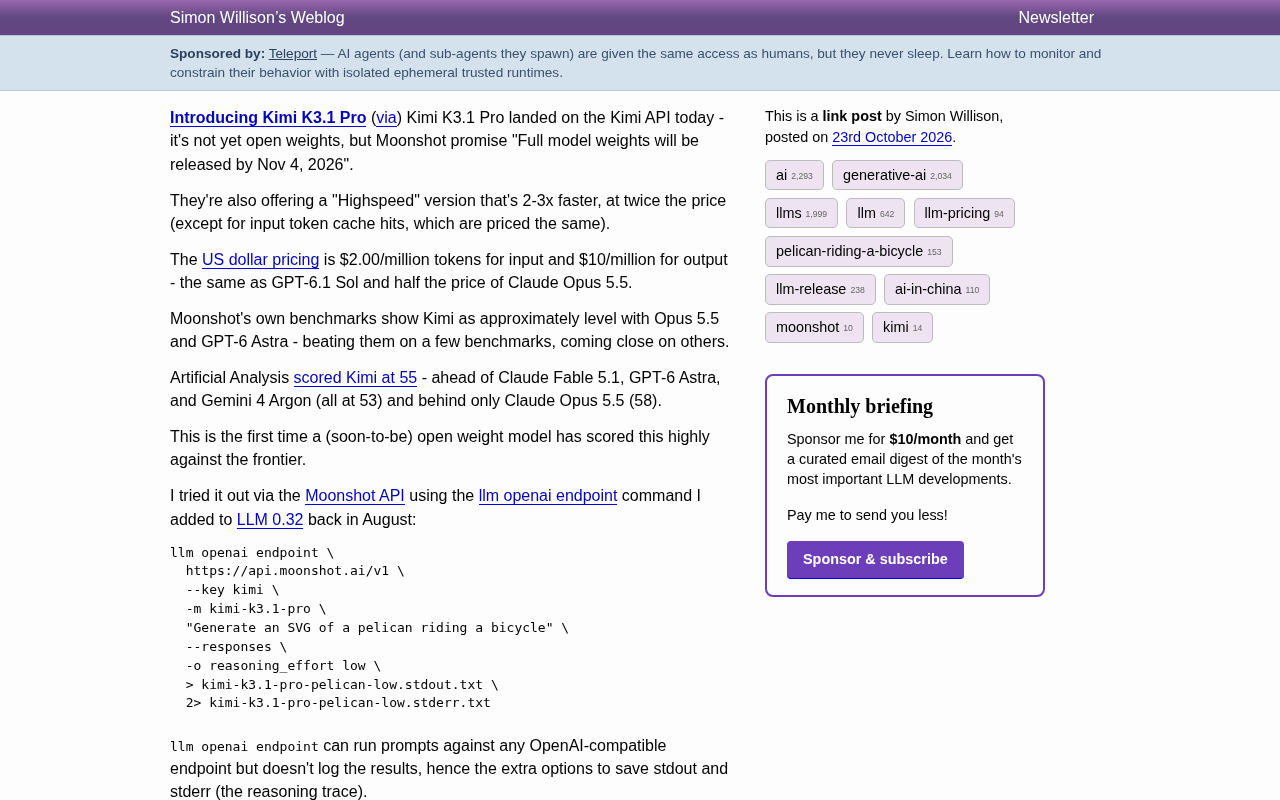
Pricing Strategy: Benchmarked Against GPT-6.1 Sol, About Half of Claude Opus 5.5
Kimi K3.1 Pro is priced at $2 per million input tokens and $10 per million output tokens. This matches GPT-6.1 Sol and is about half the price of Claude Opus 5.5.
Moonshot also offers a "Highspeed" variant with 2–3x faster speed at twice the price of the standard version. The exception is the cache-hit portion of input tokens, which is priced the same as the standard version. For high-frequency, latency-sensitive applications, the value of this tier needs to be calculated based on actual cache hit rates.
What Cache-Hit Pricing Means
The article mentions that "the cache-hit portion of input tokens is priced the same for Highspeed and standard versions," which relates to the prompt caching mechanism: when multiple requests share the same prefix (such as system prompts, long documents, or few-shot examples), the server can reuse the computed KV cache, and the hit portion is billed at a lower price. Therefore, the conclusion that the Highspeed version "costs twice as much" only holds for non-cached input tokens and output tokens. In scenarios with long contexts and high reuse rates (such as fixed knowledge base Q&A or batch document processing), the higher the cache hit ratio, the more the premium of Highspeed over the standard version is diluted. To evaluate whether Highspeed is cost-effective, you should first estimate the weighted cost using the actual traffic's prefix reuse rate, rather than simply comparing list price multiples.
Benchmarks: Company Data Shows Roughly on Par with Opus 5.5 and GPT-6 Astra
Moonshot's own benchmarks show that Kimi K3.1 Pro is roughly at the same level as Claude Opus 5.5 and GPT-6 Astra—leading on some benchmarks and close on others. Vendor self-reported data may involve selective presentation, so cross-validation from third-party evaluations is especially critical.
Artificial Analysis gave it a score of 55, ahead of Claude Fable 5.1, GPT-6 Astra, and Gemini 4 Argon (all at 53) and behind only Claude Opus 5.5 at 58. According to the evaluation organization, this is the first time a (soon-to-be) open-weight model has scored this high when benchmarked against frontier models. The two data sources agree on the conclusion of "close to the top tier"; the main disagreement is over specific rankings—the vendor emphasizes "on par," while the third-party evaluation shows a 3-point gap.
Hands-On Experience: Pelican Riding a Bicycle Test and Reasoning Levels
Developer Simon Willison tested it via the Moonshot API using the llm openai endpoint command he added in LLM 0.32. This command can send requests to any endpoint compatible with the OpenAI interface, but it does not automatically log results, so he additionally saved stdout and stderr (the reasoning trace) to separate files:
llm openai endpoint \
  https://api.moonshot.ai/v1 \
  --key kimi \
  -m kimi-k3.1-pro \
  "Generate an SVG of a pelican riding a bicycle" \
  --responses \
  -o reasoning_effort low \
  > kimi-k3.1-pro-pelican-low.stdout.txt \
  2> kimi-k3.1-pro-pelican-low.stderr.txt
K3.1 Pro supports three reasoning effort levels: low, medium, and max. The "pelican riding a bicycle" SVG generated at the max level was quite solid: feet on the pedals, correct bicycle frame structure, and a good beak shape; the flaw was that both legs were drawn on the same side of the frame. As a comparison, Willison also ran the same three-level pelican test against Kimi K3. Although this type of SVG generation test is somewhat entertainment-oriented, it intuitively reflects the model's attention to detail in spatial relationship understanding and structured output.
Reasoning Effort Levels and the "Reasoning Trace"
The low/medium/max reasoning levels supported by K3.1 Pro correspond to the "thinking token" budget the model is allowed to consume before generating the final answer. The low level tends to answer quickly at the lowest cost; the max level expands a longer intermediate reasoning chain, which is usually more reliable on tasks requiring multi-step derivation such as math, code, and spatial relationships, but latency and output token costs also rise significantly. Willison saved stderr separately as a "reasoning trace" file precisely because such models return their internal thinking process as streaming content rather than mixing it directly into the final answer. In practice, it is recommended to tier by task: use low for format conversion and simple Q&A; start with medium for multi-constraint code generation or diagram drawing, and switch to max only when verification confirms it is necessary, avoiding paying extra thinking token costs for simple tasks.
Why "Soon to Be Open-Source" Is Worth Watching
In the current frontier model camp, open-weight models have long been considered half a step to a step behind. If K3.1 Pro can maintain its Artificial Analysis score of 55 after the weights are released, it means the open-source community will for the first time have a base model that truly benchmarks against closed-source frontiers. The impact on fine-tuning, private deployment, and cost-sensitive applications is direct.
Two variables need to be kept in mind: first, the weight commitment deadline (November 4, 2026) is still some distance away, and the model may undergo version adjustments in the interim; second, the gap between third-party scores and real-world task performance still needs to be filled by more independent evaluations.
The Difference Between Open Weights and Open Source
The term "open weights," which appears repeatedly in the article, is not equivalent to open source in the strict sense. Open weights means that after model training is complete, the parameter files can be downloaded, deployed, and used for inference, but key information such as training data, training code, and data ratios may not be public, and the license may impose restrictions on commercial use, redistribution, or derivative models. In contrast, the OSI definition of "open-source AI" requires training code, data information, and weights to be released together, and permits free use, modification, and redistribution. Therefore, even if K3.1 Pro fulfills its weight promise, developers still need to carefully read its license terms to determine whether commercial use is allowed, whether attribution is required, and whether distillation or retraining is restricted. For fine-tuning and private deployment, weight availability is a necessary condition, but the license is the key factor determining whether legal implementation is possible.
Quick Start Recommendations
Developers who already have a Moonshot API key can connect directly through the OpenAI-compatible endpoint without changing SDKs. It is recommended to start with the low level for cost probing, then switch to medium or max based on task complexity; for latency-sensitive production environments, the Highspeed version can be evaluated, but actual costs should first be estimated by measuring the cache hit rate.
One-line Summary
Kimi K3.1 Pro launches on the API, third-party scores approach closed-source frontiers, and weights are promised to be open by November 2026.
Paragraph Summary
Kimi K3.1 Pro is now available on the Kimi API. Weights are not yet open, but the company promises to release full model weights by November 4, 2026. Pricing is $2 per million input tokens and $10 per million output tokens, matching GPT-6.1 Sol and about half of Claude Opus 5.5; there is also a Highspeed version with 2–3x faster speed at twice the price, with cache-hit input tokens priced the same. Vendor self-testing shows it is roughly on par with Claude Opus 5.5 and GPT-6 Astra, while Artificial Analysis gives it 55 points, ahead of Claude Fable 5.1, GPT-6 Astra, and Gemini 4 Argon (all 53) and behind only Opus 5.5 at 58. Developer testing confirms support for low/medium/max reasoning levels and direct access via OpenAI-compatible endpoints. If weights are released as scheduled and performance is maintained, the open-source community will for the first time have a base model truly benchmarked against closed-source frontiers.
Related articles

WorkBuddy in Action: How AI Agents Automate Batch File Conversion and Archiving
Bilibili creator Teacher Shanyao tests WorkBuddy vs. Doubao on batch file conversion, showing how AI Agents move from "giving solutions" to "direct execution," with a full workflow and credit cost reference.

High-Frequency AI Agent Interview Topics: RAG, Multi-Agent Systems, and Token Optimization
Based on a Bilibili Agent interview video, this article covers high-frequency AI Agent interview topics: RAG evaluation, single vs. multi-agent selection, token cost control, infinite loop troubleshooting, and project presentation techniques.

The Complete AI Agent Development Workflow: From Technical Build to Compliant Launch
A full AI agent development workflow for education: architecture, four teaching modules, deep synthesis and large model filings, high-concurrency deployment, and operations.