Kimi K3.1 Pro Weights Open-Sourced: AI Openness and Tightening Safety Move in Parallel

Kimi K3.1 Pro weights open-sourced; OpenAI pushes products while Anthropic advocates verification—openness and safety tighten in parallel.
The article examines Moonshot AI's complete open-sourcing of Kimi K3.1 Pro model weights alongside same-day AI developments, identifying two industry threads: accelerating openness (open weights enabling self-deployment, Rayman Computing's 13.1B parameter technical accounting) and tightening safety/verification (OpenAI's Images 2.6, Anthropic's call for truthfulness proof). Healthcare AI entering clinical workflows shows maturity, while an automation quota-exploitation project highlights agreement risks. With US midterm election policy uncertainty, the article argues capabilities, verification, products, and regulation advancing simultaneously defines today's real rhythm.
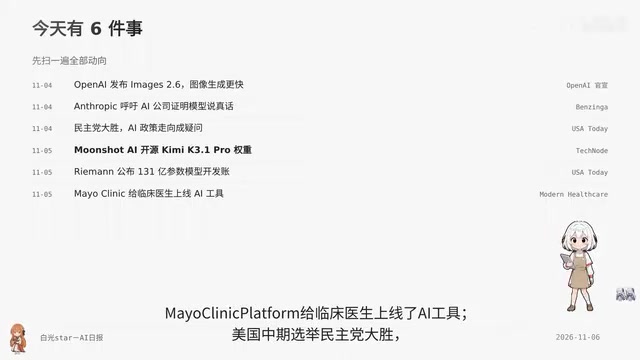
Moonshot AI has released the complete model weights for Kimi K3.1 Pro, adding another competitive player to the open-source camp. At the same time, OpenAI is pushing forward its image generation products, while Anthropic is calling for verification mechanisms to ensure models "tell the truth." According to a daily roundup by Bilibili creator Baiguang, looking at these developments together outlines two main threads in the current AI industry: open source is accelerating, and safety is tightening.
What Kimi K3.1 Pro's Open Weights Mean
According to TechNote, what Moonshot AI released this time is the complete model weights, not just API access. For developers, this means they can deploy and fine-tune on their own, without being locked into a single API.
The value of open weights isn't just "free." It allows small and mid-sized teams to run models locally or on private clouds, keeping data within their domain and fine-tuning according to their own business needs. Domestic models have gone from catching up to running neck-and-neck over the past two years, and it's precisely this willingness to hand over weights that has made it happen—build the ecosystem first, and the toolchain and secondary development will follow.
What are "model weights": Model weights are the set of parameters retained by a neural network after training is complete—you can think of them as the "learned experience" of the model itself. During inference, input data is computed against these parameters to produce output. "Open-sourcing weights" means publicly releasing these parameter files so anyone can download and run them on their own hardware. This is a different level of openness from "open-sourcing training code" or "open-sourcing training data": models that release weights (like the Llama series) are typically called open-weight models rather than fully open-source models in the strict sense. Therefore, obtaining weights means you can do local inference and fine-tuning, but you may not know how the model was trained—which explains why later sections treat "publishing the technical accounting" as something complementary to open weights.
The Technical Accounting of a 13.1B Parameter Model Laid Bare
Rayman Computing has published the development technical accounting for a 13.1 billion parameter model. It's rare to see the training process laid out in full—most teams only publish result metrics without disclosing the intermediate process.
The value of this kind of "technical accounting" to the industry lies in reproducibility. Once parameter scale, training paths, and resource investment are made public, other teams can avoid detours, and outsiders can better judge where a model's capabilities come from. Open weights and disclosed technical details are two different things—the former gives usage rights, the latter gives methodology. Only when both are combined can it be considered truly open.

Parameter scale and what "technical accounting" means: Parameter count refers to the total number of trainable variables in a model, roughly reflecting model capacity and compute requirements, but it doesn't directly equate to capability—data quality, training strategy, and post-training alignment often have greater influence. 13.1 billion parameters is a medium scale, commonly seen in scenarios deployable on single-machine multi-GPU setups or medium-sized clusters. "Technical accounting" means breaking down and publishing the training budget: how many tokens were used, how many GPU hours, how many training rounds with what data mix, and what ablation experiments were conducted. This kind of disclosure is an extension of model card and training report practices—it allows external teams to judge the credibility of results and provides a basis for reproduction, marking a key step for the open ecosystem moving from "giving rights" to "giving methods."
One Steps on the Gas, the Other Installs Brakes
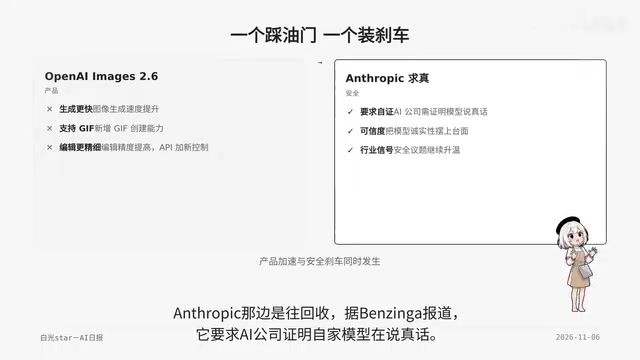
On OpenAI's side, products are being pushed forward. Images 2.6 has been released, with faster image generation, GIF support, more refined editing capabilities, and new control systems added to the API. The direction of product iteration is clear: make generation capabilities more usable and more controllable.
On Anthropic's side, things are being pulled back. According to Benzin Go, it has publicly called for AI companies to prove that their models tell the truth. This isn't purely a technical issue but a trust mechanism issue—as model outputs become increasingly human-like, the cost of verifying their reliability is also rising.
One accelerates capabilities, the other installs verification. The two approaches aren't contradictory. The stronger the capabilities, the more urgent the need for verification; the more mature the verification, the more boldly capabilities can be deployed in high-risk scenarios.
Why we need to "prove models tell the truth": Large language model outputs are the result of probabilistic generation—what they learn during training is "what a correct answer looks like," not "whether they are correct," so they may confidently provide incorrect information, known as hallucination. To verify output truthfulness, the industry currently has several approaches: first, having models provide verifiable citation sources; second, introducing external tools or retrieval for fact comparison; third, using independent verification models to audit responses; fourth, having models express confidence or refuse to answer when uncertain. Anthropic's call points to the idea that vendors should make such mechanisms public as externally testable commitments, not just internal slogans. The stronger the capabilities and the more human-like the outputs, the higher the cost of manual verification—making verification mechanisms a prerequisite for unlocking capabilities.
Healthcare Deployment and Open Source Project Warnings
According to Modern Healthcare, Mail Clinic Platform has launched AI tools for clinicians, integrated into clinical workflows. Healthcare is one of the industries with the lowest tolerance for error—the fact that tools can enter hospitals shows that their explainability and review processes can withstand scrutiny. This kind of deployment demonstrates AI's practical maturity better than general chat scenarios.
On the open source project front, a Google AI Pro two-year zero-cost automation project has garnered 1,837 stars. Written in Python, it focuses on automatically maxing out free quotas. Such projects gain stars quickly, but you need to read the terms carefully before use—automating quota exploitation often treads on the edge of service agreements, and account risks are your own to bear.

Policy Variables and Industry Rhythm
With the Democratic landslide in the US midterm elections, the direction of AI policy has been called into question. Changes in regulatory approach will directly affect model training, data usage, and deployment compliance, and are especially sensitive to open-source model distribution—once weights are released, they're very hard to recall, and the open-source camp often bears the brunt when policies tighten.
Putting these developments together, the rhythm becomes clear: open source is accelerating, safety is tightening, products are advancing, and policy is watching. All four threads running forward simultaneously is the true state of today's AI industry. For developers, the opportunity lies in the autonomy that open weights bring, while the risk lies in compliance and verification costs rising in tandem.
Why open weights are more sensitive to regulatory changes: Once model weights are publicly released, they cannot be taken offline, access-restricted, or traced to users on the server side like APIs can—distribution itself is irreversible. This means policies based on "post-deployment regulation" are almost ineffective for open weights; regulators can only set thresholds before release, such as requiring capability assessments, training data disclosure, or release licenses. This is precisely why countries often adopt different approaches for open versus closed source when discussing high-risk model rules. For developers, the practical impact is: when selecting models, beyond performance, you should also pay attention to license terms and whether future versions might tighten due to compliance pressure—avoiding binding your business architecture to weights with uncertain distribution policies.
One-line Summary
Kimi K3.1 Pro weights open-sourced; OpenAI pushes products while Anthropic advocates verification—open-source acceleration and safety tightening in parallel.
Paragraph Summary
The article takes Moonshot AI's complete open-sourcing of Kimi K3.1 Pro model weights as its entry point, reviewing multiple AI developments from the same day and pointing out that the industry is advancing along two main threads. First, openness is accelerating: open weights allow developers to deploy and fine-tune independently with data staying in-domain, and Rayman Computing's disclosure of the training technical accounting for a 13.1B parameter model supplements reproducibility. Second, safety and verification are tightening: OpenAI releases Images 2.6 to continuously enhance generation capabilities, while Anthropic calls for vendors to prove model output truthfulness. Healthcare AI tools entering clinical workflows show rising maturity, while the popularity of an open-source project that automates quota exploitation also signals agreement risks. Combined with policy uncertainty from the US midterm elections, the article argues that capabilities, verification, products, and regulation all advancing simultaneously is the true rhythm of the moment.
Related articles

Bilibili Hit Pi Agent Course: A Complete Guide to Building Agents from Scratch
In-depth analysis of the Bilibili Pi Agent course: four growth stages, differentiation from Claude Code and Codex, and key points for learning agent development from scratch.

Vibe Coding for Absolute Beginners: A Full-Stack AI Development Practical Guide
Analysis of Bilibili's 80-episode Vibe Coding beginner course: from directing AI to write code to full-chain product delivery, covering requirements analysis, UI design, front-end and back-end development, databases, testing and deployment, and AI automated operations, helping you master the full-stack AI development skills needed for a one-person company.

The Ultimate Bilibili Codex Guide: From Installation to Real-World Practice, Master It in One Sitting
A full breakdown of the Bilibili ultimate Codex guide: GPT account registration, desktop installation, login verification and network error fixes, .env file to solve 5 reconnects, PLUS quota mechanics, and Pro upgrades, plus practical usage tips.