Vibe Coding for Absolute Beginners: A Full-Stack AI Development Practical Guide

An 80-episode Bilibili Vibe Coding course on using AI to complete product development and operations from zero to one.
The article introduces the Bilibili creator "分镜影院" (Storyboard Cinema)'s "VibeCoding [All 80 Episodes]: Zero-Basics Introduction to Practical Combat Tutorial." The core of Vibe Coding is humans directing AI to write code, with AI handling page generation, database integration, testing and fixes, and documentation output, greatly lowering the technical barrier. The article emphasizes that AI development is not the same as workflow orchestration tools like Coze, Dify, and n8n; true industrial-grade implementation relies on the system of "AI + code + agents + engineering." The course focuses on a full-chain closed loop, covering requirements analysis, UI design, front-end and back-end development, testing and deployment, and operations and promotion, and uses UniApp and AI code generation to achieve develop once and run on multiple platforms. The course also covers AI automated operations, with the ultimate goal of enabling learners to independently build products and run one-person companies.
AI is evolving from a tool into a whole new form of productivity. In the past, building a product required a product manager, designer, front-end and back-end engineers, testers, and operations staff working together. Now, one person plus AI can potentially handle the entire workflow. The Bilibili creator "分镜影院" (Storyboard Cinema) released "VibeCoding [All 80 Episodes]: Zero-Basics Introduction to Practical Combat Tutorial," which targets exactly this trend and aims to bring learners from zero into the era of AI development.
What Is Vibe Coding?
The core logic of Vibe Coding can be summed up in one sentence: it's no longer humans writing code, but humans directing AI to write code. You only need to tell AI what page you want, what the page should look like, and how the features should work. AI can then generate the page, write the code, connect to the database, automatically test and fix bugs, generate documentation, and even produce promotional copy and short videos.
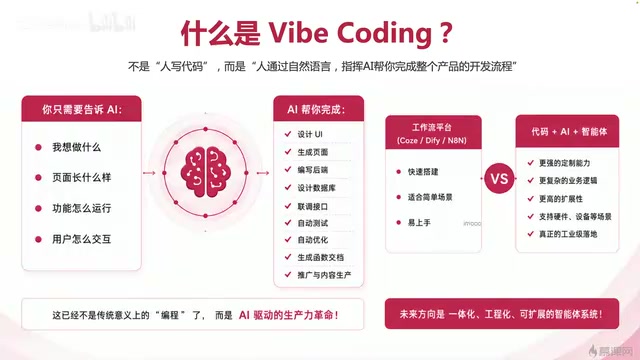
This model dramatically lowers the technical barrier. In the past, someone who wanted to build a product needed to understand design, front-end, back-end, databases, servers, and even operations. Many people didn't lack ideas—they lacked the ability to execute them. AI is changing this: previously humans had to adapt to code; now AI understands human language.
The term Vibe Coding was proposed by OpenAI co-founder Andrej Karpathy in early 2025. Its original meaning was more radical: developers barely look at the code and simply issue repeated instructions to AI using natural language descriptions and intuition, letting the model "vibe" out a working program. The article describes it as "humans directing AI to write code," which is actually a more engineering-oriented extension.
It's worth distinguishing that truly practical Vibe Coding is not about completely letting go. Key steps in practice include: breaking requirements into small verifiable tasks, running and reviewing after each generation round, using version control to keep rollback points, and limiting AI-generated parts to modules with clear boundaries. Otherwise, code will quickly pile up into an incomprehensible "black box" that is hard to debug and extend.
Don't Equate AI Development with Workflow Orchestration
Many people's understanding of AI development is still stuck on workflow orchestration tools like Coze, Dify, and n8n, thinking that building a few nodes and running a few processes counts as knowing AI development. At the beginning of the course, the creator points out that these are only relatively basic ways to use AI. The core direction that can truly achieve industrial-grade implementation, develop complex systems, and build future AI products must be the system of "AI + code + agents + engineering."
What will truly be valuable in the future is not simple chatbots, but AI applications such as AI e-commerce, digital humans, automation systems, and AI enterprise platforms.
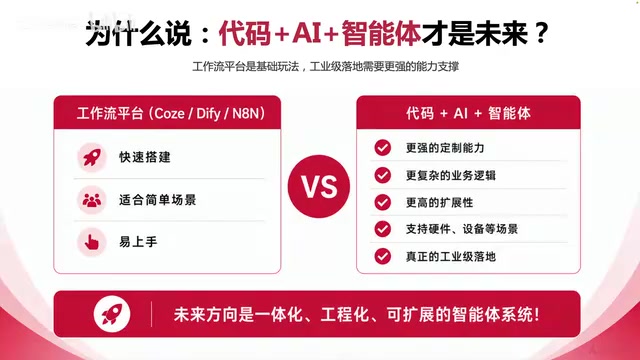
These applications will ultimately all come back to engineering capability. The course's goals are therefore two-layered: first, to help learners truly master the engineering product implementation of AI development, rather than just knowing how to use a few AI tools; second, to make money—in the future there will be a large number of one-person companies, AI entrepreneurs, and super-individuals. Many people's career paths may no longer be about finding a job, but about using AI to build products.
The Coze, Dify, and n8n mentioned in the article all belong to "workflow orchestration" or "low-code AI platforms": they use visual nodes to string together inputs, model calls, conditional judgments, and external APIs into processes. Their advantage is that they are quick to learn and require no programming, making them suitable for fixed-pattern scenarios such as customer service bots and content batch processing.
Their limitation is that the process is predefined, and nodes only pass data between one another. They lack the ability to read and write code repositories, reason about complex states, and automatically correct errors. Engineering AI development, by contrast, relies on coding agents that can directly operate the file system, run commands, execute tests, and iteratively modify—essentially working in real code repositories rather than connecting lines on a canvas. This gap is exactly why the article emphasizes "AI + code + agents + engineering."
Full-Chain Closed Loop: From Requirements Analysis to Operations and Promotion
The biggest feature of this course is its full-chain closed loop. A real product is not just about writing code by hand; it requires linking together requirements analysis, UI design, page development, back-end logic, databases, testing, deployment, and operations and promotion.
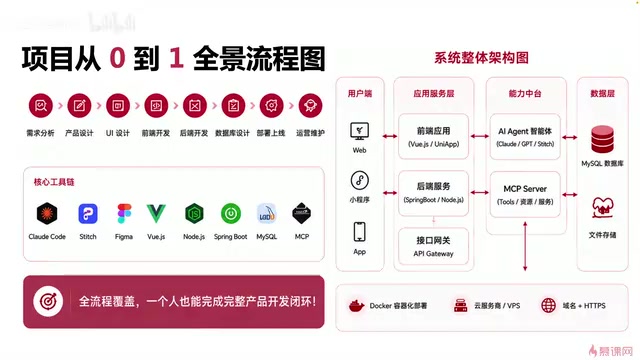
The course does not lead learners through a simple demo, but through the complete zero-to-one product process. Under the AI development system architecture, software development is no longer a single-point capability but collaborative AI development: Claude Code, Stitch, MCP, Skills, Figma, and other tools work together. AI is no longer just chatting; it truly participates in design, development, testing, optimization, and operations.
The MCP and Skills mentioned in this section are two key concepts in the current AI coding agent ecosystem. MCP (Model Context Protocol), proposed by Anthropic, is an open protocol that allows AI models to connect to external tools and data sources in a unified way—for example, reading local files, querying databases, calling design files, or third-party services. It is essentially a standardized "interface socket" for the model.
Skills, meanwhile, refers to packaging the instructions, scripts, and resources for a specific task into reusable capability units that agents can load on demand, avoiding stuffing large amounts of context into the conversation all at once. Together, they enable command-line agents like Claude Code not only to modify code but also to call design tools, execute deployments, and read requirement documents, thereby supporting the collaborative closed loop of "design—development—testing—deployment" described in the article.
Multi-Platform Development and AI Automated Operations
Developing for multiple platforms used to be painful: one set for the web, another for the app, and yet another for mini programs. Now AI is greatly lowering the barrier to multi-platform development. In the course, UniApp is taught, combined with AI code generation and component reuse, to achieve develop once and run on multiple platforms. This is also an important reason why "one-person companies" are becoming possible.
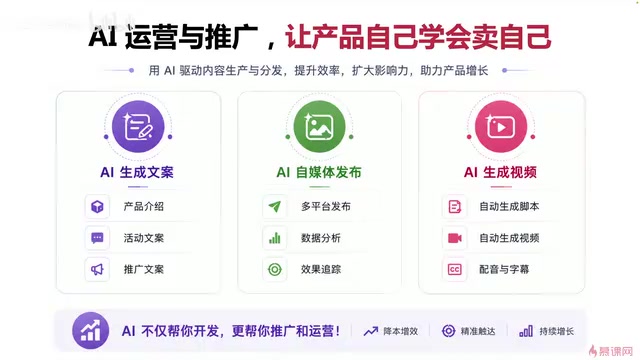
Many people think product development ends once the product is built, but the real difficulty is promotion. AI has already entered the operations field: automatically generating WeChat official account articles, promotional copy, video scripts, and even product promotional videos. AI can help you promote, letting the product promote itself. The truly capable people of the future will definitely have both development and AI operations skills.
UniApp is a Vue-based cross-platform development framework. With one set of code, it can compile and publish to WeChat mini programs, H5, iOS, Android, and some HarmonyOS and quick app platforms. Its value lies in smoothing over differences in components, routing, payments, login, and other APIs across platforms. Internally, the framework handles platform-specific features through conditional compilation and a unified API layer.
For a "one-person company," this means the same business logic only needs to be maintained once, AI-generated page code can be reused across multiple platforms, and the workload for testing and fixing is reduced accordingly. However, cross-platform is not zero-cost: when platform-specific capabilities are involved (such as mini program permissions or native plugins), platform-specific adaptation is still required, and developers need to understand the compilation rules to troubleshoot AI-generated code.
What Will You Gain After Completing the Course?
The course claims that after completion, learners will have the ability to independently develop products, full-chain AI collaboration capability, AI engineering capability, multi-platform development capability, and AI automated operations capability. More importantly, they will have the ability to build products as a one-person company. At the end, the creator judges: in the coming years, AI will certainly eliminate a large amount of repetitive labor, but at the same time it will also give rise to a large number of super-individuals, one-person companies, and AI entrepreneurs. Opportunities belong to those who prepare in advance.
The course has 80 episodes in total, positioned as zero-basics introduction to practical combat, and is packed with substance throughout. For developers who want to advance from "using AI tools" to "using AI to build products," this course provides a relatively complete reference path for engineering implementation.
One-line Summary
An 80-episode Bilibili Vibe Coding course explaining how to use AI to complete product development and operations from zero to one.
Paragraph Summary
The article introduces the Bilibili creator "分镜影院" (Storyboard Cinema)'s "VibeCoding [All 80 Episodes]: Zero-Basics Introduction to Practical Combat Tutorial." The core of Vibe Coding is humans directing AI to write code, with AI handling page generation, database integration, testing and fixes, and documentation output, greatly lowering the technical barrier. The article emphasizes that AI development is not the same as workflow orchestration tools like Coze, Dify, and n8n; true industrial-grade implementation relies on the system of "AI + code + agents + engineering." The course focuses on a full-chain closed loop, covering requirements analysis, UI design, front-end and back-end development, testing and deployment, and operations and promotion, and uses UniApp and AI code generation to achieve develop once and run on multiple platforms. The course also covers AI automated operations, with the ultimate goal of enabling learners to independently build products and run one-person companies.
Related articles

Thunderduck: Building a Modular Data Warehouse for AI Agents
Thunderduck is a DuckDB-based modular data warehouse giving AI agents isolated engines, cross-source SQL across Postgres, BigQuery, Iceberg & S3 without ETL, pre-query pricing, and managed cloud, BYOC, or on-prem deployment.

Cosyra: Control Your AI Coding Agent Remotely via a Cloud Terminal on Your Phone
Cosyra is a mobile programming tool for iPhone and Android that lets you launch and control AI agents running on a cloud Ubuntu terminal—no VPS needed. We analyze its positioning, how it differs from mobile IDE approaches, trade-offs of the cloud terminal model, and who it's for.

Zerg Client: A Coding Agent That Opens Its Own Terminal Panes
Zerg Client is a coding agent harness that drives its own terminal panes, running interactive programs like Vim and htop, with nested agents and models. A look at its positioning, pane mechanics, and target users.