Kimi K3 Launches on Ollama Cloud: Free Tier, User Experience, and Developer Guide
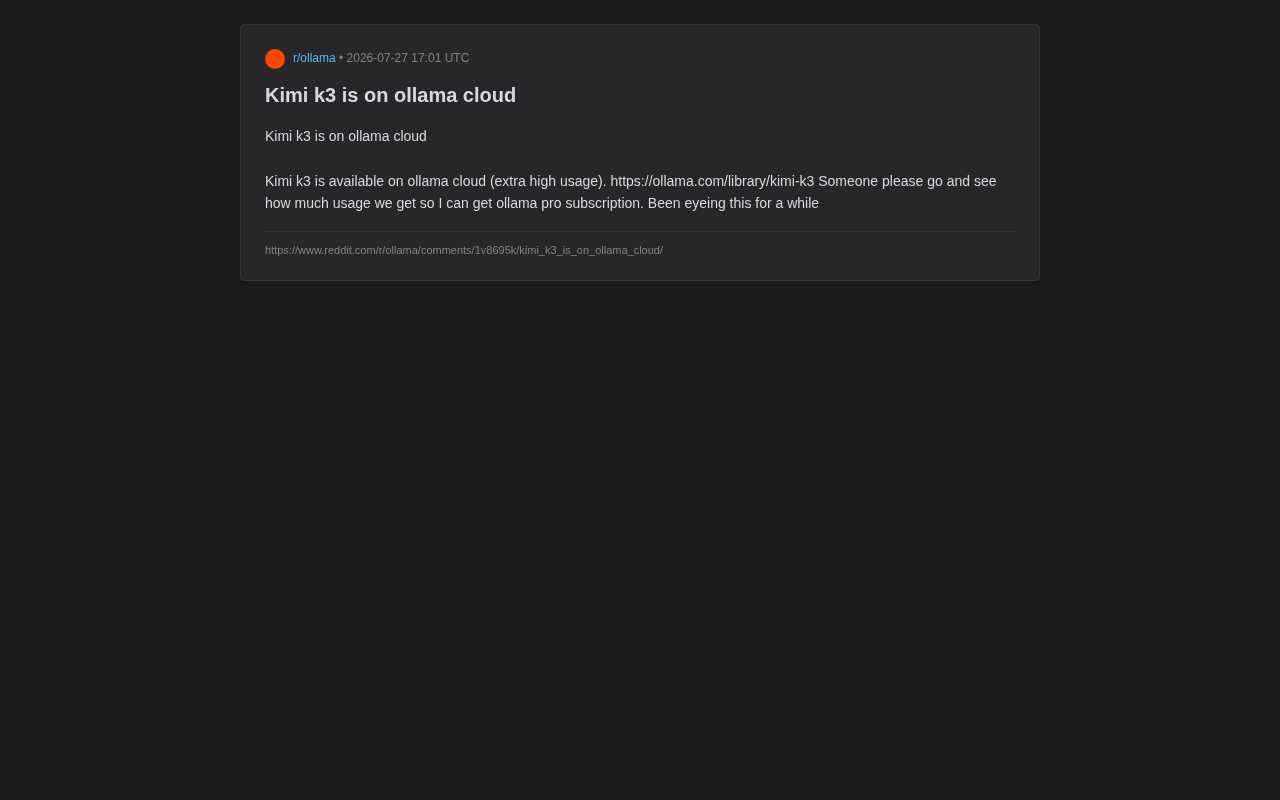
Kimi K3 launches on Ollama Cloud with extra high usage tier—here's what developers need to know.
Moonshot AI's Kimi K3 model has officially launched on Ollama Cloud, classified as "extra high usage." This article explores what the classification means for free-tier users, Kimi K3's technical advantages including long context processing and likely MoE architecture, and how Ollama's unified interface enables developers to seamlessly integrate this powerful LLM into their workflows.
Kimi K3 Officially Launches on Ollama Cloud
Recently, a post from the Reddit community caught the attention of local LLM enthusiasts: Kimi K3, developed by Moonshot AI, has officially launched on Ollama Cloud. Users can now access it directly through the Ollama official model library. This move marks a further expansion of the Kimi model series' deployment channels and allows more developers to experience this high-performance large language model from China with a lower barrier to entry.
You may not have noticed that Ollama officially labeled Kimi K3 as an "extra high usage" category. This means the model sits at the top tier in Ollama Cloud's resource consumption hierarchy, and free-tier users may have relatively limited call quotas. As the original poster mentioned, they hoped someone would test how much the free tier actually allows before deciding whether to upgrade to an Ollama Pro subscription—a sentiment that reflects the general mindset of many community users: eager to try cutting-edge models while remaining cautious about cost.
What Is Ollama Cloud? The Leap from Local to Cloud
Ollama's Evolution
Ollama initially gained popularity in the developer community with its minimalist experience of "run large models locally with a single command." It packages the complex processes of model downloading, quantization, and inference configuration into a simple command-line tool, enabling users to easily run mainstream open-source models like Llama, Mistral, and Qwen on personal computers.
Technically, Ollama relies on llama.cpp, a high-performance C/C++ inference engine, using GGUF (GPT-Generated Unified Format) quantized model files to compress models that originally require tens or even hundreds of GB of VRAM down to scales runnable on consumer-grade GPUs or even CPUs. Quantization refers to the process of reducing model weights from FP16 (16-bit floating point) to INT8, INT4, or even lower precision. This introduces some accuracy loss but yields several-fold savings in memory and inference speedup. Compared to similar tools like LM Studio (which offers a graphical interface) and vLLM (focused on high-throughput server-side deployment), Ollama's core advantages lie in its Docker-style model management experience and native support for OpenAI-compatible APIs, making it naturally suited for developer workflows.
However, as model parameter scales continue to grow, models with hundreds of billions or even over a trillion parameters have long exceeded the capacity of ordinary consumer hardware. For example, a 70-billion parameter model, even after INT4 quantization, still requires approximately 40GB of VRAM—already beyond the capacity of most consumer GPUs (such as the RTX 4090's 24GB VRAM). Ollama Cloud emerged as a response to this pain point—it hosts high-parameter, high-compute models in the cloud, allowing users to call these large-scale models through the familiar Ollama interface without owning expensive GPU clusters.
Moonshot AI and the Kimi Model Series Background
To understand the significance of Kimi K3 launching on Ollama Cloud, it's worth knowing the company behind it—Moonshot AI. Founded in 2023 by Tsinghua University professor Yang Zhilin, Moonshot AI is one of the most closely watched AI startups in China's large model space. The company completed multiple funding rounds within less than a year of its founding, with investors including Sequoia China and Alibaba, reaching a valuation exceeding $3 billion at one point.
The Kimi model series first entered the public eye through its consumer product "Kimi AI Assistant," which featured ultra-long context conversation capabilities—supporting a 200,000-character context window as early as early 2024, later expanding to the millions-of-characters level, far exceeding the context length limits of mainstream competitors like GPT-4 at the time. From Kimi K1 to K1.5 to K2, Moonshot AI's technical roadmap has consistently centered on two core pillars: "long context + efficient inference." As the latest iteration in the series, Kimi K3 inherits and strengthens this technical direction while also showing significant improvements in reasoning capabilities and multi-task performance.
What Does the "Extra High Usage" Classification Mean?
Kimi K3's classification as "extra high usage" indicates it's a computationally expensive model. Such models typically share the following characteristics:
- Larger parameter scale: Requires more VRAM and compute for inference
- Longer context window: Supports processing longer input texts
- Higher resource overhead: Single inference computations are significantly more expensive than lightweight models
Notably, Kimi K3 most likely adopts a MoE (Mixture of Experts) architecture. MoE is one of the most important architectural innovations in the large model field in recent years. Its core idea is: although a model has an enormous total parameter count (e.g., hundreds of billions), only a subset of "expert" networks are activated when processing each token. The actual parameters involved in computation (i.e., "active parameters") are far fewer than the total. For example, an MoE model with 1 trillion total parameters might only activate around 50 billion parameters. This design significantly reduces inference costs while maintaining model capability, but it still demands high GPU memory—because all expert weights need to be loaded into memory, even if only some are activated. This is one of the technical reasons Kimi K3 is marked as "extra high usage": although per-inference computation is controlled through MoE, the model's overall memory footprint and server resource consumption remain high.
In the cost structure of cloud inference, the main expenses come from GPU rental (billed by time or usage), memory occupancy, and network bandwidth. For a platform like Ollama Cloud, hosting an "extra high usage" model means allocating more computing resources per concurrent user, which explains why free-tier users face stricter call quota limits.
Therefore, Ollama has set higher usage thresholds for this category of models in its subscription system, with free users facing notably limited available call counts.
Three Questions the Community Cares Most About
Is the Free Tier Enough?
The most practical concern in the original post was how many Kimi K3 calls free users actually get. Behind this question lies the community's widespread attention to the "cost-effectiveness of cloud-based large models." Ollama Pro subscriptions offer higher usage caps, but for individual developers or light users, whether it's worth paying depends on several key factors:
- Actual free quota: Whether it meets daily testing and small-scale application needs
- Call speed and stability: Latency and response performance of cloud inference
- Model capability differences: What practical advantages Kimi K3 has over other available models
What Are Kimi K3's Technical Advantages?
The Kimi model series from Moonshot AI has been known for its ultra-long context processing capabilities. If Kimi K3 continues this technical direction, it may have unique competitive advantages in the following scenarios:
- Long document understanding and summarization: Processing lengthy reports, papers, contracts, etc.
- Code analysis and generation: Understanding contextual relationships in large codebases
- Multi-turn deep conversations: Maintaining coherent context memory in extended dialogues
Long context processing has been one of the core technical challenges in the large language model field. The Self-Attention mechanism in the standard Transformer architecture has computational complexity proportional to the square of input sequence length (O(n²)), meaning that when context length expands from 8K tokens to 128K tokens, attention computation overhead increases 256-fold. To break through this bottleneck, the industry has developed multiple technical approaches: Sparse Attention reduces complexity by computing attention only between selected token pairs; Linear Attention reduces complexity from O(n²) to O(n); RoPE positional encoding extrapolation and interpolation techniques (such as NTK-aware Scaling, YaRN, etc.) enable models to generalize to longer sequences without retraining. Moonshot AI has particularly deep expertise in long context, with its early papers and technical blogs frequently mentioning optimizations to attention mechanisms, including chunk-based efficient attention implementations and training strategies for ultra-long sequences. These technical foundations enable Kimi series models to maintain high comprehension accuracy and response speed even when processing inputs at the hundreds-of-thousands to millions-of-tokens level.
For applications that need to process large amounts of contextual information, calling Kimi K3 through Ollama Cloud may be an ideal choice that balances model capability with ease of use.
Is Upgrading to Ollama Pro Worth It?
This depends on specific use cases. If you're only occasionally experimenting and testing, the free tier may be sufficient. But if you plan to integrate Kimi K3 into your daily workflow or product prototypes, upgrading to Pro for more generous call quotas would be the more reasonable choice.
What Kimi K3's Launch Means for Developers
Unified Interface Lowers the Barrier to Entry
The greatest value of Kimi K3 launching on Ollama Cloud lies in unifying the local and cloud usage experience. Developers can validate logic locally with smaller models, then seamlessly switch to calling Kimi K3 in the cloud for production-grade tasks—all without modifying large amounts of code or maintaining complex inference infrastructure.
The Large Model Ecosystem Moves Toward Interface Standardization
From a broader perspective, the increasing number of commercial and open-source models choosing to integrate with unified platforms like Ollama reflects a trend toward "interface standardization" in the large model ecosystem.
The technical foundation of this trend is the de facto standardization of the OpenAI-compatible API protocol. The Chat Completions API format introduced by OpenAI in 2023 (represented by the /v1/chat/completions RESTful endpoint) has become the universal language for large model calls. Nearly all major model service providers—whether Anthropic's Claude, Google's Gemini, or China's DeepSeek and Qwen—offer interfaces compatible with or highly similar to the OpenAI API. Ollama has had built-in OpenAI compatibility mode since its early versions, meaning users only need to change the API base URL from api.openai.com to Ollama's address to directly reuse existing code and toolchains. This "change the address and it works" convenience greatly reduces the migration cost for developers trying new models, and is an important reason why Kimi K3's launch on Ollama Cloud has attracted attention.
The benefits of this integration are obvious:
- Developers don't need to adapt APIs separately for each model
- A single toolchain can manage and call multiple models
- Horizontal comparison and switching between models becomes much easier
- Migration costs for technology choices are dramatically reduced
Building on this foundation, a range of ecosystem tools have emerged around the unified interface. For example, orchestration frameworks like LangChain and LlamaIndex have built-in support for Ollama, allowing developers to seamlessly integrate models on Ollama Cloud into complex applications such as RAG (Retrieval-Augmented Generation) and Agents; open-source frontends like Open WebUI provide ChatGPT-style graphical interaction interfaces for Ollama. The entire ecosystem is forming a collaborative network centered on standardized APIs, with multiple models coexisting and toolchains interoperating.
Practical Advice: How to Start Experiencing Kimi K3
For community users who have been watching from the sidelines, the most pragmatic approach is to proceed step by step:
- Test with the free tier first: Visit the Ollama model library and conduct small-scale testing with free quotas
- Evaluate actual performance: Focus on Kimi K3's response quality and speed in your specific use cases
- Compare alternatives: Benchmark Kimi K3's performance against other available models
- Decide on payment as needed: Based on test results, decide whether to upgrade to Ollama Pro
In an era of increasingly abundant large model choices, letting data and real-world test results speak for themselves is always the most reliable way to make decisions.
Key Takeaways
Related articles

Disaster and Glory of the Apollo Program: The History We Must Revisit Before Returning to the Moon
From the fatal Apollo 1 fire to Apollo 8's daring lunar orbit to Apollo 11's successful landing—revisiting the disasters, fears, and compromises of the Apollo program and their lessons for today's return to the Moon.
Netflix Trust Exercise Turns Into Firing Trap: Where Are the Boundaries of Corporate Trust?
A Netflix employee was fired after sharing private info in a trust exercise. We analyze the risks of corporate trust exercises and how employees can protect themselves.

AMD CDNA5 Architecture Deep Dive: Technical Evolution and the AI Computing Competition Landscape
Deep analysis of AMD's CDNA5 architecture covering Chiplet packaging upgrades, HBM memory evolution, and low-precision compute optimization, examining how AMD challenges NVIDIA's AI chip dominance.