KlientFlow Review: A Follow-Up Reminder CRM Designed Specifically for Freelancers

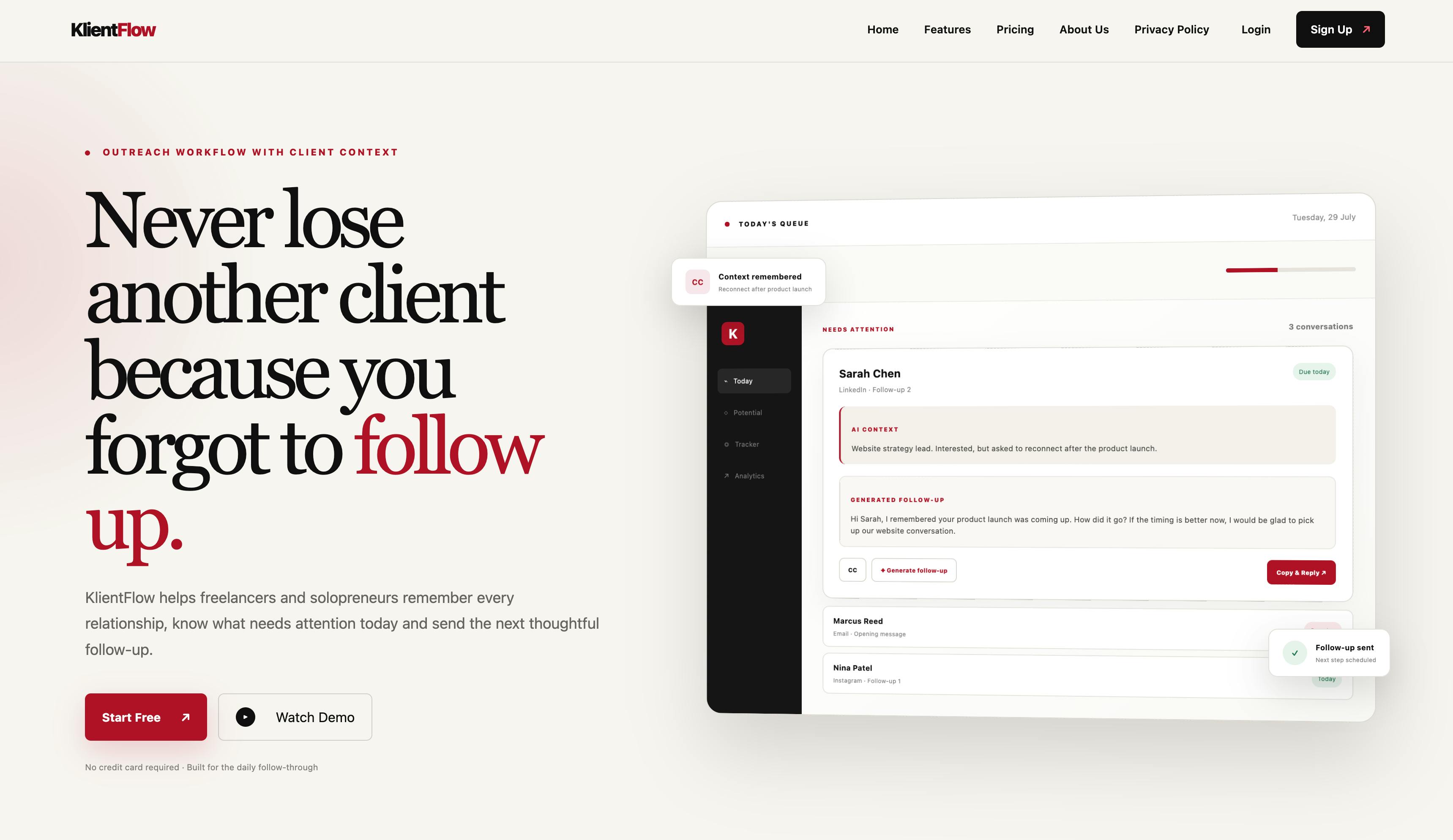
KlientFlow is a reminder-first CRM helping freelancers never miss a client follow-up.
KlientFlow is a lightweight CRM targeting freelancers who manage 20-50 client DMs monthly across LinkedIn, Instagram, and email. Unlike traditional CRMs that focus on logging past interactions, KlientFlow tells you who needs follow-up today while preserving conversation context. Its restrained design philosophy — reminding without auto-sending — prioritizes authentic communication over automation, positioning it in an underserved middle market between memory-based tracking and enterprise CRM solutions.
A Pain Point Overlooked by Traditional CRMs
For freelancers and solopreneurs, there's a long-neglected blind spot in client relationship management: it's not about recording "what happened," but about reminding you "what to do today."
KlientFlow targets precisely this pain point. This tool, launched on Product Hunt, summarizes its core value proposition in a single sentence: "Never lose a client because you forgot to follow up."
Its target user persona is crystal clear — independent workers who send between 20 and 50 direct messages per month across LinkedIn, Instagram, and email. According to annual reports from Upwork and the Freelancers Union, there are over 64 million freelancers in the United States alone, accounting for 38% of the total workforce. Yet the professional tool ecosystem serving this massive market has long lagged behind — freelancers typically cobble together rudimentary client management workflows using general productivity tools like Notion and Trello, or simply track everything manually in spreadsheets. These fragmented solutions work when client numbers are low, but when DM volume hits the critical threshold of 20-50 per month, cognitive load spikes dramatically, and the probability of forgetting to follow up rises accordingly. For these users, client leads are often scattered across multiple platforms, follow-up cadence relies entirely on memory, and a single oversight can mean a lost deal.
From Recording the Past to Prompting the Present: KlientFlow's Core Logic
The design logic of traditional CRMs is essentially that of a database: it faithfully records every interaction, every transaction, every note. CRM systems trace their origins back to the 1990s, initially commercialized by companies like Siebel Systems, with an underlying architecture centered on the "contact-company-opportunity-activity" data model. Salesforce moved this model to the cloud in 1999, and HubSpot introduced the freemium model in 2006, but neither fundamentally changed the core logic — both remain centered on "recording" rather than "action." For businesses with sales teams, managers can extract insights from this passive data through dashboards and reports. But for individual workers with no management hierarchy, this data becomes dormant information silos if not actively retrieved.
The problem is that this information is passive — unless you proactively look it up, it won't tell you who you should be contacting right now.
KlientFlow's official messaging hits the nail on the head: "Every CRM logs what already happened. KlientFlow tells you who's waiting on you today."
Three Core Functional Actions
According to the product description, KlientFlow's workflow revolves around three things:
- Retaining conversation context: It remembers the background of every client conversation, preventing you from losing critical information when switching between platforms.
- Automatically scheduling follow-ups: The system plans when you should contact a client again based on conversation progress.
- Delivering messages on time: When the follow-up moment arrives, it pushes the prepared message directly to you.
One design detail deserves special attention — "You still need to send it yourself." This statement reveals KlientFlow's product philosophy: it doesn't try to replace genuine human-to-human communication, but positions itself as a "reminder" and "context assistant," leaving the final decision-making power and personal touch to the user.
Why KlientFlow's Positioning Deserves Attention
Precisely Targeting an Overlooked Middle Market
General-purpose CRMs (like Salesforce and HubSpot) are powerful, but often too cumbersome for freelancers running a one-person operation. KlientFlow has chosen a sufficiently vertical entry point: the single-operator business scenario involving 20-50 DMs per month.
This number is crucial. It's neither the "handful of clients" you can keep track of in your head, nor the "hundreds or thousands of leads" requiring an enterprise-grade system. It's precisely in this middle ground where forgetting and procrastination most easily occur, and where mainstream tools lack targeted solutions.
Restrained Anti-Automation Design
In an era flooded with various "AI auto-messaging" tools, KlientFlow goes against the grain by insisting users send messages manually. This choice is extremely valuable in real freelance business scenarios — independent workers earn client trust through authentic, personalized communication, and fully automated mass messaging can actually damage client relationships.
It's worth noting that in recent years, automated outreach tools on LinkedIn (such as Dux-Soup, Expandi, and Phantombuster) have become rampant, leading to frequent account bans by the platform and a sharp decline in user trust toward automated messages. Research shows that response rates for obviously machine-generated LinkedIn InMails have dropped below 3%, while personalized manual messages can achieve response rates of 15-25%. Against this backdrop, KlientFlow's "remind only, never send on your behalf" design philosophy is effectively a correction to the market's over-automation trend.
KlientFlow channels its intelligent capabilities into the decision-making layer of "determining when to follow up," rather than replacing communication itself. This "human-machine collaboration" rather than "human replaced by machine" product philosophy aligns with the current "Copilot" paradigm in AI (such as GitHub Copilot and Microsoft 365 Copilot) — AI handles reducing cognitive load while humans retain final decision-making authority. This restraint has become its differentiating advantage.
Current Limitations and Future Challenges
As a newly launched early-stage product, KlientFlow currently has limited market presence. The challenges it faces are very real:
-
Cross-platform data integration is difficult: Truly integrating conversation context from LinkedIn, Instagram, and email involves API restrictions and privacy compliance issues across platforms, with non-trivial technical implementation complexity. Specifically, LinkedIn dramatically tightened API access permissions in 2015, and currently third-party applications have almost no way to directly read users' private messages. Instagram's (under Meta) Messenger API has opened some functionality for business accounts, but maintains strict restrictions on message reading for personal accounts. Additionally, privacy regulations like the EU's GDPR and California's CCPA require any tool involving personal communication data to obtain explicit user authorization and provide data deletion mechanisms. This means KlientFlow may need to obtain conversation context through indirect methods such as browser extensions, manual imports, or OAuth authorization rather than direct API integration — a significant challenge to product experience fluidity.
-
A functional moat needs to be established: "Follow-up reminders" as a single feature point can easily be replicated by existing CRMs or task management tools. In the SaaS world, the strategy of building products around a single feature is called a "point solution," as opposed to a "platform play." History has no shortage of success stories: Calendly solves only the scheduling problem and achieved a valuation exceeding $3 billion; Loom solved only asynchronous video communication and was acquired by Atlassian for $975 million. But the risks are equally clear — once a major platform builds the feature in-house, point solutions face the threat of "feature absorption." KlientFlow needs to continuously refine its depth of context understanding and user experience to build truly differentiated barriers.
-
Freelancers' willingness to pay: Independent workers are generally sensitive to tool subscription costs. The product needs to clearly demonstrate that its "recovered client" value far exceeds the subscription cost to achieve successful commercialization.
Conclusion: Can a Small Entry Point Move a Large Market?
KlientFlow represents a product approach worth watching: rather than pursuing comprehensive feature coverage, it goes deep on a single high-frequency pain point for a single user group.
For independent workers, "forgetting to follow up with clients" is a real and costly problem, and the market genuinely lacks lightweight tools specifically optimized for this. Whether KlientFlow can grow into a successful SaaS product depends on whether it can make the seemingly simple task of "reminding you who to contact" irreplaceable.
But at least in terms of product positioning, KlientFlow has found a vacuum long neglected by mainstream CRMs like Salesforce and HubSpot — and that may well be its opportunity.
Related articles

Bilibili's Hit Dify Tutorial: A Practical Guide to Building 20+ AI Apps from Scratch
A distilled guide to Bilibili's top-rated Dify tutorial: Windows + Docker deployment, MySQL connection, five app types, model integration strategy, and publishing.

Agent Skills Beginner's Guide: From Concepts to Multi-Agent Collaboration in Practice
A comprehensive guide to Agent Skills: core concepts, components, the importance of Description, standardization, beginner learning paths, and multi-agent collaboration.

One Neuron Detects Both Cats and Cars? We Reproduced It and Found a New Explanation
The cat-car neuron reinterpreted: researcher Cammarata argues it distinguishes pointy from round, not cats from cars. We reproduced the experiment and found the new explanation holds on most inputs—but cars are the exception. The interpretability debate continues on language models.