KradleBench: Evaluating Multi-Agent AI in Minecraft
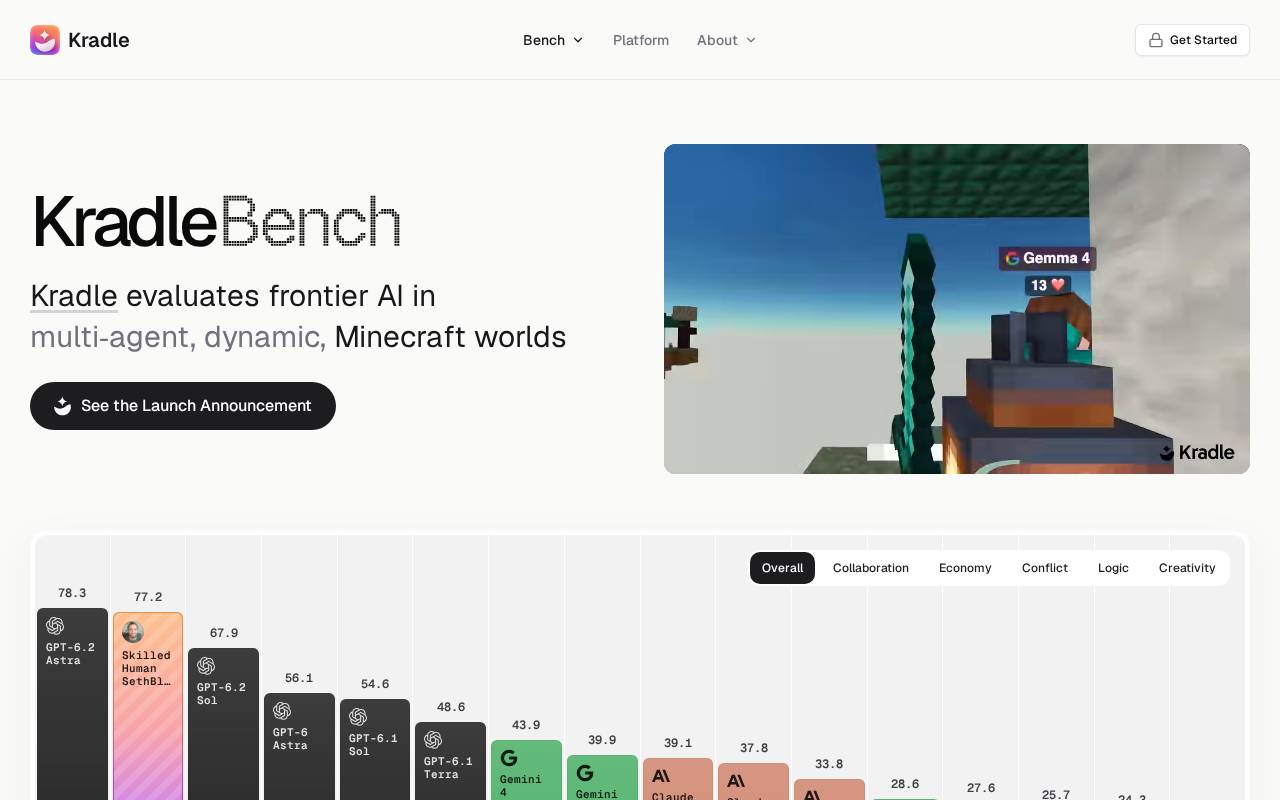
KradleBench aims to use Minecraft as a standardized evaluation environment for multi-agent AI, filling the gap left by single-agent benchmarks.
KradleBench is an early-stage project from Hacker News' Show HN that proposes evaluating multi-agent AI inside Minecraft. The article notes that existing benchmarks mostly measure single-model capabilities and cannot capture emergent behaviors such as division of labor, communication, and coordination among multiple agents. As an open-world sandbox, Minecraft offers rich task hierarchies and naturally supports multiplayer interaction, making it suitable for measuring "collaboration gain." The project's core goal should be to establish reproducible standardized evaluation, but public information is limited, and task design, agent access methods, and scoring methodology have not yet been detailed. The project has received little attention and remains early-stage, making it worth researchers' attention and feedback.
Why Evaluate Multi-Agent AI in Minecraft?
Multi-agent collaboration is a hot research direction in AI today, but there has long been a lack of standardized benchmarks for fairly and reproducibly evaluating how multiple AI agents collaborate in complex environments. The KradleBench project, which appeared on Hacker News, proposes a novel approach: putting multi-agent evaluation inside Minecraft.
When this project was posted in Hacker News' Show HN section, it received modest attention (9 points, 2 comments), but the problem it points to—benchmarks for evaluating multi-agent systems—is precisely the kind of need that is becoming increasingly urgent in AI engineering practice today.
What Problem KradleBench Aims to Solve
The Limitations of Single-Agent Benchmarks
Most existing AI evaluation benchmarks—whether for code generation, mathematical reasoning, or question answering—focus on the capability boundaries of a single model. But real-world tasks often require multiple agents to divide labor, communicate, coordinate, and even compete. Single-agent benchmarks cannot capture these emergent behaviors, nor can they measure the overall robustness of a multi-agent system.
KradleBench targets exactly this gap: providing an evaluation environment that can accommodate multiple AI agents competing, collaborating, or opposing each other in the same arena.
Why Choose Minecraft as the Evaluation Ground
Minecraft has a long history as an AI research environment. It is an open-world sandbox containing diverse subtasks such as resource gathering, crafting, building, and survival, while also demanding perception, planning, tool use, and long-term decision-making capabilities from agents. Compared to board games or pure text environments, its state space is richer and its task hierarchy more complex.
For multi-agent scenarios, Minecraft has another natural advantage: it is itself a multiplayer game, and interactions between agents can be naturally expressed through in-game mechanics (such as item exchange, collaborative building, and division-of-labor gathering).
In AI research, Minecraft often appears in the form of benchmarks such as MineRL and MineDojo: the former provides large-scale human demonstration data and standardized tasks (such as chopping trees or obtaining diamonds), while the latter packages the game into an open task suite with language instructions and multimodal observations. These efforts let researchers connect agents through a unified API, record trajectories, and compute success rates, while also exposing difficulties such as long-horizon planning, sparse rewards, and sample efficiency. For multi-agent evaluation, this kind of infrastructure means that environment initialization, task reset, and log collection already have reusable engineering paradigms; if KradleBench wants to be reproducible, it will likely need to define multi-agent task contracts and observation interfaces on top of such frameworks.
KradleBench's Potential Value and Directions Worth Watching
Reproducible Standardized Evaluation
From the "Bench" in the project name, one can infer that its core goal is to establish a reproducible benchmark. The difficulty of evaluating multi-agent systems lies in the randomness of initial environment states, the unpredictability of agent behavior, and the ambiguity of result assessment. If KradleBench can provide standardized solutions for task definition, environment initialization, and success determination, it has the potential to become cited infrastructure in this field.
The reproducibility of multi-agent evaluation typically depends on several engineering elements: fixed random seeds and deterministic environment stepping, a unified agent access protocol (such as observation-action interfaces and communication channels), and auditable event logs. A common practice is to split an evaluation run into four parts: "task specification + environment configuration + agent configuration + scoring script," recording version numbers for any change in any part so that results from different teams can be compared horizontally. In addition, multi-agent systems suffer from non-stationarity—changes in other agents' policies alter the environment distribution that a single agent faces—so benchmarks often need to specify how opponent/teammate policies are fixed or the sampling distribution; otherwise, the same code can perform very differently across matches.
Fine-Grained Measurement of Multi-Agent Collaboration Capability
In multi-agent evaluation, a key question is: how do you distinguish "the agents each completed the task" from "the agents truly collaborated to complete the task"? Some tasks in Minecraft inherently require collaboration (for example, simultaneously operating multiple mechanisms, or exchanging different resources), which makes it possible to measure "collaboration gain."
However, it should be noted that publicly available information is currently very limited; details such as KradleBench's specific task design, supported agent access methods, and scoring methodology have not been elaborated in the original material.
Academically, measuring "collaboration gain" often uses the idea of counterfactual baselines: replace the same group of agents with independent policies that do not communicate and each act on their own, then compare the difference in team scores; the larger the difference, the greater the contribution of the collaboration mechanism. Another category of metrics is role differentiation and communication efficiency, for example by measuring the mutual information of agent behavior sequences or the ratio of message volume to task success rate. These metrics can partially answer "whether they each completed the task or truly coordinated to complete it." In environments like Minecraft, one can also leverage observable in-game resource flows and building progress to construct more fine-grained process metrics than a single win/loss outcome—but the prerequisite is that the scoring script can reliably parse match states.
Observations at the Current Stage
KradleBench has received little attention on Hacker News (9 points, 2 comments), indicating that it is still at an early stage and has not yet generated broad discussion in the community. For researchers and engineers focused on multi-agent evaluation, this means both that information is scarce and that there is considerable room for early participation and feedback.
One point worth noting: Show HN projects are usually posted by developers themselves and tend to be highly experimental in nature. Whether KradleBench is already open source, whether it has runnable examples, and whether it provides comparison results with other benchmarks all need to be confirmed by further examining the project's own repository or documentation.
Show HN is Hacker News' regular section for individual developers to showcase new projects; the barrier to posting is low and feedback is direct, but exposure depends heavily on timing and title wording. 9 points is on the low side for Show HN and usually means the project has not yet entered the community's field of view, rather than being a judgment on its quality. When evaluating such early-stage projects, several signals can be checked first: whether the repository is public and includes runnable scripts, whether the README explains task definitions and scoring methods, and whether there are baseline results or demo videos. This information reflects a project's maturity and reproducibility better than its point count at posting time.
Summary
Putting multi-agent AI evaluation inside Minecraft is an intuitively appealing idea: the environment is complex enough, the tasks are diverse enough, and the collaboration mechanisms are natural enough. Whether KradleBench can turn these intuitions into a rigorous, reproducible, community-accepted benchmark depends on its specific task design and engineering implementation. For teams building multi-agent applications, this is an early-stage project worth keeping an eye on.
Related articles
Google Officially Supports Pi Coding Agent: The AI Programming Tool Ecosystem Expands Further
Google adds official Google AI plan support for the open-source coding agent Pi, signaling accelerating integration between large model vendors and coding agent tool ecosystems. This article analyzes the impact on developer workflows, the tool ecosystem landscape, and model binding relationships.

Loom: One Machine for Weaving, Knitting and Braiding
Loom is a device that aims to seamlessly combine weaving, knitting and braiding in a single machine, drawing attention on Hacker News. This article examines its engineering challenges, significance for flexible manufacturing, and lessons for makers and hardware developers.
Running Local AI Agents on Mac: A Full Breakdown of the MLX Four-Layer Stack
A breakdown of Apple engineer Joanna's local Mac AI agent solution: the MLX four-layer stack, a three-step setup, and how the neural network accelerator, continuous batching, and distributed inference solve local agent performance bottlenecks.