LangChain Beginner's Guide: Core Concepts, Agents, and RAG in Practice

LangChain is a general-purpose scaffold for large model application development built around "Agent = Model + Framework."
Based on a hands-on Bilibili course and official documentation, this article systematically outlines LangChain's positioning and entry path. LangChain is defined as the framework part of "Agent = Model + Harness," analogous to Spring for web applications, helping developers quickly drive large models. Its core value centers on three aspects: using internet-connected tools to overcome the model's training time boundary for real-time information; connecting external data and internal systems through RAG and knowledge bases; and providing multi-turn context and memory management. The article notes that products like DeepSeek already have built-in internet capabilities, so users aren't interacting with a bare model. The course covers seven modules—introduction, core features, quick start, message passing, model invocation, structured output, and tools and short-term memory—and recommends that Python developers start with LangChain and read the Chinese and English docs side by side.
LangChain is one of the most commonly recommended starter frameworks in the field of large model application development. For developers who already know Python, it's often the first tool they pick up when getting into AI application development. The overall difficulty isn't high, but the details are quite rich. This article is based on a hands-on course from Bilibili, combined with official documentation and code demos, to outline LangChain's core concepts, use cases, and quick-start path, helping readers build a clear mental framework.
What Is LangChain: Agent = Model + Framework
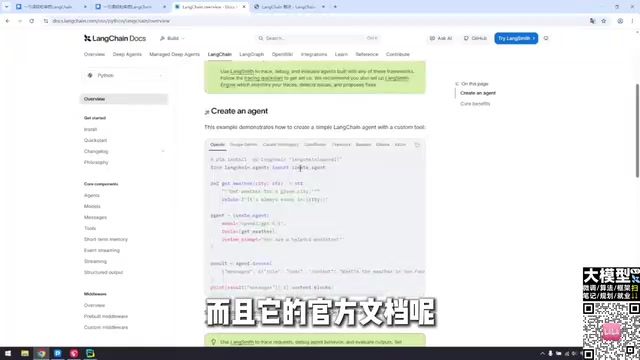
The course opens with a concise definition: Agent = Model + Harness. Here, "model" refers to large language models like DeepSeekAd, Claude, and GPT, while the "harness" is exactly the ecosystem that LangChain represents. The English documentation uses the expression Agent = Model + Harness, and LangChain is essentially a solution built around the Harness.
According to the Bilibili creator's explanation, various vendors (such as OpenAI and DeepSeek) have all rolled out similar approaches with slightly different directions—some focus on pricing margins, others on their own ecosystems—and LangChain stands out for its strong generality and well-developed official documentation, offering everything from beginner demos to code examples. That's why it's recommended to start directly with LangChain in the early stages.
LangChain positions itself as "an open-source framework for developing applications powered by large language models." By analogy, Spring helps you quickly drive web applications, while LangChain helps you quickly drive models. It's not just a wrapper around model invocation APIs—tool calling, context management, and other capabilities are already integrated within the ecosystem, so developers don't need to build complex architectures from scratch.
Three Core Problems: What LangChain Actually Solves
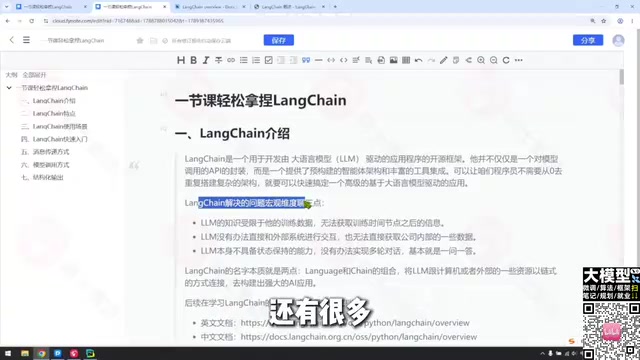
The course distills LangChain's value into three main directions. It should be noted that these aren't its only capabilities, but they are the most commonly perceived ones.
Breaking Through the Model's Knowledge Time Boundary
Large models aren't omniscient—they only know things up to their training cutoff. For example, if a model finished training in June, and you ask about something that happened in August, it can't answer. The model itself has no ability to directly call tools or access the internet; it can only "realize" that it doesn't know, but can't look it up on its own. The internet-connected tools provided by the LangChain ecosystem fill this gap.
The creator specifically reminds us: when you chat in products like DeepSeek, you're no longer interacting with a pure model—the product itself already provides internet access capabilities, making it more like a knowledge base or agent. A pure model cannot connect to the internet to obtain real-time information.
Knowledge Cutoff is the time boundary of a large model's training data. The model's parameters are solidified from previously collected corpora and are no longer updated after training is complete. Therefore, the model genuinely "doesn't know" about events after the cutoff date, but it often still gives seemingly confident answers in conversation—a phenomenon known as hallucination. Internet-connected tools (such as search or scraping tools integrated with LangChain) stitch real-time retrieval results into the prompt as context during inference, enabling the model to answer based on external information and thereby bypassing the static knowledge limitations within its parameters. This differs from fine-tuning: fine-tuning changes the model's weights, is costly, and also has a new cutoff; tool calling is a runtime enhancement, so information always stays fresh.
Connecting External Data and Internal Systems
RAG (Retrieval-Augmented Generation) and knowledge bases are high-frequency scenarios today, involving vector databases, source tracing, and other components—capabilities the model itself doesn't have. LangChain can handle this part of the work, including accessing a company's internal databases and connecting to external data sources.
RAG (Retrieval-Augmented Generation) works as follows: first, documents are split into chunks, and each chunk is converted into a vector using an embedding model and stored in a vector database. When a user asks a question, the question is likewise vectorized, a similarity search is performed in the database, and the most relevant chunks are retrieved. These are then stitched together with the original question into a prompt and handed to the large model to generate an answer. It solves the problem of private or up-to-date knowledge not being included in the model's parameters, and because answers can be traced back to specific document chunks, it naturally supports source tracing. A vector database is a storage system designed for approximate nearest-neighbor search over high-dimensional vectors, with common implementations including FAISS, Chroma, Milvus, pgvector, and others. LangChain's value lies in abstracting document loading, splitting, embedding, retrieval, and prompt assembly into composable components, so developers only need to replace one link rather than rewriting the entire chain.
Multi-turn Context and Memory Management
Normally, a model works on a question-and-answer basis: you send a message, it replies, and when you ask again it doesn't reference the previous conversation. But what humans expect is multi-turn contextual communication—where the second question can be answered based on the context of the first. LangChain provides a context management mechanism that makes these things easy to handle. Of course, developers can implement this themselves, but the framework greatly reduces complexity.
Large models are inherently stateless: each API call is an independent request, and the model doesn't remember the previous conversation. What we call "multi-turn dialogue" is actually the client re-sending the entire history of messages to the model each time. Messages are usually distinguished by role: system sets the persona and rules, user is the user input, and assistant is the model's previous reply. As turns increase, the history keeps growing, eventually hitting the model's context window limit and driving up token costs. Therefore, the key to memory management lies in trade-off strategies—for example, keeping only the most recent N turns, summarizing and compressing earlier conversations, or extracting key facts and storing them externally for on-demand recall. LangChain encapsulates these strategies as different Memory components, which is also the origin of the distinction between "short-term memory" and "long-term memory."
Knowledge Modules Covered in the Course
This course is organized into seven modules, progressing layer by layer from concepts to code:
- Introduction to LangChain: building basic understanding for audiences unfamiliar with the framework
- Core Features: explained with reference to official documentation, which clearly introduces the features
- Use Cases and Quick Start: the starter code is very easy
- Message Passing: message roles and structures in model interaction
- Model Invocation Methods: code demos for different invocation patterns
- Structured Output: getting the model to return parseable structured results
- Tools and Short-term Context Memory: some content couldn't be covered due to live-stream time constraints
Course notes can be obtained from the corresponding agent teacher, and a QR code entry was also provided in the live stream.

Why Start with LangChain
Based on the course's perspective, there are three reasons to choose LangChain as your first stop in large model application development: low difficulty, well-developed official documentation, and strong ecosystem generality. For developers with a Python foundation, it's usually the first framework they get hands-on with. LangChain integrates capabilities like tool calling, external data access, and context management—things that "seem like just a word but actually involve many details"—within the ecosystem, so developers don't need to build complex architectures from scratch.
It's worth noting that the framework lowers the entry barrier, but the details still need to be reviewed one by one against the official documentation. The course recommends reading the Chinese and English documentation side by side—the English documentation is the clearest, while the Chinese documentation can serve as a supplement.
Summary
LangChain's positioning can be summed up as: a general-purpose scaffold for large model application development. Around the formula Agent = Model + Framework, it fills in the model's shortcomings in three areas: real-time information access, external system interaction, and multi-turn memory. For Python developers preparing to enter AI application development, starting with LangChain's core concepts and official documentation, and running through basic functionality with code, is a proven entry path.
One-line Summary
LangChain is a general-purpose scaffold for large model application development built around "Agent = Model + Framework."
Paragraph Summary
Based on a hands-on Bilibili course and official documentation, this article systematically outlines LangChain's positioning and entry path. LangChain is defined as the framework part of "Agent = Model + Harness," analogous to Spring for web applications—it helps developers quickly drive large models. Its core value centers on three aspects: using internet-connected tools to break through the model's training time boundary and obtain real-time information; connecting external data and internal systems through RAG and knowledge bases; and providing multi-turn context and memory management mechanisms. The article emphasizes that products like DeepSeek that users interact with daily already have built-in internet capabilities and are not bare model interactions. The course covers seven modules: introduction, core features, quick start, message passing, model invocation, structured output, and tools and short-term memory. It recommends that developers with a Python foundation start with LangChain and read the Chinese and English documentation side by side.
Related articles

VP ≠ VNP: A Major Breakthrough in Computational Complexity Theory
A study claiming to prove VP ≠ VNP over every field sparks heated discussion on Hacker News. This article analyzes the algebraic complexity background of VP and VNP, the proof approach, community controversy, and its potential impact on computational complexity theory.

Developer Naming Woes: The Technical Names That Drive Us Crazy
Why is technical naming so maddening? From Nginx and Vite to Qt and Sudo, a YouTube creator rants about the chaos of developer naming and pronunciation, revealing the tug-of-war between creators' intentions and community habits, and the cultural roots behind spelling traps like PyPI and GNOME.

Figma Workplace Scandal: Employee Sues CEO for Forcing Confrontation with Harasser
Figma and its CEO are sued by a current employee alleging sexual harassment and discrimination, and forcing the victim to confront her harasser. This article outlines the background, potential impact, and industry reflection.