LangChain Beginner's Guide: From LLM Limitations to Agent Development
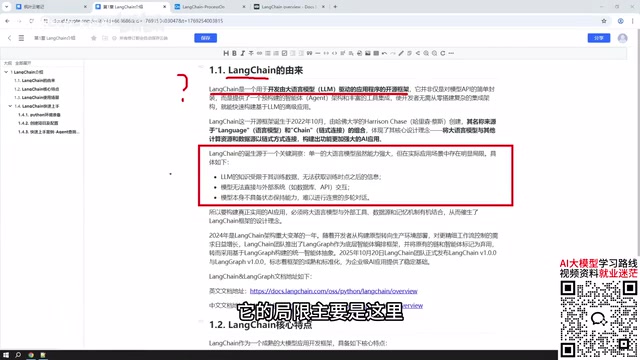
LangChain is an application framework that extends LLM APIs with external data access, tooling, and state management.
Starting from the most common beginner question, this article explains that native LLM APIs have three major limitations — knowledge cutoff, disconnection from business data, and no session persistence — which is exactly why LangChain exists. The name comes from Language and Chain, and its role is not to replace the LLM but to add pluggable capabilities like external data access, tool calling, state and history management, and security. The article also notes that after LangChain 1.0, the architecture was reorganized, with LangChain and LangGraph unified under the graph-flow system and Agent capabilities powered by LangGraph. For learning resources, the Chinese site suits beginners but is incomplete; non-beginners should read the English site. The recommended path: first understand the problems the framework solves, then move on to project creation and coding.
What is LangChain? Why do we need it when we already have LLM APIs? This is the first question many beginners have before opening a tutorial. A comprehensive zero-to-hero LangChain tutorial series on Bilibili covers everything from the framework's origins and core features to real-world project implementation. This article distills the key takeaways from its first chapter into a clear learning path to help you build the right mental model from the start.
The Three Limitations of LLM APIs
Models like OpenAI's GPT and DeepSeekAd all offer mature APIs that can handle reasoning and Q&A out of the box. But the tutorial points out that native LLM APIs have three key limitations.
First is knowledge cutoff. Models only know data from before their training cutoff — anything that happened after training is beyond their reach.
Second is disconnection from business data. Model responses are based on training corpora and have nothing to do with a company's internal data or specific business scenarios. If you want the model to answer using your company's database, the native model simply lacks the ability to access external data.
Third is no session persistence. A standalone LLM is one-question-one-answer — it has no chat history or state management. The "memory" users experience is typically added at the application layer.
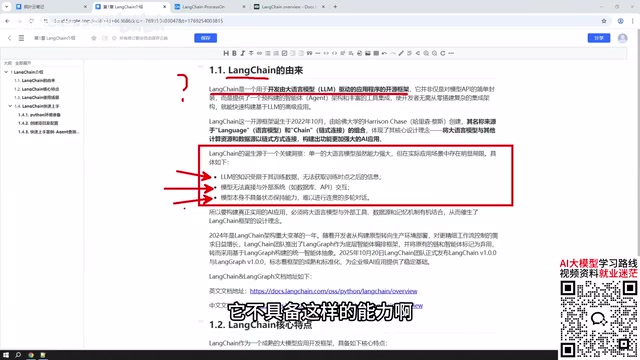
These three limitations are precisely why frameworks like LangChain exist.
Knowledge Cutoff refers to the fact that once a large language model finishes training, the knowledge baked into its parameters is frozen at the point when training data was collected. Events, documents, and products that emerged afterward cannot be natively perceived by the model. For example, a model with a training cutoff in early 2024 cannot answer questions about 2025 news. In practice, this is typically addressed through Retrieval-Augmented Generation (RAG) — retrieving the latest materials and injecting them into the prompt — or through web search tools that let the model fetch real-time information. This is exactly one of the gaps that frameworks like LangChain are designed to fill.
LangChain's Positioning and the Origin of Its Name
LangChain is an open-source framework for building LLM-powered applications. The name comes from two words: Language (language model) and Chain (chained connection) — together, "language model + chained connection."
The problem it solves is extending the native capabilities of LLMs. According to the tutorial, these extensions are provided as pluggable features: connecting to external data, calling tools to retrieve information, managing state and conversation history, and security management.
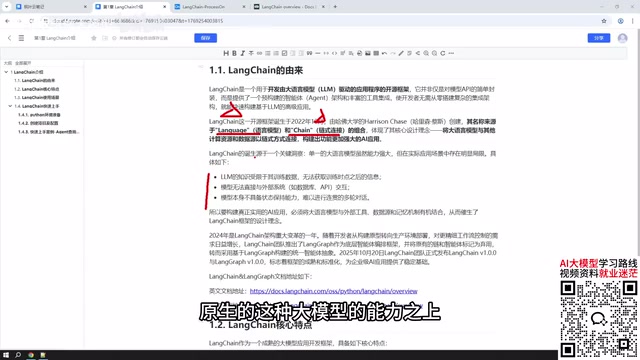
In other words, LangChain doesn't replace the LLM — it adds the application-layer "peripherals" around the model's reasoning capabilities. Understanding this point will keep you on track when you later learn about Agents and tool calling.
The tutorial mentions that LangChain was released in October 2022 — useful background context.
Chain is LangChain's most core abstraction: stringing together steps like "prompt template → model call → output parsing" into a reusable processing pipeline, where each step's output becomes the next step's input. With chains, multi-step calls that were previously scattered across business code are encapsulated into declarative components that are easy to compose, reuse, and debug. Early versions of LangChain were organized primarily around various Chain types. Later, as Agents and graph-based orchestration rose in prominence, the role of chains was gradually taken over by more flexible workflows and graph orchestration — but the core design philosophy of "connecting multiple steps together" has never changed.
Architecture Changes After 1.0: LangChain and LangGraph
The tutorial specifically flags a common point of confusion: LangChain underwent an architectural reorganization after version 1.0. LangChain and LangGraph, previously relatively independent, are now both brought under the graph-flow system (referred to as graph2 in the tutorial).
As for Agent-related capabilities, the tutorial notes that these are actually powered by LangGraph under the hood. The details of their relationship will be covered later when the tutorial discusses Agents and LangGraph.
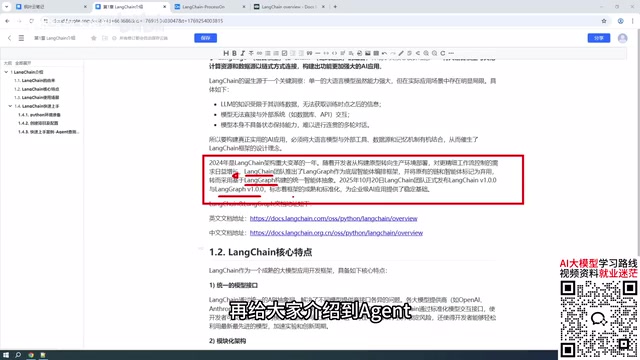
For beginners, all you need at this stage is a general impression: the LangChain ecosystem was reorganized after 1.0, and LangChain and LangGraph are no longer two unrelated tools but components of the same system.
LangGraph is the orchestration framework within the LangChain ecosystem designed for stateful, multi-step, loopable workflows. It models applications as a "graph": nodes represent processing steps (calling a model, executing a tool, making a decision), edges represent transitions between steps, and it supports conditional branching, loops, and persistent state. Compared to linear Chains, the graph structure is better suited for implementing Agents that need to reason iteratively and call tools repeatedly. After LangChain 1.0, capabilities like Agents were consolidated under this graph system, making LangGraph an essential step for anyone diving deep into LangChain application development.
Navigating the Official Sites: Chinese vs. English
LangChain has both an English and a Chinese official website. The tutorial's advice is pragmatic:
- Beginners can start with the Chinese site — it's auto-translated and beginner-friendly, but some content is missing and it's not fully complete.
- Non-beginners should go straight to the English site, using a browser translation plugin if needed — it has the most complete content.
The underlying principle is universal: translated sites are good for building conceptual understanding, while the original documentation is what you need for details and keeping up with version changes.
What to Do to Get Started Quickly
The rest of Chapter 1 walks you through creating a LangChain project, writing code, and running it — forming a minimal working loop. For zero-background learners, the value of this path is: first understand what problem the framework solves, then write your first line of code. This builds a systematic understanding far more effectively than jumping straight into stacking API calls.
FAQ
What's the relationship between LangChain and LLM APIs? LangChain is an application development framework built on top of LLM APIs. It handles application-layer capabilities like external data integration, tool calling, and state management.
Can someone with zero background learn LangChain directly? Yes. The tutorial is designed to start with conceptual understanding before moving into project creation and coding. The only prerequisite is a basic familiarity with how to call LLMs.
Is the Chinese official site sufficient? It's sufficient for getting started, but the content is incomplete. For deeper learning and troubleshooting, refer to the English official site.
One-line Summary
LangChain is an application development framework that adds external data access, tooling, and state management on top of LLM APIs.
Paragraph Summary
Starting from the most common beginner question, this article points out that native LLM APIs have three major limitations — knowledge cutoff, disconnection from business data, and no session persistence — which is precisely why LangChain emerged. The name comes from Language and Chain, and its role is not to replace the LLM but to extend it with pluggable capabilities for external data access, tool calling, state and conversation history management, and security. The article also notes that after LangChain 1.0, the architecture was reorganized, with LangChain and LangGraph unified under the graph-flow system, and Agent capabilities actually powered by LangGraph. As for learning resources, the Chinese official site suits beginners but is incomplete; non-beginners should read the English site directly. The recommended learning path: first understand what problem the framework solves, then move on to project creation and coding.
Related articles
The Next Hundred Rust GUIs: Practical Advice from Linebender
Linebender shares practical Rust GUI advice on architecture design, state management, rendering performance, and ecosystem tooling for the next 100 Rust GUIs.
Tamagotchi: Lessons from the Virtual Pet's Rise and Fall
A look back at the Tamagotchi's rise and fall, how its emotional design hooked users, and what it teaches today's AI companionship products.
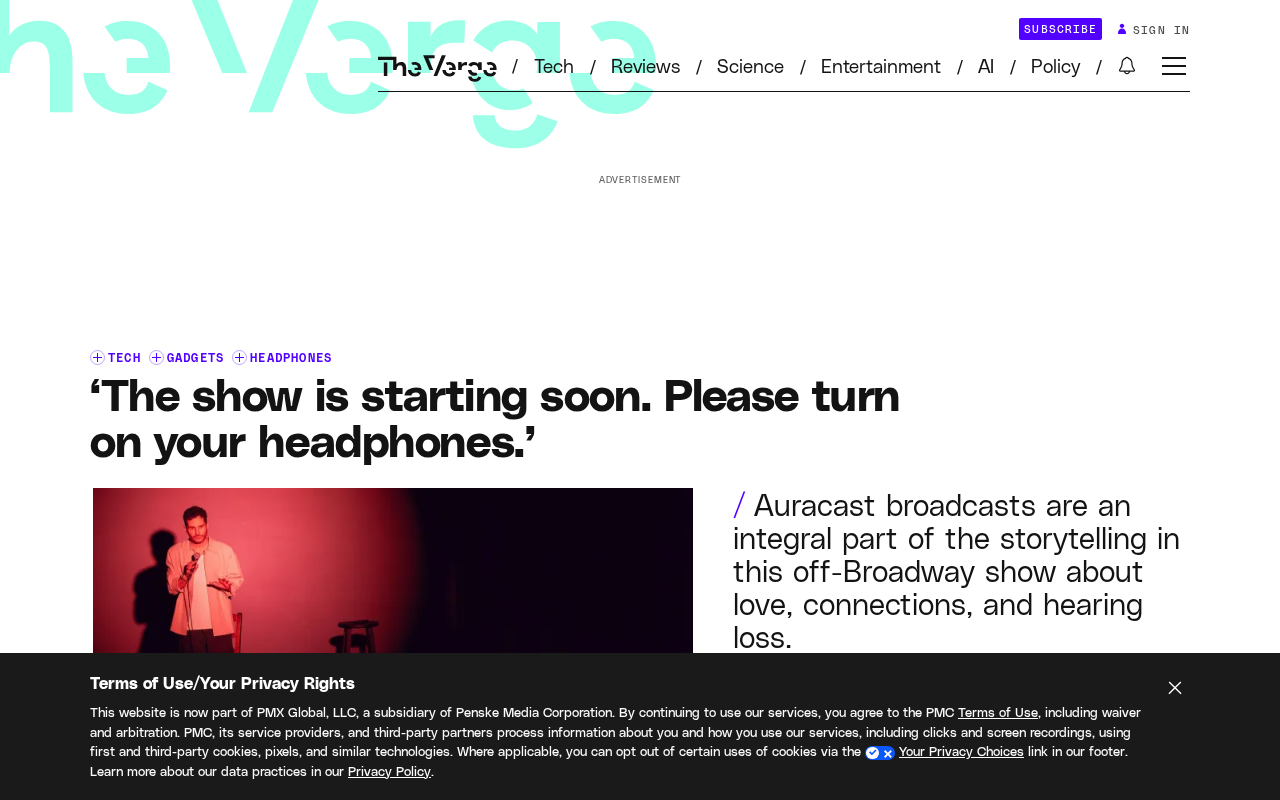
Headphones as Stage: How Auracast Is Reshaping the Live Performance Experience
A New York SoHo Playhouse performance required audiences to wear Auracast-connected headphones. This article examines how Bluetooth broadcast audio is changing the sound experience and operating model of live performance.