LangChain Contribution Guide: How Issue Assignment Works and Practical Tips for Newcomers

LangChain contributors do not need to wait passively for assignment; proactive communication and research can bypass the assignment bottleneck.
The article centers on the confusion first-time contributors face after submitting an Issue to LangChain and explores how the Issue assignment mechanism actually works. Official documentation requires that an Issue be approved or assigned by a maintainer before it can be linked to a PR, in order to avoid duplicate work and ensure the direction aligns with the plan; however, community practice shows that contributors can comment in the Issue to state their intent and attach a preliminary approach, forming a "soft claim," and can often begin work even without formal assignment. The article suggests doing in-depth test research, adding reproduction steps, following related PRs, and following up politely while waiting, and also lists situations in which a PR can be opened directly, such as when the Issue has a good first issue label or a maintainer has expressed a welcome for contributions. The core conclusion is: do not wait passively, but do communicate proactively; transparent communication and research results drive progress more than assignment itself.
Why Does the Issue Assignment Mechanism Confuse Newcomers?
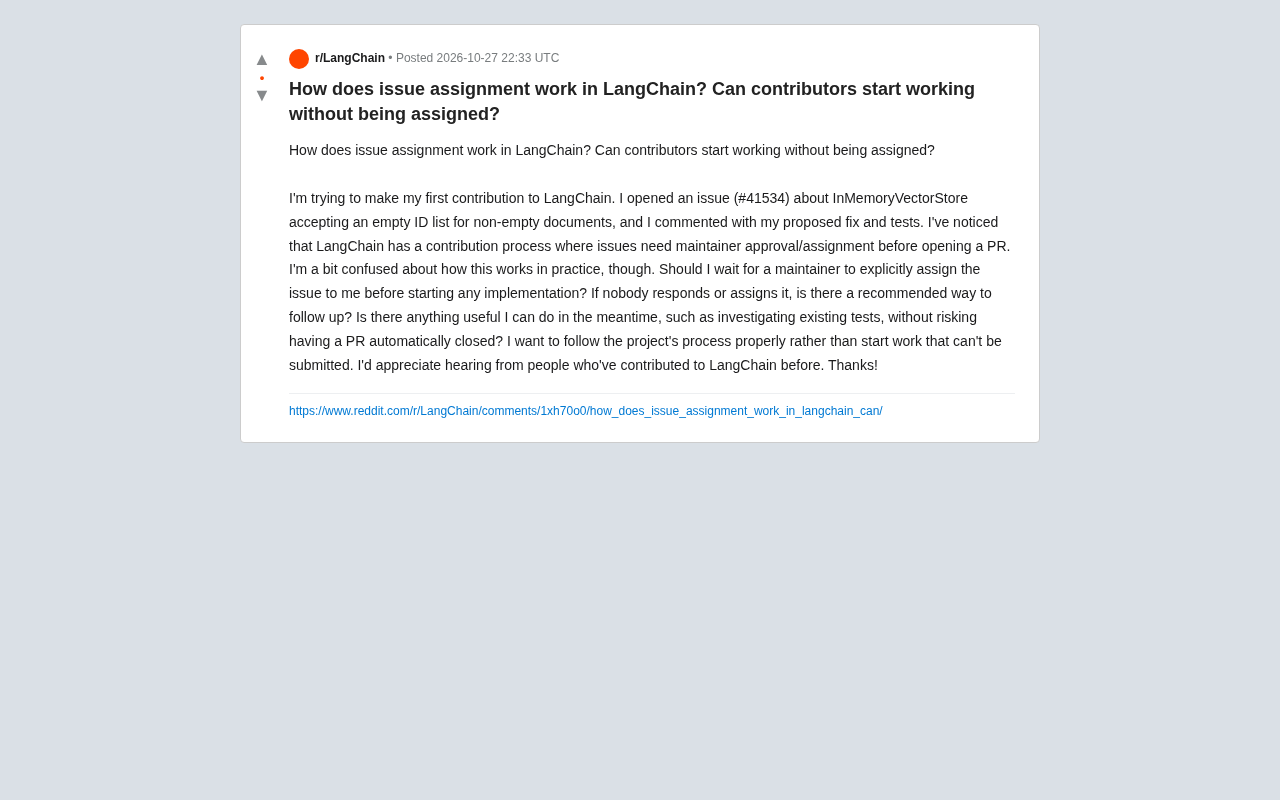
A developer planned to make his first contribution to LangChain. He created Issue #41534, pointing out that InMemoryVectorStore still accepts an empty ID list when the document is non-empty, and attached a fix and testing approach. But he then discovered that LangChain's contribution process seems to require an Issue to be approved or assigned by a maintainer before a PR can be opened. This put him in a dilemma: should he wait for assignment, or can he start implementing right away? And if no one responds, how should he follow up?
This kind of confusion is not uncommon in open source communities. As a highly active project, LangChain receives a large number of Issues every day, and it is difficult for maintainers to respond to each one in a timely manner. Understanding how its assignment mechanism actually works can help contributors avoid wasted effort while increasing the probability that their PRs will be merged.
LangChain's Assignment Process: The Gap Between Rules and Reality
The Written Requirements of the Official Process
According to LangChain's contribution documentation, an Issue usually needs to be approved or assigned by a maintainer before it can be linked to a PR. The original intent of this design is to avoid duplicate work—if multiple people develop for the same Issue at the same time, resources are wasted; it also helps ensure that the fix direction aligns with the project's overall plan. For first-time contributors, the project often wants to first confirm the value of the problem and the feasibility of the approach through Issue discussion before moving into the coding phase.
Good first issue and help wanted are two standard labels on the GitHub platform, often used by open source projects to mark tasks suitable for external contributors to participate in. The former is specifically selected by maintainers, meaning "the problem boundary is clear, the scope of changes is controllable, and there are existing tests to refer to," and usually also requires that maintainers be willing to provide guidance in the comments; the latter generally refers to tasks where the project welcomes external assistance, but the difficulty is not necessarily the lowest. The difference between the two is that good first issue emphasizes "newcomer friendliness," while help wanted emphasizes "a manpower gap." In a large repository like LangChain, these two labels are also clear signals released by maintainers that "formal assignment can be skipped," so contributors can regard them as soft authorization.
Flexibility in Actual Practice
However, community experience shows that rules are not set in stone. Many contributors report that after commenting under an Issue stating that they intend to handle it and attaching a preliminary analysis or approach, they can begin work even without receiving formal assignment. The key is communicating in advance: clearly expressing in the Issue "I am working on this problem, and the expected approach is..." is effectively a soft claim. If maintainers see it and have no objection, they usually tacitly allow it to continue; if there is a more suitable person or the approach needs adjustment, they will also raise it in time.
This "first come, first served + transparent communication" model is relatively common in large projects like LangChain. The risk of opening a PR directly without prior communication is that it may be automatically closed or marked as a duplicate.
Soft claim is an informal coordination mechanism in open source collaboration, referring to a contributor publicly stating in the Issue comment section "I plan to handle this problem" and giving a preliminary approach or time expectation, without relying on formal assignment by a maintainer. Its role is similar to "intent broadcasting" in distributed systems: other contributors who see it usually avoid the task, and if a maintainer finds that the direction of the approach is off, they can correct it in time. A soft claim has no mandatory binding force; if the claimant makes no progress for a long time, others can still take over. Therefore, in practice, a claim comment should preferably include specific approach points, files involved, or an expected completion time, to enhance credibility and avoid being seen as "claiming a spot without doing the work."
Four Things You Can Do While Waiting for Assignment
1. Deeply Investigate Existing Tests and Code Paths
After proposing an approach in the Issue, you can begin investigating related test cases. For example, for the ID list validation problem in InMemoryVectorStore, you can check whether existing tests already cover the empty list scenario and analyze how the test framework is organized. This work does not require submitting code, but it lays the foundation for subsequent implementation and can also supplement findings in the Issue to demonstrate your commitment.
2. Add Reproduction Steps and Impact Scope to the Issue
The original Issue often only describes the surface phenomenon. You can further verify how the problem behaves across different versions and invocation methods, and organize this into clear reproduction steps. This can help maintainers quickly assess priority and also increases the likelihood that you will be assigned.
3. Pay Attention to Related Issues and PRs
Search whether similar problems are being discussed within the project to avoid duplicate work. If you find an existing related PR, you can evaluate whether its approach covers your scenario and, if necessary, cross-reference it in the Issue. This reflects respect for the community context.
4. Follow Up Politely, but Avoid Frequent Urging
If the Issue receives no response within a reasonable time (for example, one week), you can comment under the Issue to add new information or ask whether more details are needed. Avoid simple "bumping"-style urging; instead, provide valuable updates, such as "I further verified that this problem is also triggered in scenario X, with logs attached."
Community Experience: When Can You Open a PR Directly?
Based on feedback from multiple contributors, the following situations usually allow you to skip formal assignment and open a PR directly:
- The Issue has been labeled "good first issue" or "help wanted": these labels themselves are signals inviting contributions.
- A maintainer has expressed a welcome attitude toward contributions in the Issue: for example, replying "PR welcome."
- The scope of the fix is very small and clear: such as documentation typos or obvious boundary condition validation, and you have already explained the approach in the Issue with no objections.
- You have already commented in the Issue to claim it, and no one has competed for a reasonable period of time.
Conversely, if the Issue involves core architecture changes, API design adjustments, or a maintainer has indicated that internal discussion is ongoing, you should wait for explicit assignment.
Linking a PR (Pull Request) to an Issue is a key part of the GitHub workflow. When submitting a PR, contributors can use keywords such as Fixes #41534 or Closes #41534 in the description, and GitHub will automatically link the PR to the corresponding Issue and automatically close the Issue when the PR is merged. This link is both a source of context for maintainers during review and convenient for the project to track "which Issue is resolved by which PR." For an Issue that has not received formal assignment, citing the Issue number in the PR description and explaining "this PR responds to Issue #xxx with the following approach" allows maintainers to judge during merge whether it conflicts with existing discussion, reducing the risk of being directly closed.
Action Checklist for First-Time Contributors
Returning to the original question: should you wait for assignment? The answer is—you do not need to wait passively, but you must communicate proactively. The specific steps can be summarized as follows:
- Comment in the Issue to clearly state that you intend to handle it and briefly describe your approach (you have already completed this step).
- Begin investigating tests and code, but do not submit a PR yet.
- If there is no response after about a week, add valuable information and ask politely.
- If you receive tacit approval from a maintainer or the Issue has a contribution-welcome label, you can begin implementation and link a PR.
- If there is no response for a long time and the problem is clear, you may consider opening a PR first and citing the Issue in the description, leaving it to the maintainer to decide whether to accept it.
The LangChain community is generally friendly to newcomers, but the pace is fast and the volume of Issues is large. Transparent communication and proactive investigation are effective ways to bypass the assignment bottleneck. Rather than waiting idly, it is better to use research results to prove your commitment; this often drives things forward more than assignment itself.
Related articles

Vaani Developer Platform: Build Human-Like Voice AI Agents with Zero Code
Vaani Developer Platform tops Product Hunt with 175 upvotes, offering zero-code construction of human-like voice AI agents with flow design, tool and knowledge base connections, real phone deployment, and structured call data output.

Knocket AI: A Lightweight Tool That Lets Visitors Chat with Zero Friction
Knocket AI is a lightweight tool that lets visitors start real-time chats via a website or link without registering, targeting founders, creators, and small teams.

XWiki Launches Open-Source MCP Server: Let AI Read Your Wiki
XWiki's open-source MCP Server extension connects your Wiki knowledge base to AI agents like Claude Code and GitHub Copilot, supporting Q&A, page editing, and structured data—self-hosted to keep data control.