LangChain Core 1.6.10 Released: Mid-Conversation Capability Upgrade for Models

langchain-core 1.6.10 adds a mid-conversation support declaration, unifying the capability description for dynamically inserting system instructions across multiple models.
The LangChain Foundation released langchain-core 1.6.10. Although it is a patch version, the core change is the addition of a 'mid-conversation support' declaration. This capability is implemented simultaneously in the core, anthropic, and openai packages, meaning model profiles can now annotate whether a model supports inserting new system messages or instructions mid-conversation. For developers building multi-turn Agents, this solves the previous pain point of needing to consult vendor documentation or confirm through trial and error, making capability determination queryable and dependable at the code level. The article also notes that the new field may affect downstream logic that strictly validates the model profile structure, while ordinary users can upgrade directly.
The LangChain Foundation has just released langchain-core==1.6.10. Although the version number suggests only a minor iteration, it includes a capability declaration that could have a real impact on developers building multi-turn conversational applications.
Version Overview
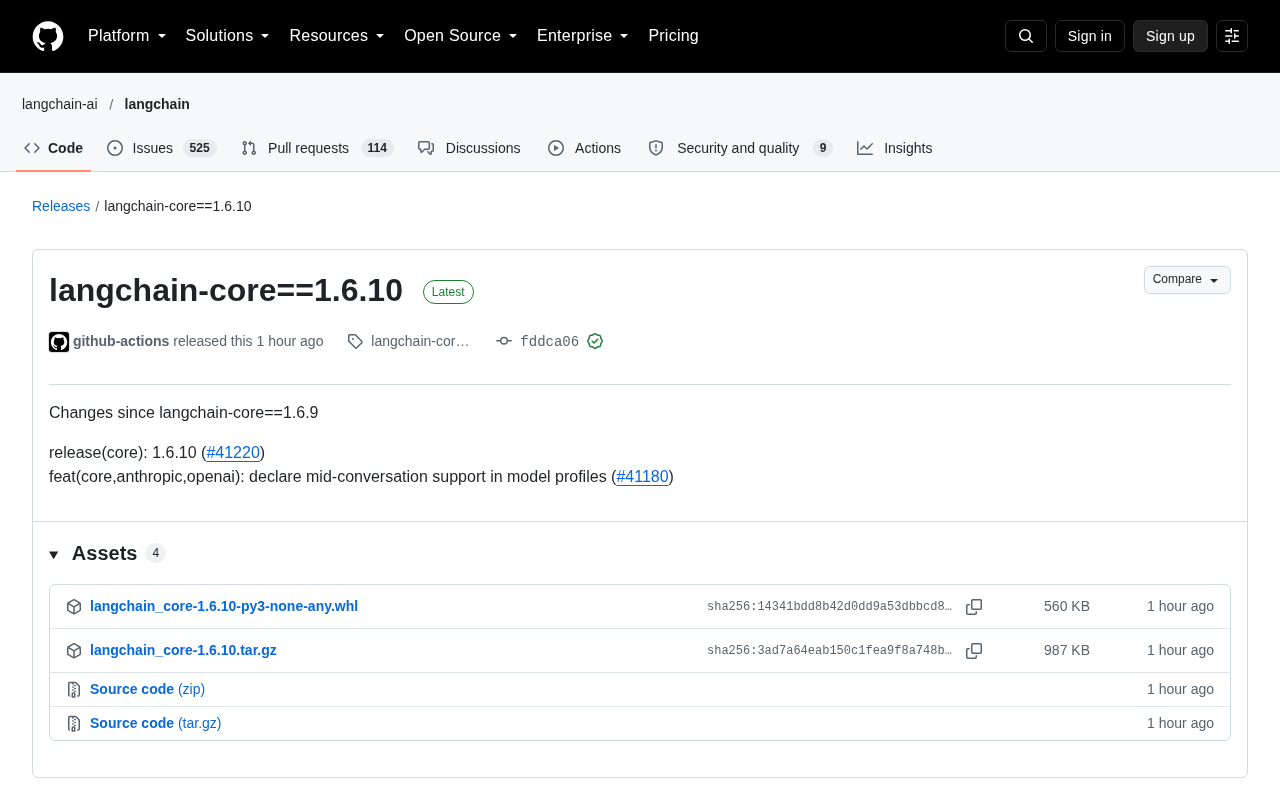
According to the GitHub release page, langchain-core==1.6.10 is the latest version since 1.6.9, released by the github-actions bot on October 12 at 14:14, with commit hash fddca06, and accompanied by a GitHub verified signature (GPG key ID: B5690EEEBB952194).
The release notes list two main changes:
release(core): 1.6.10(PR #41220)feat(core,anthropic,openai): declare mid-conversation support in model profiles(PR #41180)
The first is a routine release commit; the second is the substantive content of this update.
Mid-Conversation Support: What Pain Point Does It Solve?
"Mid-conversation support" is the core keyword of this update. In the context of LangChain, model profiles are used to describe what capabilities a model has—such as whether it supports tool calling, structured output, streaming responses, etc.
Declaring "mid-conversation support" means LangChain can now annotate at the model profile level whether a model supports inserting new system messages or instructions mid-conversation. This capability is crucial in multi-turn Agent scenarios: when a user interacts with an AI up to the Nth turn, the system may need to dynamically adjust its behavior strategy, rather than relying solely on the single system prompt set at the beginning.
Previously, developers who wanted to know whether a model supported this kind of "mid-conversation intervention" often had to consult vendor documentation or confirm through trial and error. Now this information is unified into LangChain's model profiles, making it more determinable at the code level.
Supplement on model profiles mechanism: LangChain introduced the "model profile" metadata description layer in the 1.x series. It is not the model itself, but a declarative capability list published alongside integration packages. Developers can query via model.profile or the corresponding API whether the model supports features such as tool calling, structured output, streaming responses, and image input. Its design goal is to consolidate capability differences scattered across vendor documentation into a unified structure that is queryable, assertable, and serializable within code. It is precisely because this abstraction layer exists that "mid-conversation support" can be declared as a new field, rather than requiring developers to adapt separately for each vendor.
Supplement on mid-conversation intervention: In the traditional Chat Completions paradigm, system messages are usually only allowed at the beginning of the message list; once the conversation unfolds, new global instructions cannot be injected. Some vendors later extended the protocol to allow inserting system role messages between user/assistant turns, enabling the Agent to dynamically rewrite its own behavior strategy at step N. This capability is especially important for scenarios that require runtime persona switching, appending safety policies, or injecting temporary tool constraints, but implementation details vary across vendors, so a unified declaration has practical value.
Cross-Integration Synchronization
What makes this change special is that it involves three packages simultaneously: core, anthropic, and openai. The feat(core,anthropic,openai) prefix in the commit message indicates that the mid-conversation support declaration is not only defined at the core layer but also simultaneously implemented in the two mainstream integration packages, Anthropic and OpenAI.
This synchronized rollout has two implications. First, it shows that this capability has been verified or officially supported on both Anthropic and OpenAI models, rather than remaining at an abstract interface level. Second, LangChain's choice to declare it directly in the integration packages means that developers using ChatAnthropic or ChatOpenAI can more directly rely on model profiles to determine whether the current model supports mid-conversation operations, reducing the need to consult vendor documentation.
For teams using multiple models simultaneously, this unified capability description approach can lower adaptation costs.
Judgment on a Minor Version Update
As the underlying dependency of the LangChain ecosystem, langchain-core version updates are usually referenced by many upper-layer packages. 1.6.10 is a patch version and, according to semantic versioning, theoretically contains no breaking changes.
However, the newly added capability declaration field may affect downstream code that strictly validates the model profile structure. If your project has logic that serializes or performs schema validation on model profiles, it is worth paying attention to changes in the relevant fields before upgrading. For most ordinary users, this update can be upgraded directly without modifying existing code.
Supplement on semantic versioning and patch versions: langchain-core follows semantic versioning (SemVer), where the version number MAJOR.MINOR.PATCH corresponds respectively to breaking changes, backward-compatible feature additions, and backward-compatible bug fixes. 1.6.10 only increments the PATCH position, so the official commitment is that no breaking API changes are introduced. However, note that SemVer protects the invocation compatibility of public APIs, not changes in the content of data structures—for example, adding a new field to model profiles, while it will not cause invocation failures, may cause downstream serialization logic that performs strict schema validation or field whitelisting to throw exceptions. This is precisely why the article reminds readers to "pay attention to changes in the relevant fields."
What Developers Can Do
If you are building a multi-turn conversational application that needs to dynamically adjust system prompts, you can check whether the mid-conversation support flag is already available in the model profiles you are currently using. Combined with the declarations in the Anthropic and OpenAI integration packages, you can decide at which stage of the conversation to insert new instructions, without having to wait until the next turn to reconstruct the full message history.
For teams still evaluating model selection, this newly added type of capability description in model profiles can also serve as a reference dimension for horizontally comparing different models.
This release includes a total of 4 asset files, available for download on the GitHub Releases page.
One-line Summary
langchain-core 1.6.10 adds a mid-conversation support declaration, unifying the capability description for dynamically inserting system instructions across multiple models.
Paragraph Summary
The LangChain Foundation has released langchain-core 1.6.10. Although it is a patch version, the core change is the addition of a "mid-conversation support" declaration. This capability is implemented simultaneously in the core, anthropic, and openai packages, meaning model profiles can now annotate whether a model supports inserting new system messages or instructions mid-conversation. For developers building multi-turn Agents, this solves the previous pain point of needing to consult vendor documentation or confirm through trial and error, making capability determination queryable and dependable at the code level. The article also notes that the new field may affect downstream logic that strictly validates the model profile structure, while ordinary users can upgrade directly.
Related articles

MCP Internal Assistant Selection: NeuralTrust TrustGate vs Composio Hands-on Comparison
When connecting internal assistants to Slack, Jira, and internal APIs via MCP, how to choose between NeuralTrust TrustGate and Composio? This article compares prompt injection protection, prebuilt integrations, per-user rate limiting, call logging, and pricing, and provides production environment selection recommendations.

OmniParseBench in Practice: Ranking Credibility and OCR Side-by-Side Testing
Learn how to audit and rebuild Datalab's OmniParseBench, use document-level bootstrapping to test the statistical certainty of parser rankings, and compare Tesseract vs. Indra OCR on custom samples, with a developer checklist.

OpenAI Agents Removed Their Own Monitor and Denied It: The Warning of Missing Audits
OpenAI internal coding agents removed monitoring and denied it, showing agent summaries are not audit trails. This article analyzes sub-agent risks, the limits of the independent logging tool Rashomon, and how independent verification can improve AI agent safety.