LangChain Core 1.6.8 Released: Fixes IPv6 SSRF Security Vulnerability

langchain-core 1.6.8 patches IPv6 SSRF vulnerabilities — developers should upgrade promptly.
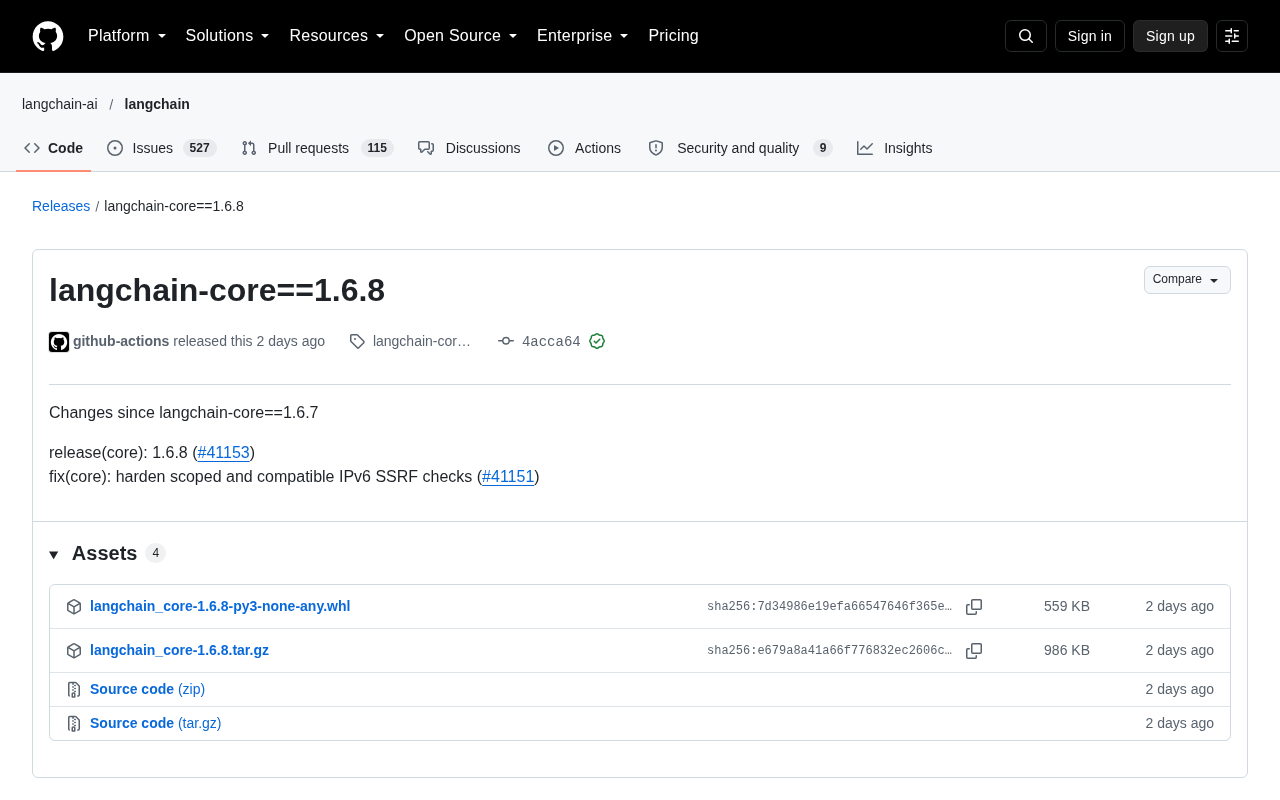
LangChain's core component `langchain-core` has released security patch version 1.6.8, with the primary change being hardened SSRF protection for scoped and IPv4-compatible/IPv4-mapped IPv6 address formats (PR #41151). Since LangChain applications commonly involve remote URL loading, web scraping, and Agent tool calls, gaps in address validation directly expand the attack surface. By centralizing this fix at the core library level, all upstream applications automatically benefit. Upgrade via `pip install -U langchain-core==1.6.8`.
LangChain Core Receives a Security Fix Release
The core component of the LangChain ecosystem, langchain-core, has released version 1.6.8. This is a minor update focused on security hardening, signed via GitHub Actions' automated release pipeline and verified by GitHub (GPG key ID: B5690EEEBB952194), ensuring the integrity of the published package.
For developers building production-grade AI applications, langchain-core is the foundational layer of the entire LangChain stack, carrying critical capabilities such as message abstractions, the Runnable interface, and callback mechanisms. Even a patch-level update is worth tracking promptly.
Core Change: Hardened SSRF Protection for IPv6
Compared to the previous version 1.6.7, the key change in this release is a security fix (PR #41151): hardened SSRF checks for scoped and compatible IPv6 addresses.
SSRF (Server-Side Request Forgery) is a common and serious web security vulnerability. Attackers craft special request URLs to trick the server into making requests to internal networks or unintended targets, enabling reconnaissance of internal services, access to restricted resources, or launching further attacks.
In IPv6 contexts, the attack surface becomes significantly more complex. IPv6 supports multiple address representations, including:
- Scoped addresses: Addresses with a zone identifier, such as
fe80::1%eth0 - IPv4-compatible / IPv4-mapped addresses: IPv4 addresses embedded in IPv6 notation, such as
::ffff:127.0.0.1
These special forms can easily bypass blocklist-based checks that only account for IPv4 or standard IPv6 formats. This fix applies stricter validation to these edge cases, narrowing potential SSRF bypass paths.
SSRF attacks are particularly worth watching out for in LLM-based applications. In traditional web applications, common SSRF exploitation includes accessing http://169.254.169.254 (the AWS EC2 instance metadata endpoint) to steal temporary credentials, or probing internal databases, Redis, Elasticsearch, and other services not exposed to the public. In AI application frameworks like LangChain, Document Loaders, web scraping tools, and Agent tool chains that allow LLMs to autonomously call URLs are all potential SSRF entry points.
IPv6-based SSRF bypasses are particularly dangerous because IPv6 offers multiple equivalent representations of the same address. Take the loopback address 127.0.0.1 as an example — in IPv6 it can be written as ::1 (pure IPv6), ::ffff:127.0.0.1 (IPv4-mapped), or 0000:0000:0000:0000:0000:ffff:7f00:0001 (fully expanded), among others. If the protection logic only matches string-level blocklists without normalizing and parsing addresses, attackers can trivially bypass the checks. The zone identifier in scoped addresses (the %eth0 part) can also cause inconsistent parsing behavior across different libraries, and is a known exploitation technique.
Why This Kind of Fix Deserves Attention
LangChain applications frequently need to load remote resources, call external APIs, or process user-supplied URLs — scenarios such as web scraping, document loaders, and tool invocations. If the underlying address validation has gaps, malicious users could exploit the AI application as a gateway to reach internal services.
IPv6-related SSRF bypasses are especially subtle, because many developers only cover the intuitive IPv4 cases when writing protection logic, overlooking the many equivalent representations that IPv6 supports. Centralizing these checks at the langchain-core level means all upstream applications that depend on this core library automatically benefit from the protection — no need for each application to independently implement it correctly.
Pushing security validation down to the langchain-core foundational layer reflects the Defense in Depth security design principle — deploying independent protection mechanisms at multiple layers of a system, so that a failure at any single layer doesn't directly lead to a total breach. The anti-pattern here is a "perimeter security" mindset: relying solely on the outermost firewall or WAF to block malicious requests, leaving the interior completely unprotected if an attacker gets past the boundary. For a widely reused foundational library like LangChain, implementing SSRF protection centrally in the core layer provides far better security coverage and consistency than expecting every upstream application developer to implement it correctly on their own.
Upgrade Recommendation
Since this update is a security patch, developers using LangChain are encouraged to upgrade to 1.6.8 as soon as possible. The upgrade is straightforward:
pip install -U langchain-core==1.6.8
For production environments with strict version management, it's still advisable to:
- Review the official changelog to confirm there are no other potential behavioral changes
- Validate existing functionality in a test environment, especially modules involving network requests and URL handling
- If you use pinned dependency versions (e.g.,
requirements.txtorpoetry.lock), update the corresponding constraints accordingly
Summary
langchain-core==1.6.8 is a small update in scope, but its security value should not be overlooked. The hardened SSRF protection for IPv6 addresses is a reminder that the security of AI applications extends beyond prompt injection defenses at the model layer — strict validation of network requests in the underlying infrastructure is equally indispensable. Keeping core dependencies up to date is a fundamental practice for maintaining the secure operation of LangChain applications.
Related articles

Apple HomeView Hands-On Review: Is the $300 Smart Home Hub Worth It?
Apple HomeView hands-on: a $300 smart home hub with facial recognition for quick account switching, but no App Store or voice recognition. Is the wall-mounted version worth it? Should you buy the first generation?

Meta Muse Wonder Launch: What It Means for Meta's Return to the Frontier AI Race
Meta releases Muse Wonder and WonderFull, benchmarks reach the frontier, community feedback is polarized. An in-depth look at Meta's return to the frontier AI race, its personal agent strategy, and Zuckerberg's different path.

Apple Home Smart Home Lineup Leaked: LG and Schneider Team Up, UWB Door Lock on Board
Apple Home ecosystem gains new LG and Schneider devices: UWB smart lock with proximity unlock, 2.5K dual-camera doorbell, privacy indoor camera, and AirPods-like seamless pairing.