LangChain Crash Course: A Complete Roadmap from Zero to Agent Development

A complete roadmap from LangChain to multi-agent development for real-world AI application engineering.
This guide maps out the advanced learning path from LangChain and LangGraph to multi-agent systems, covering core concepts like RAG, Tool Calling, and MCP. It explains why low-code platforms fall short for real business needs and offers a practical methodology for developers entering AI application development.
Why Low-Code Platforms Can't Meet Real Business Needs
As demand for AI applications has surged, low-code workflow platforms like Dify, Coze, and n8n have emerged one after another. These tools let you quickly build applications such as intelligent customer service or automated image generation through drag-and-drop operations. They're ideal for small and medium-sized enterprises to rapidly validate business scenarios and are convenient for demos and presentations.
It's worth noting that low-code platforms like Dify and Coze are essentially visual wrappers around underlying AI frameworks. Take Dify as an example: its foundation still relies on frameworks like LangChain to implement RAG pipelines and Agent orchestration, but it abstracts the complex logic into drag-and-drop nodes. While this encapsulation brings convenience, it also introduces an insurmountable customization ceiling—when an enterprise needs to customize scheduling strategies, deploy specialized components on-premises, or deeply integrate with legacy systems, the abstraction layer becomes an obstacle instead.
From a software engineering perspective, this contradiction can be understood as follows: low-code platforms are essentially an extreme embodiment of the "Convention over Configuration" principle—they trade development efficiency for a large number of preset conventions, at the cost of sacrificing configuration freedom. This principle was first systematically articulated by David Heinemeier Hansson, the creator of the Ruby on Rails framework: the framework provides reasonable default behavior for common scenarios, and developers only need explicit configuration when deviating from the defaults. This design is extremely efficient in standard scenarios, but once business logic deviates from the framework's preset track, developers often find themselves fighting against the framework's "best practices" rather than being helped by them. For large organizations that need to integrate with internal enterprise permission systems, customize vector retrieval strategies, implement special traffic control, or meet compliance requirements, the configuration options exposed by visual nodes fall far short of covering real needs.
This architectural limitation manifests in concrete forms in actual enterprise projects: China's MLPS 2.0/3.0 (Multi-Level Protection Scheme) compliance requirements often demand fine-grained control over every link in the data transmission chain, yet the abstraction layer of low-code platforms makes it impossible to freely customize audit log formats, encryption strategies, and network isolation schemes. In on-premises deployment scenarios, enterprises typically need to deploy model inference services, vector databases, and business systems within the same intranet security zone, and platform-level dependency injection mechanisms become overly cumbersome in such scenarios. Although n8n offers self-hosting capabilities, its JavaScript-only custom node development model creates obvious integration friction when facing enterprise tech stacks dominated by Java/Python—existing Java microservice ecosystems and Python data processing pipelines all need to be accessed via HTTP bridging, which increases network overhead and introduces additional points of failure.
However, the capability boundaries of these platforms are equally clear. For large and medium-sized enterprises, state-owned enterprises, and mainstream internet companies, business needs often require deeply customized secondary development and transformation. These companies have the ability to invest computing power and resources, and they pursue technical solutions that can be deeply controlled. At this point, mastering the underlying framework becomes a hard requirement—LangChain and LangGraph are precisely the core tools at this layer.
For developers with a Java background, the status of these two frameworks is no less than that of Spring and Spring Boot. In other words, in real projects, they are almost unavoidable fundamentals.
What Exactly Is LangChain
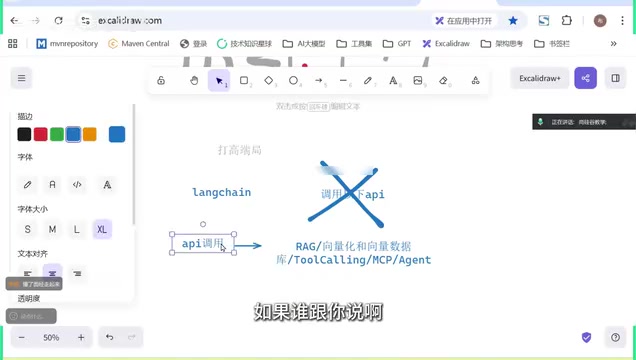
Many beginners have a common misconception about large model development: they think that configuring an API key and calling an interface counts as "large model development." This kind of understanding is like saying Java is simple—just install Tomcat and write some JDBC and you're done. In reality, that's just scratching the surface of getting started.
The Essence of LangChain: A Connector
LangChain was born in 2022, created by Harrison Chase, and is an AI engineering development framework for large models. Its name is intuitive when broken down: Lang (language model) + Chain, essentially a tool that links large models with other components into a working chain.
From an architectural standpoint, LangChain consists of multiple abstraction layers: the Model I/O layer is responsible for unifying the input/output interfaces of different large models, shielding the API differences among providers like OpenAI, Anthropic, and Google through a unified ChatModel abstraction; the Retrieval layer encapsulates the complete pipeline of document loading, text splitting, vectorization, and retrieval; the Chains layer provides composable processing chains, supporting various composition patterns such as sequential chains and routing chains; and the Agents layer implements autonomous decision-making loops based on tool calling. This layered design allows developers to replace and extend at any layer—for example, replacing OpenAI with a local Ollama model, or replacing the FAISS vector store with Milvus, without modifying the upper-level business logic.
Behind this replaceability lies the classic design philosophy of interface-oriented programming. LangChain defines unified abstract base classes for each type of component (BaseLanguageModel, BaseRetriever, BaseTool, etc.), and all concrete implementations follow the same interface contract. This is highly consistent with the concept of interface-oriented programming in Java (programming to abstractions rather than implementations)—just as Java developers operate databases through the DataSource interface without caring whether the underlying database is MySQL or PostgreSQL. This design enables the LangChain ecosystem to quickly accommodate newly emerging model providers and tool services—the community only needs to implement the corresponding interface to seamlessly integrate into the entire ecosystem. As of early 2025, LangChain officially integrates over 70 model providers and hundreds of tools; this high degree of interoperability is one of the key reasons it has become the industry-standard framework.
It's worth mentioning that LangChain introduced the LangChain Expression Language (LCEL) in late 2023, introducing the Runnable protocol as a new-generation component composition paradigm. LCEL implements chained composition through the pipe operator (|) and natively supports three execution modes: streaming output (Streaming), batch processing (Batch), and asynchronous calls (Async)—these three modes correspond to distinctly different performance optimization needs in large model applications: streaming output improves perceived user latency, batch processing boosts throughput, and asynchronous calls support high-concurrency scenarios. Understanding LCEL is the key leap from "being able to use LangChain" to "using LangChain well."
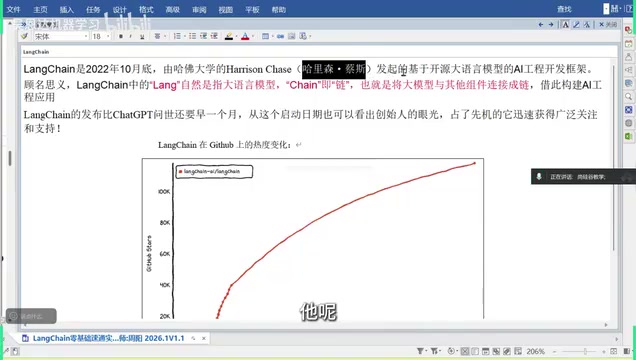
To understand it with an analogy: in traditional Java development, business code needs JDBC as an intermediate layer to connect to a MySQL database. Similarly, for your service code to connect to a large model, it also needs a connection layer—that's LangChain (for the Java ecosystem, there's the corresponding LangChain4j).
It's worth mentioning that LangChain was released even a month before ChatGPT. It is primarily Python-based, and it currently remains highly popular on GitHub, making it one of the most mainstream engineering frameworks in the AI development field.
Two Levels of Large Model Development: Understanding Your Positioning
Understanding the tiered division of large model development helps developers find the right direction for their efforts and avoid directional mistakes.
Foundation Model Development: The Top 2% of Positions
This refers to the R&D work on the foundational general-purpose large models themselves—for example, the core development of underlying large models like Alibaba's Tongyi Qianwen, Baidu's Wenxin Yiyan, and ByteDance's Doubao. The technical bar is extremely high, and the salaries are quite substantial (annual salaries can reach the million-yuan level), but the threshold is equally high: it usually requires a master's or doctoral background in computer science from a top university, focusing on rewriting and optimizing the underlying code of large models.
The core work of foundation model development includes: improving and researching variants of the Transformer architecture (such as sparse attention mechanisms and the MoE mixture-of-experts architecture—the latter decouples parameter scale from computational cost by activating only some "expert" networks in each forward pass), engineering optimization of distributed training systems (involving GPU memory scheduling, gradient communication, and pipeline parallelism strategies across thousands of GPUs), and the implementation of RLHF (Reinforcement Learning from Human Feedback) alignment techniques. The complete RLHF process includes: supervised fine-tuning (SFT) to establish basic instruction-following capabilities, training a Reward Model to quantify human preferences, and then optimizing the policy model through reinforcement learning algorithms like PPO—these three stages are tightly interlocked, requiring an extremely high level of mathematical foundation (linear algebra, probability theory, optimization theory) and systems engineering capabilities. The vast majority of these positions are concentrated in top tech companies and leading AI research institutions.

For the vast majority of developers, this path is basically out of reach—just as it's hard for ordinary developers to join the JDK team to modify the underlying source code.
Application Development: 98% of the Market Opportunity
This is where the vast majority of developers can truly seize opportunities. Application development refers to using the capabilities of existing large models to build software or systems that solve real-world problems. A typical scenario is K12 education: when parents encounter a difficult problem while tutoring their children, they take a photo and upload it, and the large model provides multiple problem-solving approaches—products like this have already been widely deployed in the market.
This layer can be further subdivided:
-
Vertical large models: Building on general-purpose large models, training and fine-tuning them for industries such as law, medicine, insurance, and finance to form specialized industry models. The core technical path of vertical models is usually to enhance domain knowledge density through continual pre-training on domain corpora based on a pre-trained general model, then combine instruction fine-tuning and RLHF to optimize the model's output quality in specialized scenarios. The development of Parameter-Efficient Fine-Tuning (PEFT) techniques has greatly lowered the engineering threshold of this path: LoRA (Low-Rank Adaptation) injects low-rank decomposition matrices alongside the original weight matrices, requiring only a tiny proportion of parameters (usually less than 1%) to be trained to achieve effective domain adaptation, compressing the GPU memory requirement of a single fine-tuning run from hundreds of GB down to a range that consumer-grade graphics cards can handle. Compared to training from scratch, this approach compresses training costs by several orders of magnitude while retaining the language understanding and reasoning capabilities of the general model.
-
Super individuals + agents: The core opportunity facing the future. For example, building an intelligent assistant for streamers that integrates supply chain management, financial invoicing, and tax reporting—similar to the role of Jarvis in Iron Man. As the technology matures, "everyone having their own dedicated agent" is moving from concept to reality.
The Complete Advanced Roadmap from LangChain to Agents
The entire learning path can be clearly divided into three levels, forming a complete system from beginner to expert.
Beginner Stage: LangChain Core Capabilities
The goal of this stage is not simply to call APIs, but to systematically master the core components of large model engineering development:
-
RAG (Retrieval-Augmented Generation): RAG was proposed by Meta AI in 2020 and is the core paradigm for solving the "hallucination" problem of large models and the timeliness problem of knowledge. Its working principle is: user query → vectorization → retrieving semantically similar text fragments from the knowledge base → injecting the retrieval results along with the original question into the model prompt → the model generates an answer based on real documents. This paradigm allows enterprises to give general-purpose large models the ability to access private knowledge bases without retraining the model, making it the most frequently used technical solution in current enterprise AI implementation.
In engineering practice, the quality of RAG heavily depends on the precision of the "retrieval" step, so a large number of optimization techniques have been derived: Hybrid Search (fusing vector semantic retrieval with BM25 keyword retrieval results through RRF or linear weighting, effectively solving retrieval inaccuracies for proper nouns, product model numbers, etc.—pure vector retrieval often has lower recall for proper nouns than keyword matching), Reranking (using a Cross-Encoder to reorder the initially retrieved results; compared to the approximate similarity calculation of dual-tower models, the cross-encoder's joint modeling of the query and document is more precise, significantly improving the relevance of the Top-K documents), and HyDE (Hypothetical Document Embeddings, first letting the model generate a hypothetical "ideal answer" and then using it as the retrieval query, solving the semantic expression gap between short user queries and long knowledge base documents). These technique combinations can improve the accuracy of RAG systems in actual business from the 60% level of basic implementations to over 90%.
-
Vectorization and vector databases: The foundational technology for semantic search and similarity matching, converting text into coordinates in a high-dimensional vector space so that "semantically similar" content is also closer in mathematical distance, thereby achieving semantic retrieval that goes beyond keyword matching. Text vectorization relies on Embedding Models, which are neural networks that map natural language to a dense vector space—mainstream choices include OpenAI's text-embedding-3 series and the open-source BGE series (released by the Beijing Academy of Artificial Intelligence, which performs excellently in Chinese semantic understanding and supports flexible adjustment of retrieval scenarios through instruction prefixes). Vector databases (such as Milvus, Qdrant, and Weaviate) are specially optimized for approximate nearest neighbor (ANN) queries of high-dimensional vectors: through index algorithms such as HNSW (Hierarchical Navigable Small World graphs) and IVF (Inverted File Index), they reduce the O(n) complexity of brute-force enumeration to near-logarithmic level at the expense of minimal accuracy loss, achieving millisecond-level retrieval response at the scale of tens of millions of vectors—a scenario that the B-tree indexes of traditional relational databases are completely incapable of handling.
-
Tool Calling: Giving large models the ability to call external tools is the core mechanism for agents to autonomously execute tasks. The implementation principle of Tool Calling is: developers provide the tool's name, function description, and parameter Schema to the model in JSON format (essentially injecting a structured tool list into the system prompt); during reasoning, the model determines whether it needs to call a tool, and if so, outputs a structured tool-calling instruction (rather than natural language), which is parsed and executed by the application layer, and then returns the result to the model to continue reasoning. This mechanism upgrades large models from being "only able to talk" to being "able to do things," and is the technical cornerstone of building agents. It's worth noting that Tool Calling requires the model to have good instruction-following capabilities and stability of JSON format output—this is also why different models perform significantly differently in agent scenarios; the reliability of tool calling has become an important dimension for evaluating the capabilities of production-grade large models.
-
MCP (Model Context Protocol): An open standard protocol released by Anthropic in November 2024, aimed at solving the fragmentation problem of integrating AI models with external tools. Before MCP appeared, every AI application needed to write dedicated integration code for each type of external tool, forming an N×M adaptation matrix—pairwise adaptations between N models and M tools, with maintenance costs growing exponentially with scale. MCP simplifies this to N+M by introducing a unified communication standard: tool providers only need to publish an MCP server implementation once, and all MCP-supporting model clients can directly call it, analogous to how the USB interface historically unified the standard for connecting peripherals.
From a technical architecture standpoint, MCP adopts a client-server model, communicating through the standardized JSON-RPC 2.0 protocol, and supports two deployment modes: local processes (stdio transport, suitable for desktop AI assistants such as Claude Desktop calling local tools) and remote services (SSE/HTTP transport, suitable for cloud-based agents calling remote APIs). MCP servers expose three types of capabilities to clients: Tools (executable operations, such as querying databases, calling APIs, and writing files), Resources (readable data sources, such as file systems, database records, and real-time data streams), and Prompts (predefined prompt templates for standardizing common interaction patterns). Currently, mainstream AI products including Claude, Cursor, and Windsurf have fully supported MCP, and it is becoming the de facto industry standard.
-
Agent: An AI program with autonomous planning and execution capabilities that completes complex tasks through iterative "think-act-observe" loops. The core reasoning paradigm of agents is ReAct (Reasoning + Acting), proposed by Princeton University and Google in 2022: at each step, the model alternates between "reasoning trace generation" (Thought) and "action execution" (Action), and uses the action result (Observation) as input for the next reasoning step, gradually approaching the goal through multiple rounds of iteration. Compared to pure Chain of Thought, ReAct introduces actual interaction with the external environment, allowing agents to obtain real information through tool calls and verify reasoning hypotheses, thereby greatly reducing the risk of hallucination. This paradigm has greatly improved model performance on complex tasks and is the theoretical foundation of modern agent systems.
Intermediate Stage: LangGraph
After mastering the construction of individual agents, you advance to LangGraph. It was developed by the LangChain team and released in early 2024, with a design inspired by the graph computing paradigm. Unlike traditional linear Chains, LangGraph models workflows as directed graphs (or cyclic graphs), where each node represents a processing step and edges represent state transition conditions. It supports conditional edges (dynamically deciding the next node to execute based on the current state) and loop structures (allowing the workflow to repeatedly execute a subgraph until specific conditions are met), enabling it to natively support complex control flows such as loop execution, conditional branching, parallel processing, and intermediate state persistence. In agent scenarios, the model's "think-act-observe" loop naturally fits the expressive nature of graph structures, which is the fundamental reason LangGraph has quickly become the preferred framework for agent orchestration in production environments.
Another core design of LangGraph is the State Machine model: the entire workflow maintains a globally shared State object (usually defined with Python's TypedDict, providing type safety guarantees); each node in the graph receives the current State, executes its processing logic, and returns an update to the State, which the framework uniformly merges through a Reducer function. This design gives each step of the workflow a complete context snapshot, and combined with the built-in Checkpointer persistence mechanism (which supports storing State snapshots to SQLite, PostgreSQL, or Redis), enables advanced capabilities such as workflow interruption recovery (resuming from the last checkpoint after an abnormal exit during agent execution), human intervention (Human-in-the-loop, pausing at key decision nodes to wait for human review before continuing), and Time Travel debugging (rolling back the State to any historical node and re-executing, making it convenient to troubleshoot errors). These are precisely the indispensable engineering features of reliable agent systems in production environments, and are the core value of LangGraph compared to simple Chains.
LangGraph is specifically designed for building stateful, multi-step complex workflows. It is a key framework for handling complex task orchestration and is currently one of the mainstream solutions for building agent systems in production environments.
Advanced Stage: Multi-Agent Collaboration Systems
The highest stage is Multi-Agent systems, i.e., collaboration, division of labor, and mutual invocation among multiple agents. In engineering implementation, multi-agent systems typically have several typical topologies: master-slave architecture (an Orchestrator Agent is responsible for task decomposition and scheduling, distributing subtasks to specialized Worker Agents—similar to the Master-Worker pattern in software engineering, where the Orchestrator maintains the global task state and Workers focus on specific domain capabilities such as code execution, web search, or database queries), pipeline architecture (multiple agents process serially, with each agent's output serving as the next agent's input, suitable for scenarios with clear stage divisions such as document processing and content moderation), and debate architecture (multiple agents independently reason about the same problem and then question and verify each other, using the idea of "ensemble learning" to make the final answer more reliable than any single agent, especially suitable for high-risk decision-making scenarios). These patterns have mature implementations in frameworks such as AutoGen and CrewAI, while LangGraph provides the underlying graph semantics for building the above architectures—multiple agents can be modeled as interconnected subgraphs within a graph, passing collaboration context through shared State.
The core engineering challenges faced by multi-agent systems are coordination overhead and error propagation: as the number of agents increases, communication latency and token consumption grow non-linearly (each inter-agent interaction produces new context concatenation, and ultra-long contexts not only increase API costs but may also trigger the model's "attention dilution" problem, leading to forgetting of early critical information); any single sub-agent's hallucinated output may be amplified into system-level errors at subsequent nodes—once an error enters the pipeline, downstream agents often treat it as trusted input and continue processing, ultimately producing a "garbage in, garbage out" cascade of failures. This has given rise to a series of reliability engineering practices: designing clear responsibility boundaries and output Schema constraints for each agent (using structured output libraries such as Pydantic to prevent format drift), introducing human review checkpoints at key nodes (Human-in-the-loop), and building dedicated Critic Agents to independently verify the output of other agents. Microsoft Research's AutoGen framework and Stanford University's AgentBench benchmark are important references for evaluating the capabilities of multi-agent systems.
This is no longer the capability domain of a single agent, but a network of agents working collaboratively—and it is one of the most cutting-edge directions in the current AI engineering field.
Methodology for Efficient Learning
Beyond the technical roadmap, a transferable learning method is perhaps even more valuable.
Minimum Necessary Knowledge and Learning by Doing
The core of getting started quickly lies in two points: first, the principle of minimum necessary knowledge—not pursuing an exhaustive understanding of every detail of the framework, but mastering mainstream usage and high-frequency scenarios as quickly as possible. Second, transforming the way you learn, shifting from "learn first, then do" to "learning by doing": get the project running first, and supplement relevant knowledge reactively when you encounter problems. This approach breaks the deeply ingrained "finish learning before taking action" habit that many people have.
When encountering new technology, it's recommended to follow a general cognitive framework: What is it → What can it do → What pain point does it solve → Where to get it → How to get started. Always visit the official website for any technology—this is the most basic habit for maintaining cognitive accuracy.
Beware of the "Languages Are Interchangeable" Misconception
Developers with a Java background need to pay special attention: don't underestimate the learning cost of Python. Python 3 and modern Java differ significantly in syntactic conventions and design philosophy. If you can't clearly explain concepts like lambda anonymous functions, type annotations, decorators, argument unpacking, and closures, then your Python fundamentals are actually still weak. Before entering AI application development, solidifying your language fundamentals will help you progress more steadily in subsequent learning.
Particularly worth noting is Python's asynchronous programming model (asyncio). Production-level usage of LangChain and LangGraph relies heavily on async/await syntax—because the high-latency nature of large model API calls (a single inference usually takes several seconds, and in streaming output scenarios the first-token latency may exceed 1 second) makes asynchronous non-blocking calls essential for high-concurrency scenarios. Python's coroutines are scheduled by the Event Loop, sharing the same goal as Java's virtual threads (Project Loom, officially introduced in JDK 21) of "implementing non-blocking IO with synchronous-style code," but the implementation mechanisms differ significantly: Python coroutines require async/await to be used throughout the call stack from the bottommost layer to the topmost layer (i.e., "async contagion"), whereas Java virtual threads are completely transparent to existing synchronous code. In addition, Python's package management ecosystem (pip, conda, and the recently emerged uv—an ultra-fast package manager written in Rust, with installation speeds 10-100 times faster than pip) is also quite different from Maven/Gradle's central repository + local cache model. Virtual environment isolation (venv) is a fundamental practice for preventing dependency conflicts between different projects, which is equivalent to maintaining an independent classpath for each project in Java—these "seemingly simple" engineering habits all require developers with a Java background to establish systematic new understanding.
Summary
For developers who want to break into AI application development, rather than getting hung up on the extremely high threshold of large model foundation R&D, it's better to steadily master the complete technology stack of LangChain → LangGraph → Multi-Agent. This roadmap not only aligns with current market demand but is also a direction that can truly translate into professional competitiveness.
Technical frameworks will constantly iterate, but a solid engineering mindset and a transferable learning method are the true foundation that will keep you evolving in the AI era.
Key Takeaways
Related articles

WebMCP in Practice: How MakeMyTrip Is Reshaping the Travel Booking Experience
India's largest OTA platform MakeMyTrip uses WebMCP to standardize AI Agent interactions with web apps, replacing fragile DOM scraping with natural language-driven test automation and simplified complex booking scenarios.

Deep Dive into the EYG Programming Language: A New Portable Programming Paradigm Designed for Humans
Deep analysis of the EYG programming language's core design, including algebraic effects, program state persistence, and cross-platform portability, exploring how it addresses modern software fragmentation.

WebMCP in Practice: How MakeMyTrip Is Reshaping the Travel Booking Experience
India's largest OTA platform MakeMyTrip uses WebMCP to standardize AI Agent interaction with web apps, solving DOM scraping fragility, enabling natural language test automation, and simplifying complex international flight bookings.