LangChain Deep Agents in Practice: Can the Skills + Filesystem Architecture Work in Production?

A Reddit discussion sparks thinking about production deployment of the Deep Agents skills + filesystem architecture and its potential to replace LangGraph.
This article centers on a Reddit discussion about production use of LangChain Deep Agents, analyzing the architectural flexibility brought by its combination of skills, filesystem context, and subagents. It notes that this design lowers the marginal cost of capability expansion and makes state naturally persistable, but also introduces new challenges such as concurrency consistency and state recovery. Production deployment must answer four key questions: deployment form, concurrency handling, state management, and persistence. The author argues that Deep Agents and LangGraph are not a simple replacement relationship: the former emphasizes autonomy, the latter deterministic orchestration, and they suit different scenarios. Public production cases are currently lacking, and the community needs more real deployment experience to assess scaling limitations.
From LangGraph to Deep Agents: A More Flexible Agent Architecture Approach
Recently on Reddit, a developer raised a question worth digging into: how many people are actually using LangChain's Deep Agents in production? He specifically pointed out that the combination of skills, filesystem-based context, and subagents gives Deep Agents an architectural style different from what came before.
Traditional LangGraph workflows require designing a dedicated graph structure for each task or process. Once business logic changes, redesigning the graph becomes almost unavoidable. Deep Agents takes a different approach: define capabilities through skills, organize knowledge and instructions with folder structures, and let the agent decide how to execute tasks on its own. The poster believes this architecture is more flexible—adding capabilities, modifying instructions, or introducing subagents doesn't require repeatedly restructuring the underlying graph.
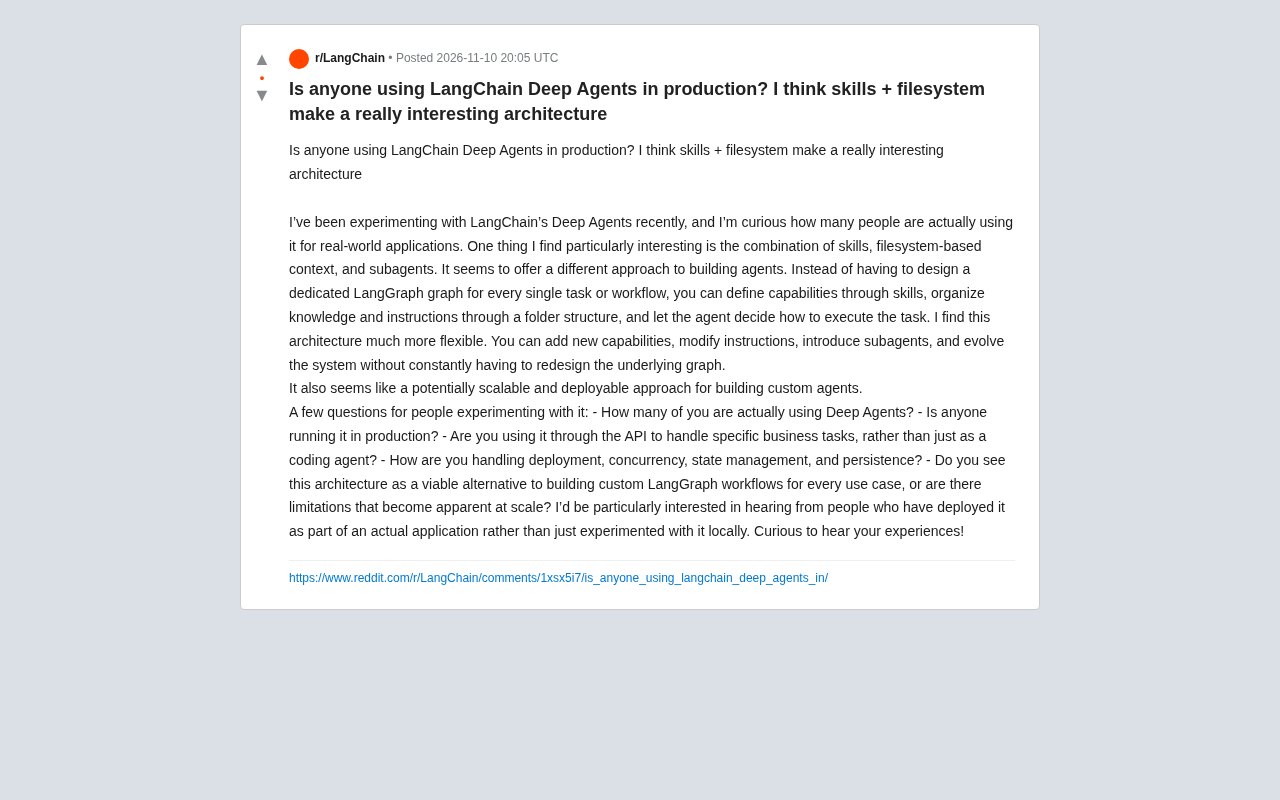
He even went further, suggesting this could be a scalable, deployable way to build custom agents. But what really gives the post weight is the set of questions he lists afterward: How many people are actually using Deep Agents? Is anyone running it in production? Is it being used via API to handle concrete business tasks, not just as a coding assistant? How are deployment, concurrency, state management, and persistence handled? Can this architecture really replace custom LangGraph workflows for each use case, or does it reveal limitations at scale?
These questions don't get systematic answers in the post, but they happen to form a framework worth exploring in depth.
LangGraph is an orchestration framework released by the LangChain team for building stateful, multi-step agent workflows. Its core abstraction is the "graph": developers explicitly define nodes (representing an operation or model call) and edges (representing control flow), thereby precisely controlling the agent's execution path. This explicit orchestration suits scenarios requiring strict process control, auditing, and reproducibility, but the cost is that when business logic changes, the graph structure often needs redesigning, and maintenance cost grows linearly with the number of use cases.
Deep Agents is a higher-level abstraction built by LangChain on top of LangGraph, aimed at reducing dependence on explicit graph structures. It introduces concepts such as skills, filesystem-based context, and subagents, enabling agents to plan tasks, read instructions, and combine capabilities more autonomously. Deep Agents doesn't replace LangGraph; rather, it offers a more autonomy-oriented architectural style suited to scenarios where task paths are uncertain and capabilities need to be extended dynamically.
Why Skills + Filesystem Deserve Attention
To understand the appeal of Deep Agents, you first need to see clearly what problem it solves. LangGraph's strength lies in explicit process control, but the cost is graph design overhead. When an agent needs to handle open-ended, multi-step tasks, designing nodes and edges for every possible path is neither realistic nor economical.
By abstracting capabilities as skills and organizing context as a filesystem, Deep Agents is effectively lowering the marginal cost of "capability expansion." Adding a skill doesn't require touching the graph structure, modifying an instruction only requires changing a file, and introducing a subagent is equivalent to adding a node in the directory. This design borrows from how humans organize knowledge—managing information with a filesystem and describing executable operations with skills.
From an engineering perspective, using the filesystem as a context carrier has an implicit benefit: state is naturally persistable. The process of the agent reading and writing files is the process of state change, which provides a handle for subsequent auditing, replay, and debugging. The poster's emphasis on "deployable" likely stems precisely from this observation.
But the filesystem also brings new problems: how do you ensure consistency of concurrent reads and writes? When multiple agent instances operate on the same directory simultaneously, how are conflicts resolved? These problems don't surface in single-machine experiments, but in production they directly determine whether the architecture is usable.
Subagents are a key concept in the Deep Agents architecture, referring to agent instances dynamically spawned during a main agent's run that focus on specific subtasks. Each subagent can have its own skill set, context, and filesystem view, and the main agent decomposes complex tasks by scheduling subagents. This design borrows from divide-and-conquer: the main agent handles planning and coordination, while subagents handle concrete operations, thereby reducing the cognitive load on any single agent.
The introduction of subagents also brings new engineering challenges. First, how subagents share or isolate filesystem state requires explicit design decisions; second, subagent lifecycle management (creation, monitoring, reclamation) and the communication protocol between them and the main agent both affect system complexity and reliability. In production, concurrent execution of subagents can also trigger resource contention and state consistency issues, all of which need to be considered during architecture design.
Four Real-World Questions for Production Deployment
Among the questions the poster lists, deployment, concurrency, state management, and persistence are grouped together—and that's no accident: they happen to be the dividing line between experimental and production environments.
On deployment, Deep Agents is currently more commonly used as a coding assistant running locally. To embed this architecture into a business system, you need to answer: in what form does the agent provide services externally? Is it wrapped as an API, or does it run as a background task? The poster specifically asks whether it's "used via API to handle concrete business tasks," showing he's focused on deployment in non-coding scenarios.
Concurrency is the most direct challenge of the filesystem approach. If each request corresponds to an independent agent instance, the filesystem needs to support multi-instance isolation; if a single filesystem is shared, concurrency control mechanisms are needed. These two choices correspond to different resource overhead and complexity, and there's currently a lack of publicly available mature solutions.
State management and persistence involve deeper issues: can the agent recover after being interrupted mid-execution? How do filesystem snapshots align with the agent's reasoning state? These problems are handled by the graph's checkpoint mechanism when using traditional LangGraph, but need to be redesigned after switching to a filesystem.
The poster admits he'd rather hear from people who have "actually deployed Deep Agents as part of an application" than feedback from local experiments. This precisely illustrates the scarcity of production cases in current public discussion.
State persistence and checkpoint mechanisms are the foundation for reliable operation of agent frameworks in production. In LangGraph, the checkpoint mechanism periodically saves the graph's execution state, allowing workflows to resume from the most recent checkpoint after interruption, and also supports replay and auditing. After Deep Agents switches to using the filesystem as the context carrier, the state persistence problem becomes more complex: filesystem snapshots need to stay aligned with the agent's reasoning state (such as conversation history and tool call records), otherwise the recovered agent may continue executing based on inconsistent context.
In addition, concurrent read-write consistency of the filesystem is also key to production deployment. When multiple instances share the same filesystem, lock mechanisms, version control, or transactional writes need to be introduced to avoid conflicts; while multi-instance isolation solutions must consider storage overhead and data synchronization. Currently, the Deep Agents community has yet to form a recognized best practice, which is one reason the poster keeps asking about production experience.
Will It Replace LangGraph Workflows?
The poster's final question is the most controversial: can Deep Agents become a viable alternative to custom LangGraph workflows?
From a design philosophy perspective, the two are not a simple replacement relationship. LangGraph provides deterministic orchestration, suited to scenarios with clear process boundaries and high compliance requirements; Deep Agents provides autonomy, suited to scenarios where task paths are uncertain and capabilities need to be combined dynamically. Treating Deep Agents as a replacement for LangGraph may run into trouble in areas requiring precise control.
But the poster's observation also makes sense: as the number of use cases grows, the effort of maintaining one graph per use case rises linearly, while the expansion cost of skills + filesystem is relatively lower. At scale, this difference could become significant. As for whether "limitations at scale" will emerge, there isn't enough public data to judge at present—which is exactly the question that needs more production practice to answer.
An Architectural Direction Worth Tracking
The value of this Reddit post isn't that it provides answers, but that it asks the right questions. The skills + filesystem architecture of Deep Agents does offer a design approach different from LangGraph, and its potential in flexibility and scalability is worth watching.
But the production deployment questions the poster keeps raising—deployment form, concurrency handling, state persistence, scaling limitations—still lack systematic answers. If you're evaluating this architecture, it's advisable to start with business tasks on non-critical paths, focus on validating concurrency and state recovery capabilities, and then decide whether to extend to core processes.
The community needs more experience sharing from real deployments, not initial impressions from local experiments. This may be a necessary step for Deep Agents to move from "interesting" to "usable."
One-line Summary
A Reddit discussion sparks thinking about the production deployment of the Deep Agents skills + filesystem architecture and its potential to replace LangGraph.
Paragraph Summary
This article centers on a Reddit discussion about production use of LangChain Deep Agents, analyzing the architectural flexibility brought by its combination of skills, filesystem context, and subagents. The article notes that this design lowers the marginal cost of capability expansion and makes state naturally persistable, but also introduces new challenges such as concurrency consistency and state recovery. Production deployment must answer four key questions: deployment form, concurrency handling, state management, and persistence. The author argues that Deep Agents and LangGraph are not a simple replacement relationship: the former emphasizes autonomy, the latter emphasizes deterministic orchestration, and they suit different scenarios. Public production cases are currently lacking, and the community needs more real deployment experience to assess its scaling limitations.
Related articles

ChatGPT Plus Subscription Pitfall Guide: Go/Plus/Pro Tier Comparison and Quick Activation
A complete ChatGPT Plus subscription guide based on a Bilibili tutorial: from registering an account, comparing Go/Plus/Pro tiers, to the practical steps for quickly completing your subscription.

GPT-6.2 Sol/Astra Released! A Step-by-Step ChatGPT Plus Subscription Guide and Tier Comparison
GPT-6.2 Sol/Astra is out—here's a ChatGPT Plus subscription guide: register an account, compare Go/Plus/Pro tiers, and subscribe in a minute.

Comparing Three Channels for Subscribing to GPT Plus in China: Is Website Top-Up the Easiest?
How to subscribe to GPT Plus in China? This article compares website top-up, credit card, and mobile top-up channels—process, cost, and risk—with steps and tips to help you choose wisely.