LangChain Getting Started: Why LLM Applications Can't Do Without It

LangChain is the go-to framework for LLM apps, filling gaps in knowledge recency, external integration, and memory.
LangChain is an open-source AI application framework launched around October 2022, designed to build production-ready intelligent applications on top of large language models. The article takes a big-picture view of software evolution to explain why LangChain emerged for the agent era. It breaks down the three inherent limitations of standalone LLMs — training data cutoffs, inability to interact with external systems, and lack of persistent memory — then shows how LangChain addresses each through a JDBC-like unified interface, supporting flexible switching between models like DeepSeek and OpenAI while building an external perception-memory-action layer that enables real-time data queries, enterprise knowledge base access, and multi-turn conversation memory.
What Is LangChain: The Framework's Role in One Sentence
In the world of AI application development, LangChain is virtually impossible to ignore. Launched by the open-source community around October 2022 (the original video credits Harrison Chase as its creator), its core role can be summarized in a single sentence: It is a framework for building applications on top of large language models (LLMs).
Many beginners get led astray by scattered demos — picking up bits of code without ever grasping the framework itself. To truly get the most out of LangChain, the key isn't memorizing APIs; it's understanding why it exists, what pain points it addresses, and which scenarios it's suited for. Get these straight, and you'll have the clarity needed to make confident technology decisions at work.
Like Spring AI, LangChain4j, and similar frameworks, LangChain is essentially a development abstraction layer built around AI capabilities. When you need to build a production-ready application on top of an LLM, it provides a complete, out-of-the-box set of building blocks to get you there.
From Traditional Apps to the Agent Era: The Context Behind LangChain
Software has always evolved. From early standalone applications (think arcade machines, Photoshop, Office 2000) to internet apps (Taobao, QQ), to the mobile era (TikTok, WeChat) — each wave of evolution was underpinned by a corresponding generation of development frameworks.
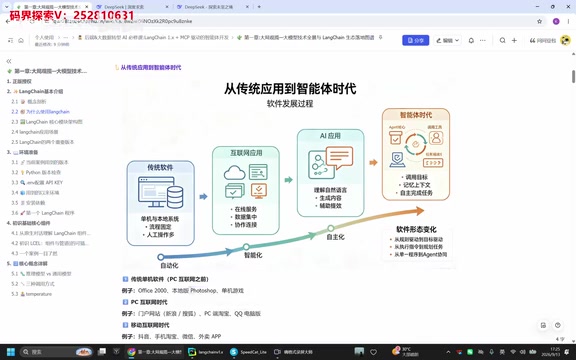
Today, we're in the era of AI-powered intelligence, with intelligent customer service bots, automated reporting agents, and similar applications emerging everywhere. If you want to build AI applications for the agent era, LangChain is the development framework that emerged precisely for this wave of technology. It didn't appear out of thin air — it's a natural product of software evolution reaching the agent stage.
Why You Need It: Three Core Limitations of Standalone LLMs
Nearly everyone has used an LLM at this point — you open a chat window, type a message, and get a response. But using a raw LLM directly comes with clear capability boundaries. The original video identifies three core limitations:
Knowledge Has a Cutoff Date
An LLM's training data has a fixed endpoint in time. A model trained last year simply has no knowledge of what's happening right now. Ask it about current events, and it has nothing to offer.
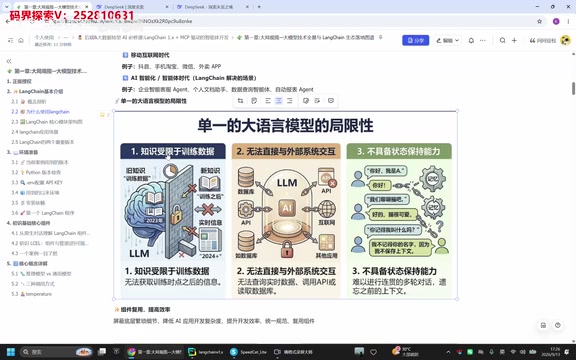
No Interaction with External Systems
A raw LLM is a closed "brain." Ask it to look up your company's expense reimbursement policy, query internal order data, call a third-party weather API, or book a ticket — it can't do any of that. It can only answer based on knowledge it "memorized" during training.
No Persistent State or Memory
Conversations lack continuity. Tell it "I'm User A," close the window, reopen it, and it has no idea who you are. Without contextual memory, building any real multi-turn conversational application is simply not possible.
Taken together, these three points represent the most common pain points when deploying standalone LLMs in production.
It's worth noting that these three limitations aren't design flaws — they're inherent characteristics of how LLMs are architected. At its core, an LLM is a static set of parameters trained on vast amounts of text. During inference, it doesn't update its weights, browse the internet, or access the file system. This means even the most powerful models are "frozen" after deployment — they possess broad knowledge up to their training cutoff, but know nothing of what came after. It's precisely this "knowledgeable but closed" nature that gave rise to orchestration frameworks like LangChain. Rather than changing model weights, these frameworks build an external "perception-memory-action" enhancement layer around the model, injecting real-time information, external tool calls, and conversational context into every interaction — dramatically expanding the model's practical capabilities without any retraining.
How LangChain Fills the Gaps: Unified Abstractions and Reusability
LangChain's value lies in systematically addressing each of these shortcomings while dramatically improving developer productivity through unified abstractions.
Component Reuse with a Unified Interface
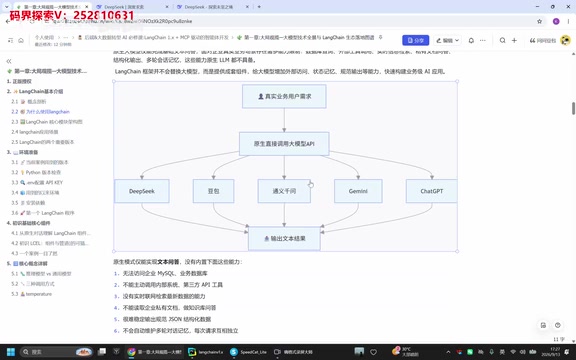
This mirrors the JDBC philosophy in Java. When connecting to a database with JDBC, you program against a unified interface regardless of whether the underlying database is MySQL, PostgreSQL, or Oracle. LangChain does the same for LLMs — whether you're integrating DeepSeekAd, OpenAI, Qwen, Doubao, or Gemini, you call them all through a consistent component interface, achieving "build once, switch freely."
Breaking Through Raw LLM Limitations
Without a framework and writing everything from scratch: a user makes a request, your code calls an LLM directly, and the model's output is returned as-is. The pipeline looks simple — but it can't query MySQL, can't read company policy documents, can't pull real-time data, and can't call third-party APIs.
Bring LangChain into the picture, and all of these capabilities become available:
- Real-time database queries (e.g., latest data from MySQL)
- Reading internal documents (enterprise knowledge bases, policy documents)
- Structured, normalized output
- Multi-turn conversational memory
In other words, LangChain transforms an "isolated LLM" into a complete application foundation that can perceive the external world, retain context, and work across multiple data sources. This is exactly what makes industrial-grade applications like RAG (Retrieval-Augmented Generation) and Agent systems viable in production.
RAG (Retrieval-Augmented Generation) is one of LangChain's most archetypal production patterns. The core idea: when a user asks a question, first retrieve relevant passages from an external knowledge base (such as enterprise documents or databases), then inject those passages alongside the original question into the prompt, and let the LLM generate the final answer. This way, the model's output is no longer limited to its static training knowledge — it can "reference" the latest documents in real time. Agents go even further: they give the model the ability to call tools, letting it autonomously decide when to query a database, when to call an API, and when multi-step reasoning is required. The whole process forms a dynamic plan-and-execute loop. LangChain provides out-of-the-box abstraction components for both patterns — and that's the fundamental reason it's so widely adopted in production deployments.
Wrapping Up: Why Understanding the Framework Matters
This section is almost entirely concept-based with no code — but its importance shouldn't be underestimated. Understanding where LangChain comes from and what problems it solves is more valuable than rushing to write code.
Remember three core takeaways: LangChain is a framework for building applications on top of LLMs; it emerged from the broader shift from traditional software toward the agent era; and it fills the three fundamental gaps of standalone LLMs — knowledge recency, external interaction, and stateful memory — through unified component abstractions and external capability integrations. With this conceptual foundation in place, diving into core modules, RAG, and Agent implementations will be far more productive.
Related articles

How Big Can Stars Really Get? The Physical Limits of the Largest Stars
Red supergiants are the largest stars by volume, with radii up to 2,000 times the Sun, engulfing the inner solar system. But there is no precise upper limit on stellar size—models predict up to 15,000 solar radii. The most massive blue stars are far smaller than red supergiants—biggest and heaviest are two different things.

Apple HomeView Smart Display Full Feature Breakdown: Wall-Mount or Desktop, $299
Apple launches HomeView, a $299 smart display with wall-mount and desktop options, 12MP camera for facial recognition, smart home control, music playback, and recipe step-by-step cooking. Full breakdown of watch faces, apps, privacy, and cooking integration.

Where Did the Promised New Studio Go? Craft Computing Answers After Five Years
Craft Computing's host responds to viewer questions: the new studio promised five years ago was shelved as construction costs soared from $30,000 to $75,000, and was replaced by a 168-square-foot garage conversion.