LangChain in Practice: A Complete Guide to Building Safe and Controllable AI Agents

A comprehensive guide to LangChain's architecture and safety mechanisms for building controllable AI Agents.
This guide explores LangChain's three-layer ecosystem architecture (LangGraph, LangChain, DeepAgents) and explains how each layer balances flexibility with ease of use. It details two critical safety mechanisms — Guardrail for input/output filtering and HITL (Human-in-the-Loop) for human oversight at key decision points — enabling developers to build AI Agents that are both powerful and safely controllable.
From Large Models to LangChain: Why You Need a Framework
For those just getting started with AI large model development, understanding large models isn't actually that complex. At its core, a large language model is simply a model trained by algorithm teams, and its most essential capability is reasoning — you give it a pile of disorganized information, and it can organize it into ordered results you want; you have a conversation with it, and it can understand your intent.
This reasoning capability stems from the Transformer architecture and large-scale pre-training process. By learning language patterns, logical relationships, and world knowledge from massive text datasets, the model develops a deep understanding of natural language. The "reasoning" here doesn't refer to strict deductive reasoning in traditional logic, but rather the model's ability to perform pattern matching, information integration, and coherent output generation based on context. For example, the GPT series models generate text token by token in an autoregressive manner, inferring the most reasonable next token at each step. This capability enables LLMs to accomplish various tasks including summarization, translation, Q&A, code generation, and more.
All large model development roles essentially boil down to one core mission: How to make the large model's reasoning capability better serve your business.
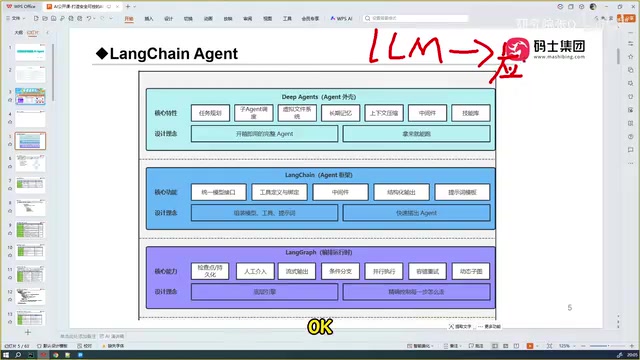
In practice, however, developers often fall into a common trap. When trying to apply large model capabilities to real business scenarios, they end up writing extensive low-level code — how to input data, how to communicate with the model, how to make outputs more stable, how to handle fragmented knowledge. The result is that programmers spend enormous effort on low-level implementation details like "how to better communicate with the large model," drifting away from the original goal of "using large models to solve business pain points."
LangChain was created to solve exactly this problem. It's an AI framework specifically designed for building large model applications, encapsulating low-level capabilities like model communication, knowledge processing, and conversation control, so developers can truly focus their energy on the business itself. LangChain was created by Harrison Chase in October 2022 and quickly became one of the most popular open-source frameworks in the large model application development space. The core pain point it addresses is this: while directly calling large model APIs (like the OpenAI API) is simple enough, building complex applications requires handling Prompt management, context window limitations, multi-turn conversation state maintenance, external knowledge retrieval, tool call orchestration, and numerous other engineering challenges. LangChain abstracts these common capabilities into standardized components (such as Chain, Memory, Retriever, Tool, etc.), allowing developers to rapidly build applications by assembling these components like building blocks.
Understanding LangChain's Three-Layer Ecosystem Architecture
Within the LangChain ecosystem, there's a clear layered architecture. Understanding this structure is crucial for choosing the right development tools.
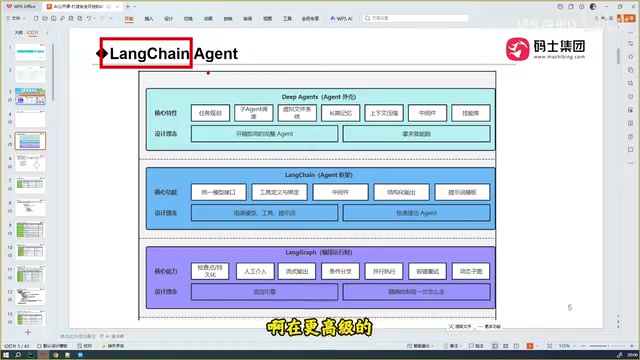
Bottom Layer: LangGraph — A Flexible Graph Orchestration Engine
The bottom-most module is called LangGraph. It implements Agent execution logic through a "graph" approach. In fact, LangChain's underlying infrastructure is built on LangGraph.
LangGraph uses directed graphs to orchestrate Agent execution flows. In this design, each node represents an execution step (such as calling an LLM, executing a tool, or making conditional decisions), and each edge represents the flow relationship between steps. Compared to traditional linear Chains, graph structures can express complex control flows including loops, branches, and parallelism. This is particularly important for Agent scenarios requiring multi-step reasoning and iterative processing — for example, an Agent might need to call a tool to obtain information, decide the next action based on results, or even backtrack and retry. LangGraph's state management mechanism also supports checkpoints and persistence, enabling long-running Agents to pause and resume at any node.
If you develop directly with LangGraph, the code volume will be larger and writing more tedious, but the advantage is — you get more flexible control over business logic and implementation details. It puts more control in the developer's hands.
Middle Layer: LangChain — Balancing Ease of Use and Flexibility
LangChain is a layer of abstraction built on top of LangGraph. It strikes a balance between flexibility and ease of use: building Agents or AI applications is faster and more concise, but at the cost of some fine-grained control over details compared to the bottom layer.
It's worth noting that among all AI Agent frameworks, LangChain has the most comprehensive large model support. Whether it's internal implementation details, ecosystem extensibility, or keeping up with the latest technologies on the market, it covers the widest range with the richest application scenarios. Currently, LangChain supports dozens of model providers including OpenAI, Anthropic, Google, Alibaba Tongyi, Baidu Wenxin, and more, forming a complete development-debugging-monitoring ecosystem through companion tools like LangChain Hub and LangSmith.
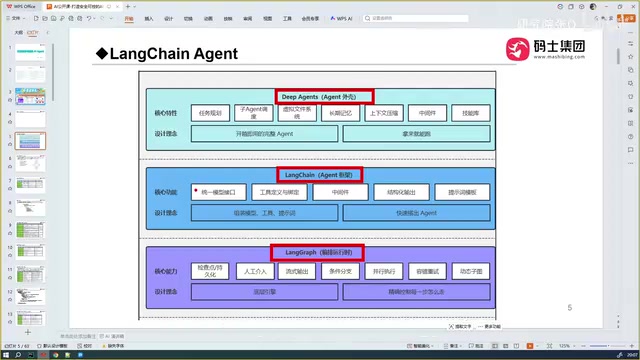
Top Layer: DeepAgents — Out-of-the-Box High-Level Abstraction
The top layer is DeepAgents, which is an implementation of the Harness architecture. Strictly speaking, DeepAgents is built on top of LangChain (with LangGraph as the underlying dependency). It has the highest level of encapsulation, the most complete features, and is the most user-friendly, offering advanced capabilities that LangChain itself lacks, such as operating system file operations and Skill invocations.
The core idea of the Harness architecture is to elevate Agent development from "programming" to "configuration." Under this architecture, developers don't need to write low-level graph orchestration logic; instead, they define the Agent's capabilities, toolsets, behavioral constraints, and interaction modes through declarative configuration. The Skill library provided by DeepAgents is a type of reusable capability unit — developers can encapsulate commonly used tool call chains as Skills and share and combine them across different Agents. This high-level abstraction is particularly suited for scenarios requiring rapid prototyping or teams without deep technical backgrounds.
Selection Logic for the Three-Layer Architecture
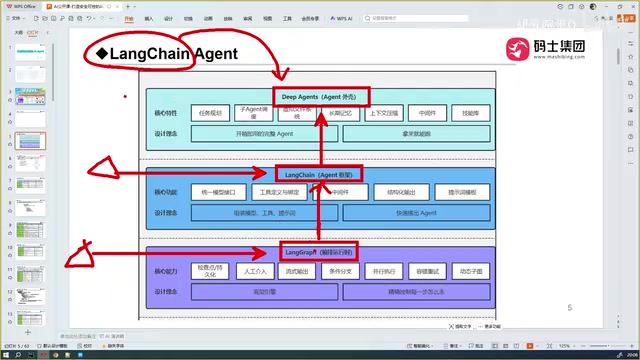
Summarizing the relationship between these three layers reveals a clear pattern:
- Higher layers: Greater encapsulation, richer features, more user-friendly, stronger out-of-the-box readiness;
- Lower layers: Greater flexibility, more implementation details to control, but also higher code volume and development costs.
Developers should choose based on business requirements: select higher layers for rapid development, lower layers for fine-grained control. The Agent security capabilities discussed in this article are universal capabilities that span all three layers — applicable whether you're using LangGraph, LangChain, or DeepAgents.
Safe and Controllable AI Agents: Core Design Philosophy
When building AI Agents, "safe and controllable" is an unavoidable topic. When we deploy large models for business services and conversations, several key questions arise:
- How do we control the large model to return correct content?
- How do we ensure outputs don't contain sensitive information?
- If sensitive information appears during a conversation, how do we block it promptly?
These requirements are extremely tedious to implement with manual code and easily become coupled with business logic. Through a framework like LangChain, implementing these safety controls becomes much more convenient.
Guardrail and HITL: Two Core Agent Safety Mechanisms
In practice, building safe Agents typically involves two core concepts:
Guardrail: This is a mechanism for validating and filtering model inputs and outputs. It can intercept sensitive information, illegal requests, or non-compliant content before user input reaches the model or before model output is returned to the user, ensuring the Agent's behavior always stays within safe boundaries.
Guardrail technical implementations typically include multiple layers: on the input side, methods like keyword filtering, regex matching, and classification models can detect malicious prompt injection, jailbreak attacks, or sensitive topics in user input; on the output side, it can detect harmful information, personal privacy data (such as ID numbers, phone numbers), trade secrets, or content inconsistent with brand tone in model-generated content. Representative Guardrail implementations in the industry include NVIDIA's NeMo Guardrails (a hybrid approach based on rules and LLM) and Guardrails AI (structured validation based on the RAIL specification). Guardrails can also implement semantic-level control to ensure model outputs don't deviate from preset role definitions and response scope.
HITL (Human-in-the-Loop): This is a design that introduces human review at critical decision points. When an Agent encounters high-risk operations or uncertain scenarios, it can pause execution and defer to human judgment before continuing. This mechanism is particularly important in businesses with extremely high safety requirements, such as finance and healthcare.
HITL mechanism implementation in AI Agents typically follows several patterns: approval mode (requiring human confirmation before the Agent executes high-risk operations like transfers or data deletion), correction mode (humans review the Agent's intermediate outputs and provide corrective feedback), and escalation mode (automatically transferring to human handling when Agent confidence falls below a threshold). In LangGraph, HITL is typically implemented through interrupt nodes — the Agent pauses at specific nodes, presents the current state and content awaiting confirmation to human reviewers, and continues execution after humans make their decisions. This design requires consideration of timeout handling, concurrency control, and audit logging in production environments.
The combination of these two mechanisms allows AI Agents to leverage automation efficiency while maintaining ultimate human control at critical junctures, truly achieving "safe and controllable" operation.
Why Agents Are the Core of the LangChain Ecosystem
Within the entire LangChain ecosystem, building intelligent agents (Agents) is the most important component and the most widely applied direction. An Agent is an intelligent application capable of autonomous planning, tool invocation, and complex task completion.
AI Agents differ from simple LLM calls in that they possess autonomy, goal-orientation, and tool-use capabilities. A typical Agent work cycle includes: perception (receiving user instructions or environmental information), planning (decomposing complex tasks into subtasks), action (calling tools or APIs to perform specific operations), observation (obtaining execution results), and reflection (judging whether the goal is achieved and deciding next steps). This "think-act-observe" cycle (the ReAct paradigm, proposed by Yao et al. in 2022) enables Agents to handle complex tasks far beyond the capability of a single LLM call. For example, a research Agent can autonomously search web pages, read documents, integrate information, and generate reports — all without step-by-step human guidance.
For beginners, mastering LangChain's layered structure and understanding Agent safety design philosophy are the critical first steps into large model application development. Safety mechanisms like Guardrail and HITL are the essential capabilities that take Agents from "functional" to "reliably usable."
As the LangChain ecosystem continues to evolve, the barrier to Agent development is lowering and capabilities are strengthening, but the importance of the core proposition of "safe and controllable" will only continue to grow. Understanding and implementing these safety mechanisms will become a core competitive advantage for every large model developer.
Key Takeaways
Related articles

OpenAI Employee Arrested for Planting Surveillance Device: AI Used to Catch the Mole
An OpenAI employee was arrested by the FBI for planting a sophisticated recording device in the office, and OpenAI used its own AI model to trace the device and identify the suspect. The incident exposes internal security threats at AI companies, while OpenAI claims no models or weights were leaked.

Apple Launches HomePod Mini 2 and Apple TV 4K: Bluetooth 6 Steals the Show
Apple launches HomePod Mini 2 and fourth-gen Apple TV 4K. HomePod Mini 2 adds album artwork light sync, Mac direct connection, and pink/green/blue colors for $149; Apple TV 4K upgrades to Wi-Fi 7 and Bluetooth 6 with Siri remote finder for $299. Siri AI rollout timing differs between the two products.

Meta Rebalancer in Practice: Task Placement and Optimization Tutorial
A practical guide to Meta Rebalancer's task placement and optimization: learn its C++ core with Python bindings, data center modeling, constraint and objective priorities, and how local search compares to the HiGHS exact solver on public benchmarks.