LangChain + MCP + Agent: A Complete Guide to Enterprise-Grade AI Agent Development

A practical guide to enterprise AI agent development with LangChain, MCP, DeepSeek, and Qwen3.
This article covers the full enterprise AI agent development stack — from model selection and private deployment to LangChain/LangGraph orchestration and MCP integration. Key topics include MCP's shift from SSE to Streamable HTTP, DeepSeek R1's Function Calling limitations and how to work around them, and Qwen3's programmable thinking modes and leading open-source agent capabilities.
Introduction: Why We Need a New Course on Agent Development Right Now
As the AI large model ecosystem evolves at breakneck speed, last year's tech stack can quickly feel outdated. Both LangChain and LangGraph have undergone major version updates — but what deserves even more attention is the emergence of MCP (Model Context Protocol).
This article draws on real-world enterprise AI agent development experience to walk through the full technical journey: from choosing and privately deploying large models, to orchestrating workflows with LangChain/LangGraph, and finally to building MCP-powered agents. The focus is on the critical details that beginners often miss and that cause the most headaches in production deployments.
A Major MCP Update: Streamable HTTP Replaces SSE
MCP is one of the hottest AI integration protocols right now. Proposed and open-sourced by Anthropic in late 2024, its core value lies in creating a standardized communication bridge between large models and external tools or data sources. Before MCP, every AI application had to write custom integration code for each tool — a massive amount of duplicated effort. By defining a unified communication protocol, MCP allows any MCP-compatible client (like Claude Desktop or Cursor) to seamlessly call tools provided by any MCP server.
You may have missed it, but MCP has introduced a brand-new transport mechanism — Streamable HTTP — to fully replace the previous SSE (Server-Sent Events). This is a significant change: numerous protocols, frameworks, and large models have already updated their implementations to adapt.
Understanding the context behind this upgrade is important. The original SSE is a one-way server push technology: the server can only push data to the client, with limited bidirectional communication and poor compatibility in certain network environments (such as enterprise proxies and load balancers). Streamable HTTP implements bidirectional streaming communication on top of standard HTTP — it retains the low-latency advantages of streaming while solving SSE's network traversal issues, making it far better suited for enterprise production deployments. That's the fundamental reason it was chosen as MCP's next-generation transport standard.
For developers, building MCP agents with Streamable HTTP is now an essential skill. Enterprise deployments also require special attention to cross-language implementation — not just building MCP servers and clients in Python, but also in Java. This is especially critical for traditional enterprises whose backend stacks are still primarily Java-based.
Choosing a Large Model: Don't Lock In on Just One
Before you start building, choosing the right large model is the unavoidable first step. Here's a perspective worth every AI practitioner taking seriously:
A qualified large model engineer should be proficient in using and fine-tuning a variety of top AI models — not fixated on just one.
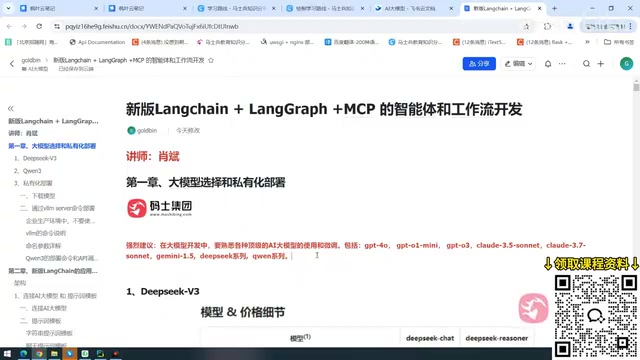
This cuts right to a real industry pain point. DeepSeek is enormously popular in China, and many state-owned enterprises and government agencies use it almost exclusively — leading many learners to assume that knowing DeepSeek alone is enough. But when real technical selection decisions come up — like "Should this project use DeepSeek V3 or Qwen3?" or "What are the trade-offs between Claude and DeepSeek V3?" — you can't give a professional answer without hands-on experience across multiple models.
A well-rounded developer should be comfortable with both domestic models like DeepSeek and Qwen, and international ones like OpenAI GPT-4o, o3, and Claude 3.5/3.7/4.0.
Practical Considerations for Private Deployment
Private deployment reduces learning costs and better mirrors real enterprise scenarios involving internal networks and data compliance requirements. Online APIs often require purchasing API keys, whereas self-hosting open-source models allows free experimentation in local or intranet environments — a common choice for enterprise projects.
A Critical DeepSeek Gotcha: R1 Doesn't Support Function Calling by Default
This is the technical detail most often overlooked by beginners — and one of the most frequent sources of production bugs.
DeepSeek offers two core models:
- deepseek-chat: DeepSeek V3
- deepseek-reasoner: DeepSeek R1
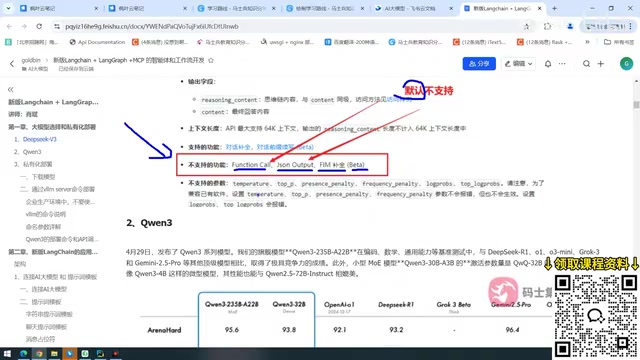
The key issue: according to DeepSeek's official documentation, DeepSeek R1 (deepseek-reasoner) does not support Function Calling, JSON Output, or FIM completion by default. Yet Function Calling (tool invocation) and JSON Output (structured output) are precisely the two most important capabilities for building agents and workflows.
To understand why R1 has this limitation, you need to understand how Function Calling works technically. At its core, it involves incorporating large amounts of "tool-calling examples" into pretraining or SFT (Supervised Fine-Tuning) data, teaching the model to output structured call instructions conforming to a specific JSON Schema when needed. When a developer calls a Function Calling-enabled model API, they attach a set of tool definitions (name, description, parameter schema). If the model determines it needs a tool, it returns a JSON object with the tool name and arguments; the client executes the call and feeds the result back to the model, forming the "think → call → observe → rethink" ReAct loop. DeepSeek R1's reinforcement learning-heavy training paradigm included insufficient tool-calling data, which is why this capability was missing in early versions.
If you try to build an Agent directly on DeepSeek R1, you'll likely hit errors like "structured output not supported" or "function calling not supported." This isn't a bug — it's an official design trade-off.
Solutions and Version Evolution
There are a few ways to address this:
- Switch to DeepSeek V3: Use the 0324 release or later. Earlier V3 versions had a looping issue with Function Calling that was fixed in 0324.
- Wait for fine-tuned versions: Function Calling is fundamentally a capability acquired by feeding large amounts of tool-calling data during pretraining or fine-tuning. R1 deployments that support tool calling in government, hospital, and similar contexts are typically re-fine-tuned versions.
More importantly, watch for official updates: DeepSeek R1's 0528 release officially added support for Function Calling and JSON Output, meaning the "unsupported by default" pain point has been resolved by the team. DeepSeek then released a distilled model based on Qwen3-8B — DeepSeek-R1-0528-Qwen3-8B — which supports both deep thinking and Function Calling, includes MCP optimizations, and in practice outperforms early vanilla Qwen3.
Qwen3: The Open-Source Benchmark for Agent Capabilities
Alibaba's open-source Qwen3 series has become a major force in the open-source landscape.
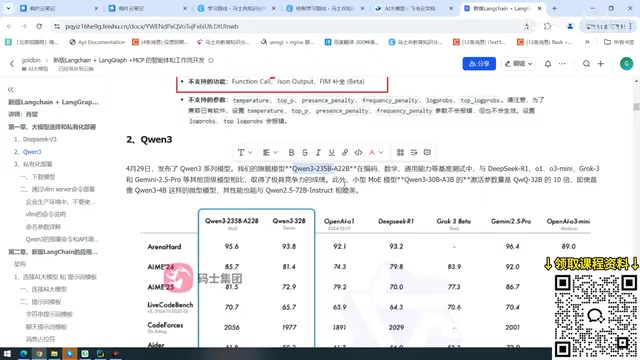
The Qwen3 series comes in two architectures:
- MoE architecture: The flagship Qwen3-235B (235B parameters) and Qwen3-30B — any 235B or 30B variant is almost certainly MoE.
- Dense architecture: Smaller models including 8B, 14B, and 1.5B.
Understanding the MoE architecture is crucial for making informed model selection decisions. MoE (Mixture of Experts) splits the model into multiple "expert networks," activating only a small subset (typically 2–8 experts) per inference step while the rest remain dormant. Take Qwen3-235B: while its total parameter count is 235 billion, only around 22B parameters are actually activated per forward pass — giving it computational costs comparable to a mid-sized dense model, while retaining far greater model capacity and knowledge. Qwen3's engineering improvements to MoE — particularly expert routing load balancing and cross-node communication optimization for distributed deployment — are key reasons it can outperform many dense models under equivalent compute budgets.
Two Standout Features
First, programmable switching between thinking modes. Qwen3 lets developers toggle between "non-thinking mode" and "deep thinking mode" via code parameters — unlike DeepSeek, which controls thinking mode through a frontend toggle. In Qwen3, this is a programmatic switch. You can enable deep reasoning for complex logic and disable it for simple Function Calling or MCP invocations, offering exceptional flexibility.
Second, significantly enhanced agent capabilities. The official description states it "enables precise integration with external tools in both thinking and non-thinking modes, with enhanced MCP support, achieving leading open-source performance on complex agent-based tasks." In the open-source ecosystem, Qwen3's support for MCP, Function Calling, and Agent workflows is currently first-tier.
Qwen3 also supports over 100 languages and dialects, and includes multiple engineering optimizations to its MoE architecture.
Summary: Core Technical Pillars of Enterprise Agent Development
Building a complete enterprise-grade Agent development stack requires mastering the following dimensions:
- Protocol layer: Embrace Streamable HTTP and phase out SSE-based communication.
- Model layer: Maintain a multi-model toolkit, avoid path dependency, and pay close attention to China's two leading open-source models — DeepSeek and Qwen3.
- Avoiding pitfalls: Be aware of DeepSeek R1 early-version limitations on Function Calling/JSON Output; prefer the 0528 release or V3 (post-0324).
- Framework layer: LangChain for component orchestration, LangGraph for state management in complex workflows, MCP for standardized tool and data integration.
The framework division of labor is worth unpacking further. LangChain's core value lies in providing a standardized "component layer" — unified wrappers for API calls across different large model providers, vector database connectors, document loaders, and other foundational building blocks. LangGraph models agent execution flows as directed graphs, where each node represents a processing step, supporting loops, conditional branching, and parallel execution. It also introduces a persistent State management mechanism, enabling long-running multi-step agents to pause, resume, and even support Human-in-the-Loop review at intermediate nodes. This graph structure is particularly well-suited for complex business processes that require iterative reasoning and dynamic decision-making.
The "Large Model + LangChain + LangGraph + MCP + Agent" stack is rapidly becoming the mainstream path for deploying enterprise-grade AI applications. For developers looking to go from zero to production, understanding the technical details and version differences at each layer is far more valuable than chasing the names of trending models.
Key Takeaways
Related articles

The Truth Behind Codex 'Build a Website in 5 Minutes': AI Isn't Creating Sites—It's Helping You Copy Them
Exposing the truth behind viral Codex 5-minute website videos: creators aren't building original sites with AI—they're copying shared prompts or scraping others' work. Learn AI coding tools' real limits.

Getting Started with AI Agent Development: A Complete Guide from Concept to Practice
A comprehensive guide to AI Agent architecture and development, covering automated marketing, intelligent customer service, and investment analysis scenarios with single and multi-agent collaboration.

The Truth Behind Codex 'Build a Website in 5 Minutes': AI Isn't Creating Sites — It's Helping You Copy Them
Exposing the truth behind viral Codex 5-minute website videos: creators aren't building original sites with AI — they're copying shared prompts or scraping others' work.