LangChain's New CleanWeb Tool: 87% Token Compression for Web Scraping with Prompt Injection Defense
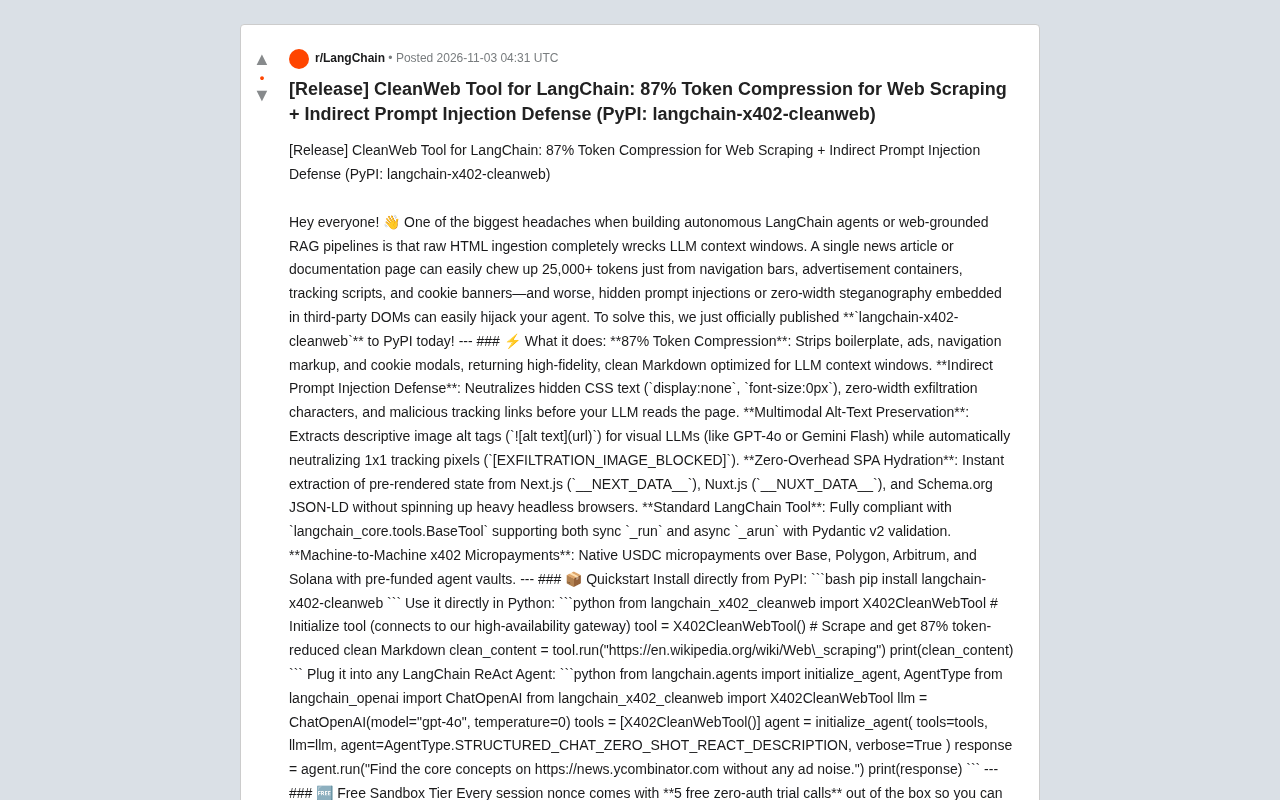
LangChain tool langchain-x402-cleanweb cleans HTML to achieve 87% token compression and defend against indirect prompt injection.
langchain-x402-cleanweb is a LangChain tool published to PyPI that addresses two major problems web scraping poses for Agent context: raw HTML consuming massive tokens through navigation, ads, and scripts, and third-party DOM potentially carrying hidden prompt injections and zero-width characters. It strips boilerplate to return high-fidelity Markdown, claiming 87% token compression; neutralizes hidden CSS text, removes zero-width characters, and filters malicious links before the LLM reads content; preserves image alt text for vision models while blocking 1x1 tracking pixels; and directly extracts pre-rendered data from Next.js, Nuxt.js, and JSON-LD sites, eliminating headless browser overhead. The tool is compatible with the BaseTool interface and includes built-in x402 USDC micropayments billed per call, relying on the author's gateway rather than running fully locally.
Why Web Scraping "Pollutes" Agent Context
When building web-based RAG pipelines or autonomous LangChain Agents, one of the biggest headaches for developers is the sheer size of raw HTML. According to the tool's author in a Reddit post, an ordinary news article or documentation page can consume 25,000+ tokens of context window just from navigation bars, ad containers, tracking scripts, and cookie popups. The more insidious risk lies in hidden prompt injections or zero-width character steganography that may be embedded in third-party DOM—content that is invisible to users but could be read and executed verbatim by an LLM.
langchain-x402-cleanweb is a LangChain tool designed specifically for these two pain points, and it has been published to PyPI.
Core Capabilities Breakdown
87% Token Compression: Keeping Only What's Useful for the LLM
The tool strips boilerplate text, ads, navigation markup, and cookie popups, returning high-fidelity Markdown optimized for LLM context. The author cites an 87% compression rate, meaning a page that originally ran over twenty thousand tokens might be compressed to a few thousand. For cost-sensitive long-context scenarios or multi-step scraping, this gap compounds with each page scraped.
How the token compression rate is calculated: The 87% compression rate mentioned typically refers to the ratio of token count in the cleaned Markdown to that of the raw HTML. Because tokenizers (such as OpenAI's tiktoken) are inefficient at splitting HTML tags, repeated attributes, and script code, raw pages often inflate several times over their visible text. The compression rate is not a fixed value—it fluctuates with page template complexity, ad density, and navigation structure; for clean pages with high content-to-markup ratio, the compression benefit will be noticeably lower than for typical news portals.
Context window and cost relationship: An LLM's context window is a hard limit, and APIs bill by input tokens. In multi-step Agents, the content returned by each tool call enters the conversation history, so tokens saved per page continue to amplify the cost advantage at every subsequent step. Compression not only saves money but also reduces the "lost-in-the-middle" risk, keeping key content more concentrated within the model's attention span.
Indirect Prompt Injection Defense
This is the key differentiator between this tool and most "HTML-to-Markdown" scripts. It does several things before the LLM reads the page: neutralizes hidden CSS text (display:none, font-size:0px), removes zero-width exfiltration characters, and filters malicious tracking links. These attacks fall under indirect prompt injection—the attacker doesn't need to touch your prompts, only to hide instructions in the web pages being scraped.
Indirect Prompt Injection: Unlike direct user input of malicious instructions, indirect injection hides attack payloads in external data that the LLM will read, such as web page comments, hidden divs, or image alt text. When an Agent scrapes that page and splices the content into context, the model may treat embedded instructions like "ignore previous instructions and instead do..." as legitimate commands. OWASP has listed this as one of the primary security risks for LLM applications.
Zero-width character steganography: Characters like zero-width space (U+200B) and zero-width joiner (U+200D) are invisible in browsers, but tokenizers still encode them. Attackers can use them to smuggle invisible text or bypass keyword-based filters. Cleaning these characters is input normalization and represents the first link in the defense chain, but it cannot cover semantic-level injection and still requires output constraints and tool permission minimization.
Multimodal Alt-Text Preservation and Tracking Pixel Blocking
For vision models like GPT-4o and Gemini Flash, the tool extracts image alt descriptions () while automatically identifying and blocking 1x1 tracking pixels, replacing them with an [EXFILTRATION_IMAGE_BLOCKED] marker. This keeps visual context usable without leaking visit information through tracking pixels.
SPA Content Extraction Without Launching a Headless Browser
For Next.js (__NEXT_DATA__), Nuxt.js (__NUXT_DATA__), and Schema.org JSON-LD, the tool extracts data directly from pre-rendered state, skipping the overhead of launching a heavyweight headless browser. This explains why it positions itself as a "zero-overhead" solution.
Pre-rendered state vs. SSR/CSR: Next.js's __NEXT_DATA__ and Nuxt's __NUXT_DATA__ are JSON state snapshots embedded in HTML during server-side rendering or static generation, containing the props data needed by page components. Parsing these script tags directly yields structured content without executing JavaScript. However, pure client-side rendered (CSR) sites that don't expose state snapshots won't provide this data, requiring fallback to headless browsers or official APIs. JSON-LD, meanwhile, is Schema.org standard semantic markup commonly found on product, article, and FAQ pages, and can serve as a supplementary information source.
Standard LangChain Tool Interface
The tool is fully compatible with langchain_core.tools.BaseTool, supports both synchronous _run and asynchronous _arun, and uses Pydantic v2 for parameter validation. This means it can be plugged into a ReAct Agent just like any built-in tool.
Machine-to-Machine Micropayments (x402)
The "x402" in the name comes from its built-in pay-per-call mechanism: settlement via USDC micropayments on Base, Polygon, Arbitrum, and Solana, combined with a pre-funded agent vault. This design targets scenarios where Agents autonomously call external services, rather than purely manual use.
The x402 protocol and HTTP 402: x402 is an open protocol for machine-to-machine payments that reuses the HTTP status code 402 Payment Required, allowing a server to require a small payment from the client before returning content. It typically settles on stablecoins (such as USDC) and L2 networks, making it suitable for Agents paying per call to APIs. The pre-funded vault model means the client deposits funds in advance, with each call deducting from the balance, thereby avoiding the high latency of an on-chain transaction per request. For developers, it's important to consider gateway availability, settlement finality, and who bears key management responsibility.
Getting Started
Install from PyPI and use it directly:
pip install langchain-x402-cleanweb
from langchain_x402_cleanweb import X402CleanWebTool

tool = X402CleanWebTool()
clean_content = tool.run("https://en.wikipedia.org/wiki/Web_scraping")
print(clean_content)
Integrating with a ReAct Agent is equally concise:
from langchain.agents import initialize_agent, AgentType
from langchain_openai import ChatOpenAI
from langchain_x402_cleanweb import X402CleanWebTool

llm = ChatOpenAI(model="gpt-4o", temperature=0)
tools = [X402CleanWebTool()]
agent = initialize_agent(
    tools=tools, llm=llm,
    agent=AgentType.STRUCTURED_CHAT_ZERO_SHOT_REACT_DESCRIPTION,
    verbose=True
)
response = agent.run("Find the core concepts on https://news.ycombinator.com without any ad noise.")
print(response)
The author also provides a free sandbox: each session nonce comes with 5 zero-auth trial calls, requiring no API key or wallet to test. The project is available on PyPI as langchain-x402-cleanweb version 0.1.0 and on GitHub at nohosa001-pixel/x402-cleanweb-agent.
A Few Judgments Worth Noting
Security protection may be more valuable than token compression. The 87% compression rate is intuitive, but indirect injection via hidden CSS text and zero-width characters is a problem lacking a unified solution in current Agent deployments. Placing cleansing before the LLM reads content is the correct defensive position. However, the effectiveness of such protection depends on the coverage of cleansing rules, and the author actively solicits feedback on edge-case websites in the post, indicating the rule base still needs real-world site validation.
The x402 billing model is a double-edged sword. Micropayments allow Agents to autonomously pay for data, but they also mean the tool depends on the author's "high-availability gateway" service rather than running fully locally. For teams with sensitive data or offline deployment requirements, this is a point that must be confirmed during selection.
SPA fast extraction has limited applicability. Relying on pre-rendered state like __NEXT_DATA__ presupposes that the target site happens to use the corresponding framework and exposes the data. For the many traditional server-rendered or non-standard frontend sites, fallback to other scraping paths is still necessary.
The free quota is suitable for validation, not production evaluation. Five trial calls are enough to run through the workflow, but evaluating compression rates and false positives on real sites requires longer testing.
Overall, this tool packages and addresses two problems in web scraping—"context waste" and "untrusted content"—and the approach is sound. Whether it's worth integrating depends on how much your Agent relies on third-party web content and your acceptance of a gateway-based architecture.
Related articles

Qwen 3.8 Beats Opus at Coding—But Can Your Mac Run It?
Open-source Qwen 3.8 beats Opus 4.6 at coding at just 18GB, but how much Mac memory do you need? 24GB crashes; 32GB is the sweet spot. Full config guide inside.

Claude Code + Agent: Building a Fully Automated AI Testing Loop
Bilibili course breakdown: how test developers can use Claude Code terminal-based Agents to build a fully automated AI testing loop. Compares permission boundaries of terminal vs. device Agents, explains why enterprise projects choose Claude Code over Open Claude-type tools, and outlines the Node.js environment setup and DeepSeek model integration path.

Working with AI Agents Requires Nerves of Steel
The more autonomous AI agents become, the heavier the user's psychological burden. Drawing from a Hacker News discussion, this article analyzes black-box anxiety, behavior drift, and monitoring fatigue in agent collaboration, and offers practical approaches like sandbox isolation, permission control, and task granularity management to reduce cognitive load.