LangChain V1.3 in Practice: Mastering AI Engineering Mindset — From Tool User to Tool Master

Master AI engineering thinking with LangChain V1.3 — from passive tool user to confident architect.
The LangChain V1.3 course by Turing Loulan argues that the real gap between effective and ineffective AI users is engineering mindset, not tool choice. Covering LangGraph, Deep Agent, RAG, Time Travel, and Token cost control, the course prioritizes systems thinking, hands-on practice, and conceptual depth over surface-level feature tutorials — helping learners truly master AI rather than be mastered by it.
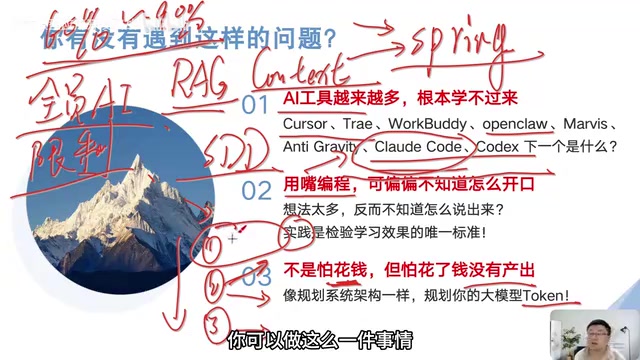
Why Do You Feel More Passive the More Tools You Learn?
Large language models have permeated virtually every aspect of our work and daily lives — yet results vary wildly among users. Some harness AI to do the work of an entire team single-handedly, while others remain stuck in anxiety over "AI taking their jobs." Bilibili creator Turing Loulan points out in his latest LangChain V1.3 course that the root of this gap comes down to one thing: how deeply you understand AI engineering.
Many beginners fall into a common trap: endlessly chasing new tools. From Cursor to Claude Code, Codex, and various Skill plugins — tools are iterating faster than ever, and people get caught in an endless learning loop. But Loulan raises a pointed question: Your focus should be on how you use LLMs to solve real problems, not on the tools themselves.
The practical reality is that mainstream tools come with significant limitations. Take Claude Code — it has access restrictions in China and logs users' complete workflows. When your entire workflow depends on a single tool, you're helpless the moment you switch. At that point, who's really in control: you or the tool?

Describing Requirements Is Harder Than You Think
Today's LLMs are genuinely powerful — give them a clear description of what you need, and they'll deliver solid results. But Loulan highlights a core challenge that most beginners overlook: for truly complex work, clearly describing the requirements is itself extraordinarily difficult.
He uses a classic example: the Spring framework, well-known to Java developers. An LLM has almost certainly seen its entire source code and understands it more deeply than most developers. But if you asked an LLM to replicate Spring from scratch — how would you even write that prompt? Describe it feature by feature? Spring's internal logic is deeply intertwined, and articulating that is nearly impossible.
In real-world scenarios, e-commerce systems and enterprise business logic are often far more complex than Spring. This is precisely where RAG (Retrieval-Augmented Generation) and Context Engineering deliver their value.
RAG was originally proposed by Meta AI researchers in 2020. Its core idea is to dynamically retrieve relevant document chunks from an external knowledge base at inference time, injecting them into the prompt context. This compensates for the LLM's training data cutoff, reduces hallucinations, and enables secure integration of enterprise-private knowledge. In plain terms, it lets the LLM "take an open-book exam" — when asking a question, you provide ample reference material rather than relying solely on what the model memorized during training.
Context Engineering is the broader concept: the deliberate design of everything fed into an LLM — system instructions, conversation history, retrieved documents, tool descriptions — to maximize output quality. Even the increasingly popular SDD (Specification-Driven Development) is fundamentally about solving the same root problem: how to clearly describe requirements by constructing context that expresses complex business logic in a way LLMs can understand.
LLMs Are Black Boxes — Only Practice Is the Real Standard
Loulan challenges two assumptions behind popular claims like "RAG accuracy improved from 60% to 90%":
First, natural language is inherently difficult to measure. Any question can be phrased in countless ways, and what "60% or 90% accuracy" actually means in scoring terms is fundamentally ambiguous.
Second, LLMs are black boxes to everyone — no one can trace their internal step-by-step reasoning. What makes you confident that writing a clearer prompt will necessarily yield a better answer? The only way to know the actual outcome is through practice.
And practice introduces a new problem: how do you validate ideas at low cost? If you jump straight to tools like Claude Code or Codex, the Token burn rate is extremely expensive — most useful features require paid access.
Tokens are the basic unit LLMs use to process text — roughly 0.75 English words or 0.5 Chinese characters per token. LLM API pricing is directly tied to token consumption. Complex multi-step Agent tasks re-submit the full context (including tool descriptions, conversation history, and retrieved documents) with every inference step, causing token consumption to grow exponentially. You might just be trying to validate an idea, only to discover mid-run that you're heading the wrong direction — and the money is already spent.
This is the core value of AI engineering ability: being able to build the ideal test scenario at low cost, without relying on expensive tools, to validate your ideas.
Time Travel: A Quintessential Example of AI Engineering Thinking
Loulan uses a concrete scenario to illustrate what engineering thinking actually looks like. When a complex Agent encounters a problem, it typically doesn't respond directly — it first plans: breaking the task into steps, dispatching different Agents to work in parallel (some searching the web, others aggregating data), forming a complete execution pipeline.
This raises an important question: what happens when one step fails mid-execution? A network issue causes a retrieval failure, or a keyword is wrong. Without engineering thinking, you have no choice but to rerun the entire pipeline — every token spent on earlier steps is wasted.
With engineering thinking, however, you can preserve the correct results from earlier steps and rerun only from the failed step forward. This capability is called Time Travel in LangChain, and it's a foundational feature of LangGraph.
LangGraph is the graph-structured Agent orchestration framework developed by the LangChain team. It abstracts an Agent's execution flow as a directed graph, where each node represents a processing step and edges represent state transitions. Time Travel is essentially a Checkpoint mechanism — the framework persists the current state after each node executes, and when a step fails, developers can roll back the execution pointer to any historical checkpoint and rerun from there, without starting over. This design draws inspiration from version control systems like Git, dramatically reducing token costs for debugging and error recovery in complex Agents. It also enables human oversight: rejecting external tool calls for simple questions, or stopping repeated execution once a task is sufficiently complete — enabling much more precise Token cost control.
Notably, even tech giants like Microsoft, Google, and Amazon have begun shifting from "AI for everyone" promotion to strategies focused on limiting usage after more than half a year of full deployment. According to public reports, some high-intensity use cases are running up per-user monthly Token costs of hundreds of dollars — unlimited token burning is simply unsustainable. If big tech companies can't sustain it, individual developers need precise control over Token consumption even more.
LangChain: The Most Classic and Flexible Agent Framework
Loulan emphasizes that LangChain is fundamentally a low-level programming framework for building Agents — upper-layer products like Manus and Codex are built on foundational frameworks like this. Among the many frameworks available (Spring AI, LlamaIndex, etc.), LangChain has two distinctive advantages:
First, it's the most established. It was the earliest Agent framework, born before the concept of "agents" had fully taken shape, and battle-tested through extensive real-world use.
Second, it's the most flexible, with a rapidly evolving ecosystem. Features that originated in specific products — like MCP and Skills from Claude Code — get integrated into LangChain quickly.
MCP (Model Context Protocol) is an open standard proposed by Anthropic in late 2024, designed to unify the communication interface between LLMs and external tools and data sources. Before MCP, tool integrations varied across platforms and required separate adapters for each. MCP defines a complete specification for tool discovery, invocation, and response through a standardized JSON-RPC interface, enabling the same toolset to be reused across frameworks. For example, the newly released Deep Agent framework supports zero-cost Skill integration — just download the tool locally and call it with a single API. LangChain's rapid MCP integration is a perfect example of its ecosystem flexibility.
Three Modules, Three Construction Philosophies
The LangChain ecosystem comprises three core modules, each representing a different approach to building Agents:
- LangChain Module: Chain-based construction — straightforward and beginner-friendly
- LangGraph Module: Graph-based construction — flexible support for multi-agent collaboration, the most widely used approach in enterprise settings today
- Deep Agent Module: Emphasizes autonomous planning — tasks no longer require manually predefined steps; the Agent makes all decisions independently
Once you truly master LangChain, picking up other frameworks like Spring AI or LlamaIndex becomes much easier. That's the underlying value of learning a foundational, classic framework.
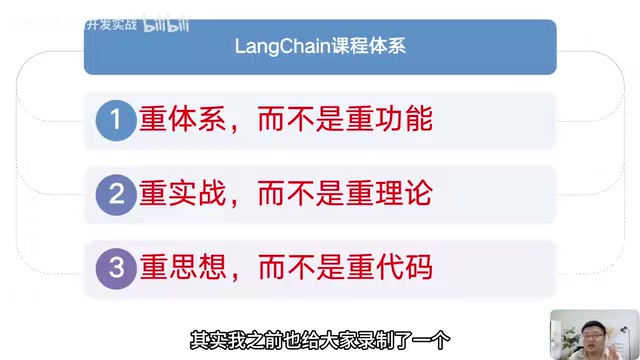
Course Design: Emphasizing Systems, Practice, and Ideas
Compared to the well-received V0.3 course, the V1.3 version incorporates substantial user feedback and introduces three important changes:
First, systems over features. Previous courses often covered LangChain and LangGraph separately. This version integrates them into a cohesive whole. The first module focuses entirely on building a solid Agent foundation — how to interact with LLMs, how to use tool mechanisms, and how to integrate MCP. These are prerequisites regardless of which construction approach you use. The course then progresses in the order LangGraph → LangChain → Deep Agents, because LangGraph is both the most widely used and the most approachable, while Deep Agents' autonomous planning requires the conceptual foundation built by the earlier modules.
Second, practice over theory. Code appears in the very first chapter. Learners get hands-on experience with the tools first, then circle back to understand the underlying principles — learning by doing. The course includes extensive multi-agent project work built from scratch.
Third, ideas over code. Loulan is candid: "Any code can be written by an LLM, but knowing how to combine tools to solve problems — that engineering mindset matters far more than the code itself." Dedicated chapters dive deep into what a Graph is, what a Chain is, and how autonomous planning actually works.
Beginner-Friendly Design
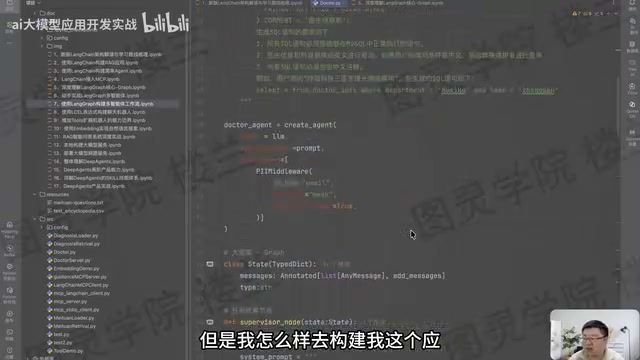
The course is thoughtfully designed with beginners in mind. Not familiar with LLMs? The framework helps you filter out what's actually useful. Weak Python fundamentals? Following along and typing through the examples twice is enough to get started. No high-end GPU? The course includes extensive local deployment content — including local setup and integration with LangSmith for full-pipeline monitoring. LangSmith is LangChain's official observability platform that visually traces every model call, tool call, and token consumption — especially valuable for enterprise scenarios with strict data security requirements that demand on-premise execution.
Conclusion: Become a Master of the AI Era
Loulan sums up the course's core philosophy in one line: "AI is the future, You must be the driver." AI is undeniably the future — but the real winners will be those who have mastered the engineering thinking behind the tools.
Only by truly understanding the underlying construction logic of LangChain, LangGraph, RAG, and related tools can you become the one in control, rather than being led around by the tools themselves. In the midst of the AI tool frenzy, taking the time to build a solid engineering mindset may be the most worthwhile investment any AI practitioner can make.
Key Takeaways
Related articles

The Truth Behind Codex 'Build a Website in 5 Minutes': AI Isn't Creating Sites—It's Helping You Copy Them
Exposing the truth behind viral Codex 5-minute website videos: creators aren't building original sites with AI—they're copying shared prompts or scraping others' work. Learn AI coding tools' real limits.

Getting Started with AI Agent Development: A Complete Guide from Concept to Practice
A comprehensive guide to AI Agent architecture and development, covering automated marketing, intelligent customer service, and investment analysis scenarios with single and multi-agent collaboration.

The Truth Behind Codex 'Build a Website in 5 Minutes': AI Isn't Creating Sites — It's Helping You Copy Them
Exposing the truth behind viral Codex 5-minute website videos: creators aren't building original sites with AI — they're copying shared prompts or scraping others' work.